
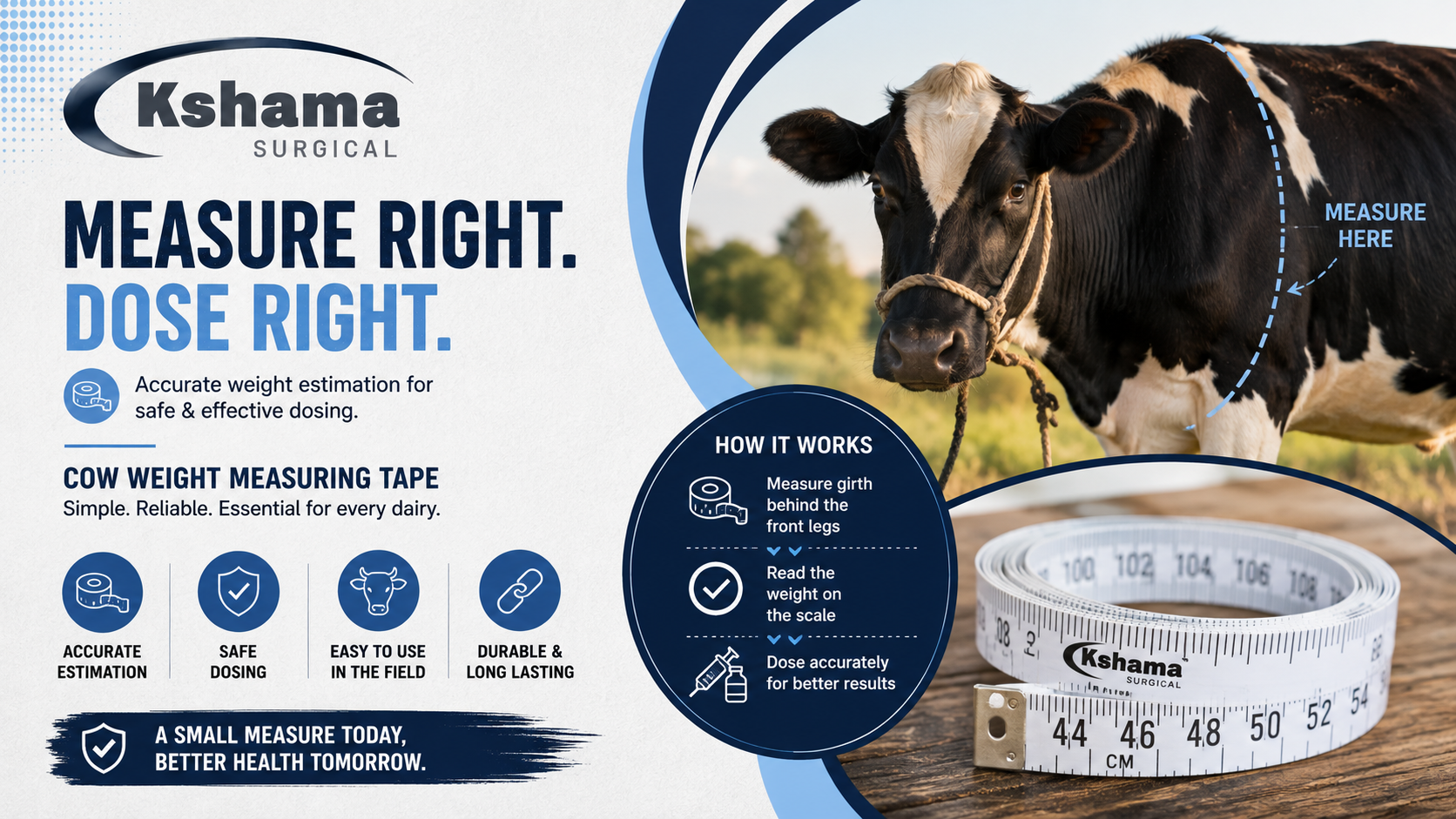
A cow weight measuring tape converts heart girth into an estimated liveweight, and it is accurate enough for dosing provided the tape sits in the right place, at the right tension, on an animal standing square. Most errors are not tape errors. They are placement errors, and they push readings in the same direction every time, which is why whole herds end up underdosed for years without anyone noticing.
Girth taping is the only weighing most Indian dairies will ever do. Weighbridges are scarce, portable scales scarcer, and the working alternative to a tape is a guess made by eye. That guess is reliably wrong in one direction, and underdosed anthelmintics are built on it.
A weight measuring tape costs almost nothing, and it gets treated accordingly: kept on a nail in the parlour, soaked daily, stretched over five seasons and never once checked against a rule. The sections below cover the landmark and the tension that decide a reading, the four systematic errors that bias an entire shed in the same direction, how to turn a cow weight measuring tape figure into a dosing weight, and where the estimate stops being good enough to act on.
What a Cow Weight Measuring Tape Actually Measures
A cow weight measuring tape measures the circumference of the chest immediately behind the front legs, then displays the weight that circumference usually corresponds to. There is no weighing involved at any point. The scale printed on the tape carries a conversion built into it, which is why a tape calibrated for cattle gives nonsense on a goat and why the printed side you read matters.
Girth works as a proxy because chest circumference tracks body mass closely across animals of similar conformation. A cow weight measuring tape assumes an average shape and stops working when conformation changes. A heavily pregnant cow, a very thin animal, and a well-muscled bull of the same girth are not the same weight, and no tape can tell them apart.
Estimate, not measurement
Treat the figure as an estimate: close enough for practical dosing, unsuitable for anything needing precision, such as a sale by weight. A cattle weight measuring tape is a field tool. Use a weighbridge for transactions where one is available.
A cow weight measuring tape estimates weight from girth. It does not weigh the animal.
How Do You Use a Cow Weight Measuring Tape?
Stand the animal square on level ground, pass the cow weight measuring tape around the chest just behind the elbow and the point of the shoulder blade, snug it until it sits flat against the coat without compressing, and read the figure where the tape meets its own zero mark. Take the reading after the animal has breathed out.
The landmark is the part people get wrong. Too far forward, over the shoulder, and you read high; too far back, into the soft flank, and you read low. The correct line sits immediately caudal to the elbow and passes over the withers area, not across the middle of the back.
Tension and coat
Snug means flat with no slack, not tight enough to dent the animal. Winter coat adds girth that is not weight, so press the tape down into the hair rather than laying it across the top. On a mud-caked buffalo, clean the line first. A cow weight measuring tape reading taken over caked mud is a measurement of the mud.
Restraint and repeatability
Use a crush, a halter or a headgate. An animal walking forward while you read changes girth by several centimetres. Read twice if the figure surprises you; if two readings disagree, the animal moved.
Four Errors That Skew a Cow Weight Measuring Tape Reading
Sloping ground, measuring after a heavy feed or a long drink, placement drifting behind the correct line, and a stretched tape account for most of the variation I see in the field. Each is systematic, so it biases every animal in the shed the same way.
| Error | Direction of the mistake | How to prevent it |
| Animal on sloping ground | Reads low or unstable | Measure on level, square standing |
| Measured after gorge feeding | Reads high | Measure before feeding, same time daily |
| Tape too far back in flank | Reads low | Land behind elbow, over withers |
| Old, stretched tape | Reads high, worsening | Replace on a fixed schedule |
Stretch deserves a note of its own. A tape used daily lengthens over time, and a cow weight measuring tape stretched by even a small fraction reads consistently heavy without ever looking damaged. Check any working cow weight measuring tape against a steel rule once a year and retire it when it disagrees.
Systematic errors from a cow weight measuring tape are worse than random ones, because they never average out.
Converting a Girth Reading Into a Dosing Weight
Dose to the weight each animal actually shows on the cow weight measuring tape, not to the average of the group, because dosing a group to one figure overdoses the small animals and underdoses the large ones. Underdosing is the more damaging half of that, and repeated underdosing of anthelmintics is one of the recognised drivers of resistance in worm populations. It stays invisible until the drenches stop working.
An animal weight measuring tape used properly gives you the number to work from, and the attending veterinarian decides the product, the dose rate and any withdrawal period that applies to milk or meat. That decision is not something to take from a label alone or from an article.
Record the figure in writing at the moment you take it. A cow weight measuring tape reading held in someone’s head between the crush and the drenching gun is a reading that will be rounded, and it is always rounded down. A notebook clipped to the crush rail solves more dosing problems than any equipment upgrade.
Where accuracy matters most
Anaesthesia and sedation are the sharp end, where the margin between an effective and an excessive dose is narrower than for a routine drench. A cow weight measuring tape reading is a starting estimate that the veterinarian adjusts on clinical assessment. Any procedure requiring sedation should be performed by or under the supervision of a qualified veterinarian.
For routine drenching, the practical routine is to tape the animal, record the figure, and set the drenching gun accordingly rather than dosing every animal at one setting for the whole shed.
Choosing a Weight Band for Cattle, Buffalo, Calves and Small Ruminants
Match the cow weight measuring tape to the species and size range, because the printed conversion is species-specific and a weight band for cattle often overestimates a buffalo of the same girth. Calves under six months follow a different girth-to-weight relationship again.
Many tapes carry two or three scales on one side and a girth scale in centimetres on the reverse. Recording raw girth is a habit worth building: it lets you recheck a conversion later and makes growth tracking possible in young stock, which is where a cattle weight measuring tape pays for itself twice over.
A general weight band for cattle covers adult crossbred and indigenous cows adequately. Beyond that group, check what the scale on the cow weight measuring tape was built for before you dose from it.
Materials in Indian conditions
A coated fibreglass or PVC tape survives humidity and washing far better than uncoated fabric, which absorbs, stretches and rots through a monsoon. A rusted metal end-clip tears the tape edge within weeks. A cow weight measuring tape kept in a dry box between uses lasts several times longer than one that lives on a nail in the milking parlour.
For small ruminants, use a scale intended for them. An animal weight measuring tape calibrated for adult cattle is far too coarse at the low end to dose a goat kid safely.
What to Check Before Buying a Cow Weight Measuring Tape
Look at printing quality, the coating, the end fitting and whether the scale states the species and range it was calibrated for. Printing that fades after fifty washes makes a cow weight measuring tape useless long before the material itself fails, and faded numerals at the crossover point are exactly where you need to read.
A cow weight measuring tape is a low-cost item, which is precisely why it gets bought carelessly and replaced late. Buy two, keep one in the store as the reference against which the working cattle weight measuring tape is checked, and diarise the replacement date. Kshama Surgical supplies tapes alongside its broader veterinary general instruments range, and the same practical question applies to all of it: what happens to this after two years of washing.
The care thinking behind smart surgical instruments for veterinary medicine transfers directly to a humble tape. Clean it, dry it, store it flat, and check it against a known reference before you trust it for dosing.
Frequently Asked Questions
How accurate is a cow weight measuring tape?
Accurate enough for routine dosing on animals of typical conformation, and less reliable on heavily pregnant, very thin or unusually muscled animals. It estimates rather than weighs.
Where exactly does the tape go?
Around the chest immediately behind the front legs and the elbow, passing over the withers area at the top. Not across the middle of the back and not into the soft flank.
Can I use a cow weight measuring tape on a buffalo?
Only if the scale is calibrated for buffalo, since chest conformation differs. Using a cattle scale on a buffalo of the same girth commonly gives a misleading figure.
When is the best time of day to measure?
Before feeding, at a consistent time, with the animal standing square on level ground. A full rumen after gorge feeding adds girth that is not liveweight.
How often should the tape be replaced?
Check it against a steel rule yearly and retire it once it disagrees or the printing has faded. Daily-use tapes in a wet parlour stretch faster than stored ones.
Does the tape work on calves?
Use a scale intended for calves. Young stock follow a different girth-to-weight relationship, and an adult cattle scale reads poorly at the low end.
Why does my reading change between two people?
Different placement and tension. Agree the landmark once, demonstrate it, and have one person do the taping. An animal weight measuring tape is only as consistent as the hands using it.
For a quotation on tapes, drenching equipment or general instruments, send your requirement to Kshama Surgical through the contact page at https://kshamasurgical.com/contact-us/ and state the species and weight range you need calibrated scales for.
