
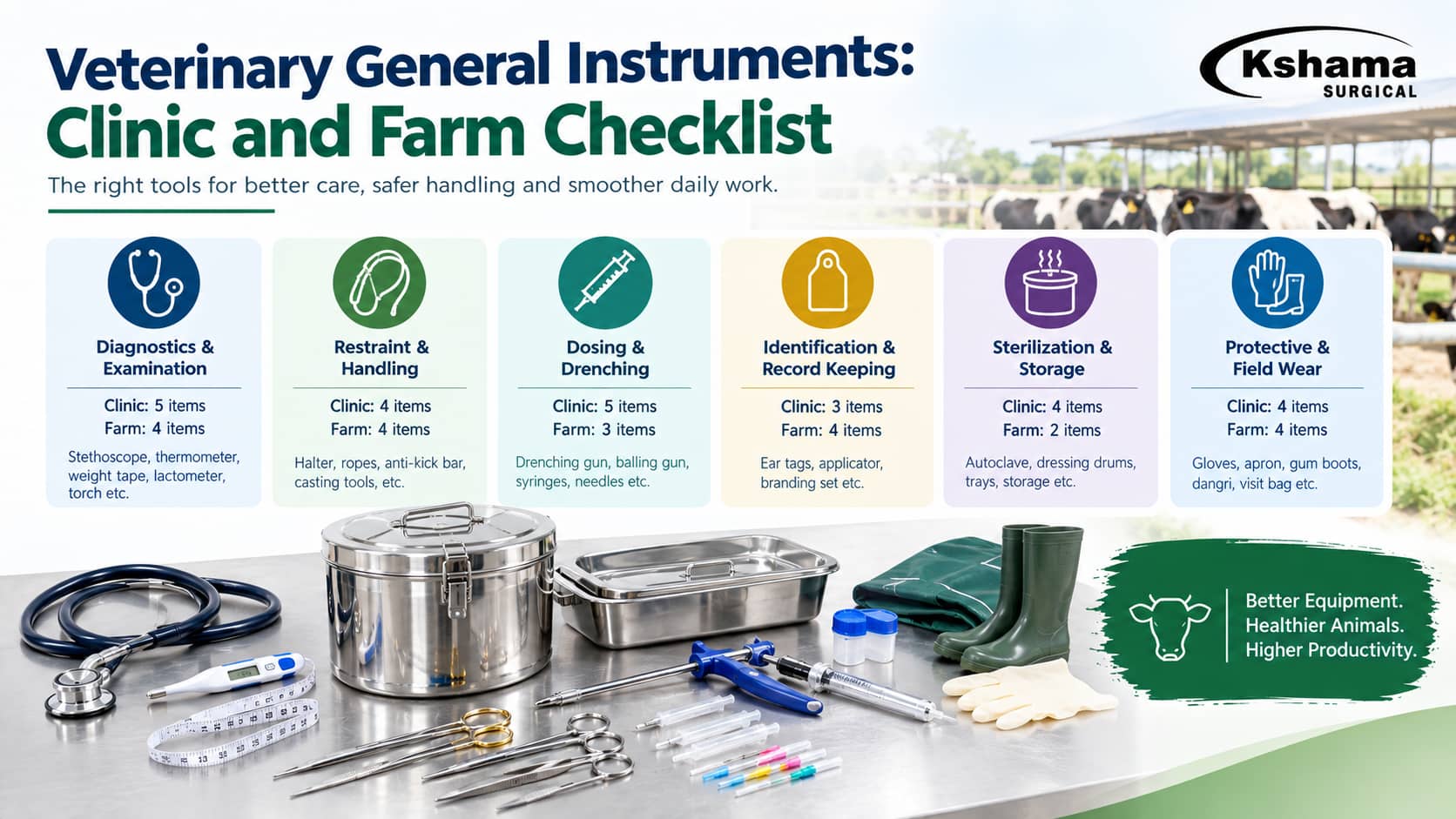
A working clinic needs five groups of kit: diagnostics such as a stethoscope and thermometer, restraint tools, dosing and drenching equipment, sterilization and storage items, and protective wear. Around 25 veterinary general instruments cover a mixed practice. A dairy farm running 50 animals needs roughly half that list.
This checklist sets out what belongs in each group and why. Most items come from the veterinary general instruments category rather than the surgical range, because the day-to-day work of a practice is examination, dosing, and husbandry rather than cutting.
What Counts as Veterinary General Instruments?
Veterinary general instruments are the non-surgical tools used for examination, restraint, dosing, identification, sterilization, and routine husbandry. They sit between diagnostic equipment and surgical kit, and they account for most of what a practitioner touches in a normal working day.
The boundary between veterinary general instruments and surgical kit is practical rather than official. A drenching gun is a general instrument. A Burdizzo castrator is surgical. A dressing drum sits in the general category because it stores both. If an item supports a procedure without entering tissue, it usually belongs here.
This matters when you are budgeting. Practices tend to overspend on surgical kit and underspend on basic veterinary tools, then lose time on every call because the thermometer is broken or the visit bag has no spare needles. The unglamorous items get used 20 times more often. A realistic veterinary clinic equipment list corrects that balance.
The Complete Veterinary General Instruments Checklist
The checklist below groups veterinary general instruments by function. Quantities assume a single-practitioner mixed practice. Scale the consumables, not the instruments.
Diagnostic and Examination Tools
A dual-head stethoscope, a digital thermometer, and a weight measuring tape cover the basics of any veterinary clinic equipment list. Add a lactometer for milk quality checks and a torch with a focused beam for oral and ocular examination.
Keep 3 thermometers rather than 1. They break, and a practitioner without a temperature reading is guessing. Digital flexible-tip models suit rectal use in cattle and cost a fraction of what a repeat visit costs.
A weight measuring tape matters more than practitioners expect. Dosing by eye is the single largest cause of under-dosing in field conditions, and a girth tape gives a usable estimate in 20 seconds.
Restraint and Handling
Restraint failures cause more injuries than surgery does, which is why these animal husbandry instruments come before anything sharp. A bull holder, an anti-kick bar, casting rope, and a set of leg ropes cover adult cattle. For sheep and goats, add a dipping fork and a lifting hook.
An anti-kick bar that adjusts across a 33 to 57 cm range fits most crossbred and indigenous dairy cattle. Fixed-width bars sound cheaper until they do not fit the herd in front of you. This is the one area where vet instruments for dairy farms should never be bought on price alone.
Dosing, Drenching, and Injection
A balling gun, a bovine drenching pipe, an adjustable drenching gun, and reusable 20 ml and 50 ml veterinary syringes form the core of the dosing group. Keep needles in 16G, 18G, and 20G, and a needle destroyer for safe disposal.
The drenching gun should have a visible dose adjustment you can set with one gloved hand. Continuous injectors that need two hands to reset are slow across a 40-animal run.
Identification and Record Keeping
Plastic ear tags, a tag applicator, spare applicator pins, and a cold branding set are the animal husbandry instruments that cover identification. Ear tagging is increasingly tied to national traceability schemes, and India’s Department of Animal Husbandry and Dairying publishes the current programme requirements.
Sterilization and Storage
An autoclave, dressing drums in at least two sizes, a kidney tray, and a tray with lid form the reprocessing chain for every instrument you own. A stainless steel autoclave drum in 9 x 9 inch and 11 x 9 inch sizes suits most clinic loads, with 6 x 6 inch useful for small packs.
Buy two drums per pack you run, not one. One is in the autoclave while the other is in use. A single drum forces you to break sterility or delay the next case.
Protective and Field Wear
Long veterinary examination gloves in 32 and 36 inch lengths, a reusable waterproof apron, gum boots, a full-sleeve dangri, and a visit bag. The bag matters. A nylon or leather visit bag with fixed compartments keeps a field kit organised, and a 42 x 18 x 30 cm bag holds a working set without becoming too heavy to carry.
Checklist Table: What to Stock and Why
| Group | Core items | Suggested quantity | Why it earns its place |
| Diagnostics | Stethoscope, digital thermometer, weight tape, lactometer | 1, 3, 1, 1 | Every consultation starts here |
| Restraint | Bull holder, anti-kick bar, casting rope, leg ropes | 1 each | Prevents injury to handler and animal |
| Dosing | Balling gun, drenching gun, drenching pipe, syringes | 1, 1, 3, 4 | Accurate delivery of oral and injectable dose |
| Identification | Ear tags, applicator, pins, branding set | Bulk, 1, 6, 1 | Traceability and herd records |
| Sterilization | Autoclave, dressing drums, kidney tray, tray with lid | 1, 4, 2, 2 | Keeps instruments usable and safe |
| Protection | Long gloves, apron, gum boots, dangri, visit bag | Bulk, 2, 1, 1, 1 | Biosecurity and operator comfort |
Why Does Steel Grade Matter in Farm Veterinary Instruments?
Steel grade decides how long veterinary general instruments survive dung, disinfectant, and hard water. Austenitic grades such as 304 and 316 resist corrosion well and suit trays, drums, bowls, and non-cutting instruments. Martensitic 410 and 420 grades harden enough to hold a cutting edge but corrode faster if left wet.
Farm veterinary instruments spend more time in poor conditions than clinic kit does. A tray that lives in a vehicle through a monsoon needs 304 at minimum. The reference material on surgical stainless steel sets out how the grades differ.
Chrome-plated carbon steel still appears in the market at low prices. It works until the plating chips, after which the exposed carbon steel rusts within weeks. If a quote for veterinary general instruments sits 60 percent below the rest, check the material specification before anything else.
Kshama Surgical manufactures its general veterinary range in standard-grade stainless steel at an ISO 9001:2015 and CE certified unit in Idar, Gujarat, and has supplied the sector since 2008. Asking a supplier to state the grade in writing is a fair request and a fast way to filter quotes.
How Do You Build the List for a Dairy Farm Rather Than a Clinic?
A farm buys for routine husbandry, not for treatment. Roughly 12 veterinary general instruments cover a 50-animal dairy unit: thermometer, weight tape, anti-kick bar, casting rope, drenching gun, balling gun, ear tags with applicator, teat instruments, hoof trimming tools, syringes, long gloves, and a first aid box.
Skip the autoclave on a farm of that size. Boil-and-store is inadequate for surgery but acceptable for the husbandry tools a farm actually uses, and the capital is better spent on hoof care and milking hygiene. Farms that do hold a small sterilizing set usually do so because a vet visits weekly and wants kit ready. That is the practical test for vet instruments for dairy farms.
Teat health deserves its own budget line on any dairy unit. Teat siphons, teat dilators, and teat knives sit in a separate range of veterinary teat instruments and address the mastitis and teat obstruction cases that drive most dairy losses. India’s National Dairy Development Board publishes herd management guidance that is worth reading alongside any equipment plan.
Breeding equipment is the other farm-specific group. AI guns, sheaths, thaw monitors, and nitrogen containers sit under AI equipment rather than general instruments, and the buying logic there is driven by straw handling and cold chain rather than by steel grade.
When You Should Not Buy the Full Checklist
There are three cases where buying every item on this list in one order is the wrong move.
If you are a new graduate building a mobile practice, buy the 12 field items and nothing else for the first 6 months. Caseload will tell you which items you actually reach for. Buying a full clinic list before you have a clinic ties up capital in items that sit in a cupboard.
If your practice is small-animal only, most of this veterinary clinic equipment list does not apply. Restraint tools sized for cattle, drenching equipment, and branding sets have no place in a companion animal clinic, and the budget belongs in anaesthesia and imaging instead.
If you already own working equipment, do not replace it because a catalogue looks tidy. A 10-year-old stainless kidney tray with no pitting does the same job as a new one. Replace on condition. Spend the difference on consumables that run out, such as needles, tags, and gloves.
Care, Reprocessing, and Replacement Intervals
Rinse instruments within 20 minutes of use. Dried blood and rumen contents are far harder to remove and corrode steel underneath. Use a neutral pH enzymatic cleaner rather than alkaline household detergent.
Steam sterilize at 121°C and 15 psi for 15 to 20 minutes for wrapped loads, or 134°C for 3 to 4 minutes on a pre-vacuum cycle. Date every drum on closing and reprocess unopened packs after 21 days.
Replace each item on condition rather than on a schedule. Retire a thermometer that reads more than 0.3°C from a reference, a drenching gun whose dose no longer matches the mark, and any instrument showing pitting. Keep a written log with dates, since the World Organisation for Animal Health treats equipment hygiene records as part of basic biosecurity practice.
Common Mistakes When Buying Basic Veterinary Tools
Buying one of everything is the first mistake when stocking veterinary general instruments. Consumable-adjacent items such as thermometers, syringes, and drums should be bought in pairs or threes, because a single unit means downtime the moment it fails.
Ignoring sizing is the second. Long gloves at 30 inches do not reach for a rectal pregnancy diagnosis in a large cow, and an undersized dressing drum forces packs to be split. Check the dimensions of vet instruments for dairy farms in centimetres and inches before ordering.
The third mistake is buying general and surgical kit from different suppliers with no shared specification. Mixed steel grades in one sterilizing drum accelerate pitting across the whole general veterinary range. Keeping the veterinary surgical instruments and the general range on a consistent material specification makes reprocessing simpler and extends the life of both.
Getting a Checklist Built Around Your Practice
A generic veterinary general instruments list is a starting point, not an order form. Send your species mix, herd or caseload size, and monthly procedure numbers to the Kshama Surgical team, and ask for a specification rather than a catalogue. You can also work through the current product range directly if you already know what you need.
Frequently Asked Questions
What are veterinary general instruments used for?
Veterinary general instruments cover examination, restraint, dosing, identification, sterilization, and husbandry. Typical items include thermometers, weight tapes, anti-kick bars, drenching guns, ear tag applicators, dressing drums, and long examination gloves used across daily clinic and farm work.
How many items does a small mixed practice actually need?
Around 25 veterinary general instruments cover a single-practitioner mixed practice, split across six functional groups. A 50-animal dairy farm needs closer to 12. Buy consumable-adjacent items such as thermometers and drums in multiples to avoid downtime.
What is the difference between general and surgical veterinary instruments?
General instruments support procedures without entering tissue, such as restraint, dosing, and storage tools. Surgical instruments cut, clamp, hold, and suture. The categories overlap at items like dressing drums, which serve both.
Which steel grade should farm veterinary instruments use?
Austenitic 304 or 316 stainless steel suits the farm veterinary instruments exposed to moisture and disinfectant, including trays and drums. Martensitic 410 or 420 is used where a cutting edge is needed. Avoid chrome-plated carbon steel for field use.
Where can I buy a complete set of veterinary general instruments in India?
Kshama Surgical manufactures and supplies the full general veterinary range from an ISO 9001:2015 and CE certified unit in Gujarat, with online ordering and shipping across India. Buying direct usually gives clearer material specifications than reseller listings.
How often should basic veterinary tools be replaced?
Replace on condition. Retire thermometers reading more than 0.3°C off a reference, dosing guns whose delivered volume drifts from the mark, and any instrument with pitting or a loose joint. Well-maintained basic veterinary tools in stainless steel often last 8 years or more.
Do small animal clinics need the same checklist?
No. Restraint tools sized for cattle, drenching equipment, and branding sets are not relevant to companion animal work. Small animal clinics keep the diagnostic, sterilization, and protective animal husbandry instruments and redirect the rest of the budget to anaesthesia and imaging.
