
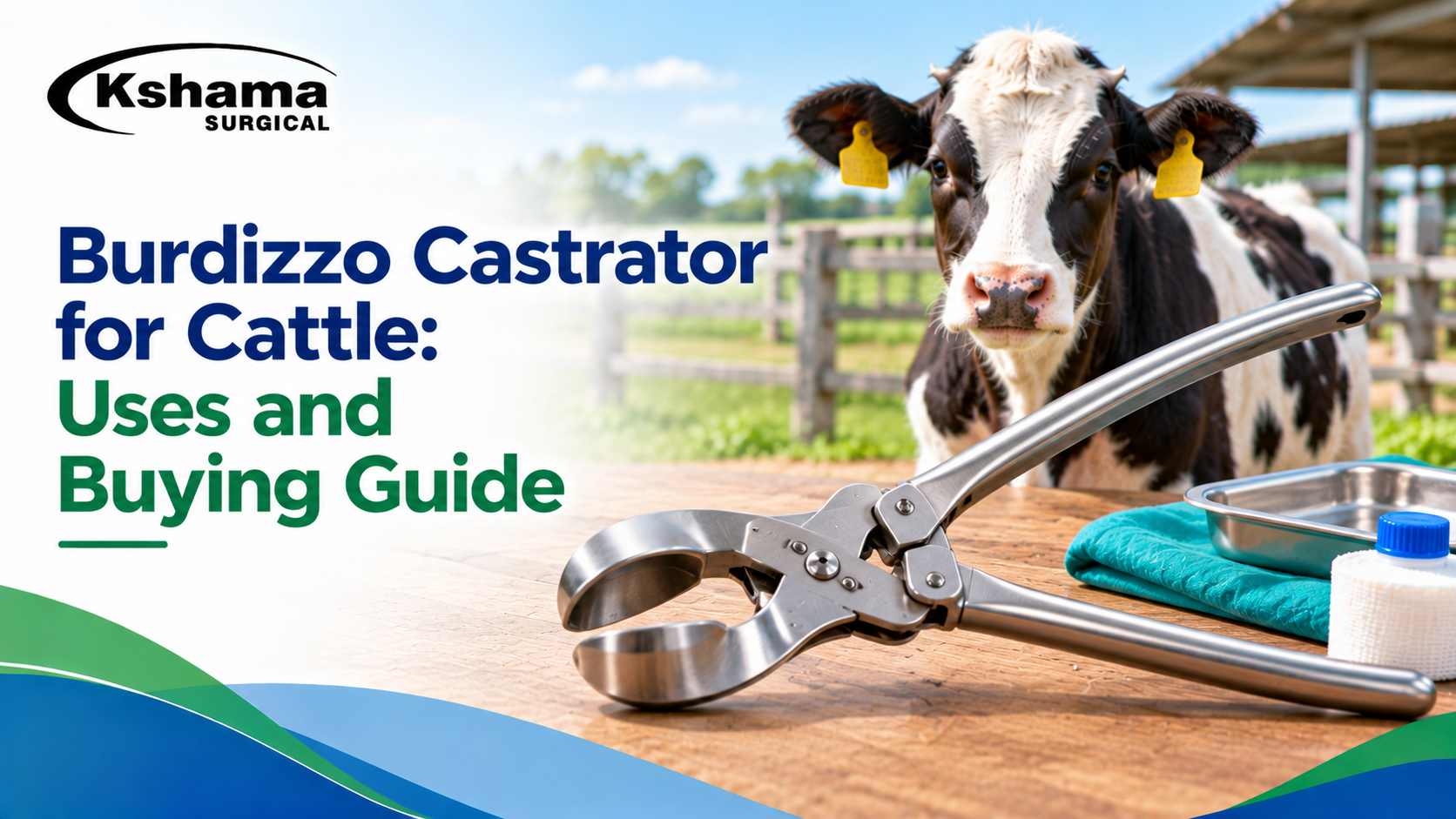
Bloodless castration is one of the most common ways farmers and vets manage bull calves, and the tool behind it has barely changed in decades. A well-made burdizzo castrator for cattle crushes the spermatic cord through the skin, so nothing is cut and no open wound is left behind. At Kshama Surgical, we make veterinary surgical instruments for farms and clinics, and this 2026 guide draws on what buyers most often ask before ordering. It explains how a burdizzo castrator for cattle works, how to read a castrator size chart, and what to check before you pay.
What Is a Burdizzo Castrator for Cattle and How Does It Work?
A burdizzo castrator for cattle is a long-handled clamp with two blunt, rounded jaws that crush the spermatic cord inside the scrotum. Once the cord is crushed, blood flow to the testicle stops and the testicle gradually shrinks. The skin stays intact, which is why the method is called bloodless castration.
The jaws are built to crush, not cut. When the handles close, the jaws compress the cord against the outer wall of the scrotum, and the long handles give enough leverage to do this by hand. Each cord is treated separately, one side at a time.
Wikipedia’s entry on the burdizzo notes that the tool is used mainly on cattle, sheep and goats. It also says the method appeals to producers because it seemingly causes less chronic pain than elastic banding and less acute pain than surgical castration. Every burdizzo castrator for cattle works on this principle, but build quality varies a great deal from one maker to another.
When Is Bloodless Castration the Right Choice?
A burdizzo castrator for cattle suits herds where producers want to avoid an open wound, particularly in warm months when flies are a problem. It is not the right answer for every animal, so it helps to weigh both sides.
Advantages of using a burdizzo for cattle
- There is no incision, so there is no open wound to infect or to attract flies.
- Bleeding is not a concern because the skin is never broken.
- Reduced weight-gain setback has been reported compared with surgical and latex-band methods.
- A burdizzo castrator for cattle is reusable and, with basic care, lasts for years.
Because of these points, a burdizzo for cattle remains a standard item in many farm kits.
Limitations you should know about
A burdizzo castrator for cattle is not foolproof. The same Wikipedia entry lists several reasons it can fail: the spermatic cord may be too small to crush properly, the cord may regenerate, the cord may be misidentified, or the instrument may not be held closed long enough. Pain is another factor. Provincial guidance cited there, such as Ontario’s page on castrating calves, says local anaesthesia plus an anti-inflammatory drug are needed to control the acute pain of the procedure.
Animal welfare rules and age limits differ by country and state. Speak with your veterinarian about the protocol and the legal position where you farm.
How Do You Read a Castrator Size Chart?
A castrator size chart matches the length of the instrument, measured in inches, to the animal it is meant for. Longer tools generally fit larger animals because they have longer jaws and handles. The table below shows the general pattern used across the trade.
| Size | Typical animals | Notes |
| 9 inch | Rabbits, sheep, goats, small stock | Compact and easy to handle, but short for mature cattle |
| 12 inch | Sheep, goats, small young stock | A common all-round size for small ruminants |
| Larger than 12 inch | Calves, bulls, horses | Longer jaws and handles for bigger animals |
Treat any castrator size chart as a starting point rather than a rule. Jaw length, jaw opening and handle length differ between manufacturers, so ask for actual dimensions and confirm the choice with your vet.
Where does a 9 inch burdizzo fit?
A 9 inch burdizzo is generally treated as a small-animal tool. Trade guidance ties 9 and 12 inch models to rabbits, goats and sheep, and longer models to cattle and horses. A vet may accept a 9 inch burdizzo for a very small calf, but it is rarely the right pick for typical bull calves or older cattle. If your herd is mixed, many farms keep one short and one long instrument instead of compromising on one size.
What Should You Check Before Buying?
Two versions of a burdizzo castrator for cattle can look identical in a photo and behave very differently on the farm. These are the points worth checking.
- Material and finish: on a burdizzo castrator for cattle, look for forged steel or stainless steel with a smooth, corrosion-resistant surface. Chipped plating tends to rust first at the hinge.
- Full jaw closure: a sprung burdizzo that does not close completely will not crush the cord, so check that the jaws meet evenly along their length.
- Rounded jaw edges: the jaws should crush without cutting, so edges should be blunt and smooth.
- Joint strength: the pivot should feel tight with no side-to-side play.
- Handle length and grip: comfortable handles make it easier to apply steady pressure.
- Correct size: match the tool to your animals using the size chart above.
- Easy cleaning: avoid designs with crevices that trap tissue and dirt.
- Supplier support: choose a seller who can share dimensions and material details before you order.
How Is a Burdizzo Used? A Step-by-Step Overview
This overview of using a burdizzo castrator for cattle is for general understanding only. Castration should follow your vet’s protocol and local animal welfare law.
- Prepare the animal and tool. Clean and disinfect the burdizzo castrator for cattle, check that it closes fully, and restrain the animal safely.
- Arrange pain control. Your vet will advise on local anaesthetic and an anti-inflammatory drug.
- Locate each cord. Feel for the spermatic cord and move it to the outer side of the scrotum so it can be clamped against the wall.
- Position the jaws on one cord only. Keep the jaws on that single cord, never both at once.
- Close and hold. Keep the jaws closed for the time your protocol specifies. Releasing early is a leading cause of failure.
- Treat the second cord at a different level from the first, using the same method.
- Monitor the animal. Watch for swelling or distress in the following days and check later that the testicle has shrunk.
Common Mistakes That Lead to Failed Castration
Most failures with a burdizzo castrator for cattle trace back to a handful of avoidable errors. Using an undersized burdizzo castrator for cattle is the first. A short burdizzo castrator for cattle may not generate enough force on a large calf. Misidentifying the cord is the second, because clamping the wrong tissue leaves the cord untouched. Releasing the jaws too soon, working with a worn or sprung instrument, and skipping pain relief round out the list.
Many people also forget the follow-up. Checking the animal a few weeks later tells you whether the castration worked or needs repeating, and it is far easier to correct early than after a bull has matured.
How Should You Clean and Store the Instrument?
After each animal, wash off blood and tissue from the burdizzo castrator for cattle, disinfect the jaws and hinge with a vet-approved solution, and dry the tool fully. A clean burdizzo castrator for cattle lowers the risk of carrying infection from one animal to the next. Apply a little instrument oil to the pivot now and then, and store the tool in a dry place. Moisture is the main enemy of any steel instrument.
How Does It Compare With Banding and Surgical Castration?
Producers usually choose between three approaches: crushing with a burdizzo castrator for cattle, applying an elastic band, or removing the testicles surgically. Each has trade-offs. Banding is cheap and quick, but the tissue below the band dies and sloughs away, which can mean a longer period of discomfort. Surgical castration gives the most definite result, yet it needs an incision, strict hygiene and good timing outside fly season. The burdizzo sits between the two: there is no wound, but the outcome depends on a correct crush.
The right choice depends on the age and size of the animal, local welfare rules and what your vet recommends. Many practices keep a burdizzo castrator for cattle in the kit alongside other methods, so they can match the technique to the animal instead of forcing one approach on every case.
What Questions Should You Ask a Supplier?
A short list of questions separates a dependable seller from a careless one.
- What are the overall length and jaw length in inches?
- Which animals is each size designed for?
- Which steel is used, and how is it finished?
- Was each burdizzo for cattle tested for full jaw closure before dispatch?
- Can I see clear photos of the jaws and the pivot?
- What is the replacement policy for a faulty unit?
- Do you supply spare parts?
A supplier who answers these plainly usually knows the product well. Vague replies about size or steel are a reason to look elsewhere.
What Aftercare Does the Animal Need?
Aftercare matters as much as the burdizzo castrator for cattle itself. Keep the animal in a clean, dry area and watch how it eats, moves and lies down. Some swelling can follow the procedure, but marked or worsening swelling, heat, fever or a reluctance to walk calls for a vet visit.
Plan a check a few weeks later to confirm that the testicle has shrunk. If it has not, tell your vet instead of repeating the crush on your own. In short, pick the size from the castrator size chart, confirm that the jaws close fully, follow your vet’s pain-control advice and keep the tool clean. A good burdizzo castrator for cattle rewards that discipline with consistent results.
Where Can You Buy a Reliable Burdizzo?
Kshama Surgical is an India-based manufacturer and exporter of veterinary instruments, and a sensible first step when buying a burdizzo castrator for cattle is to tell the team which animals you handle and how many. That lets them point you to a suitable size and share material details before you order. You can browse the full instrument range in our shop or contact the Kshama Surgical team for help choosing the right burdizzo castrator for cattle.
Frequently Asked Questions
Is burdizzo castration painful for cattle?
Yes, the procedure causes acute pain, which is why vets recommend local anaesthesia plus an anti-inflammatory drug. Ask your vet to set the protocol first, and watch the animal closely for swelling, discomfort or reluctance to move afterwards.
What size burdizzo is used for cattle?
Size follows the animal. Nine and twelve inch models usually suit sheep and goats, while cattle generally need a longer instrument. Compare the maker’s jaw and handle dimensions with your animals and confirm the choice with your vet before buying.
Can a burdizzo castration fail?
Yes. Failure is usually linked to a misidentified cord, an incomplete crush, a burdizzo that does not close fully, or releasing too early. A check a few weeks later shows whether the testicle has shrunk or the procedure needs repeating.
Does a burdizzo leave an open wound?
No. The skin stays closed, so there is no incision, no bleeding and no wound to protect from flies. Still, watch for swelling or discomfort over the next few days, and call your vet if the animal seems unwell or the area looks wrong.
What should I look for in the steel and build?
Choose forged or stainless steel with a smooth, corrosion-resistant finish, a tight pivot and jaws that close evenly. Kshama Surgical can share material and dimension details on request, so you can compare tools properly before ordering.
How do I clean a burdizzo between animals?
Wash off tissue and dirt, disinfect with a vet-approved solution, and dry the tool completely. Clean jaws and a dry hinge lower the risk of passing infection between animals and help the instrument resist rust while it is in storage.
Can one burdizzo be used on goats and cattle?
Only if the size suits both. A 9 inch burdizzo is meant for small stock and is usually too short for cattle, so many farms keep two sizes. Check jaw length and handle leverage against the animals you actually handle before you buy one.
