
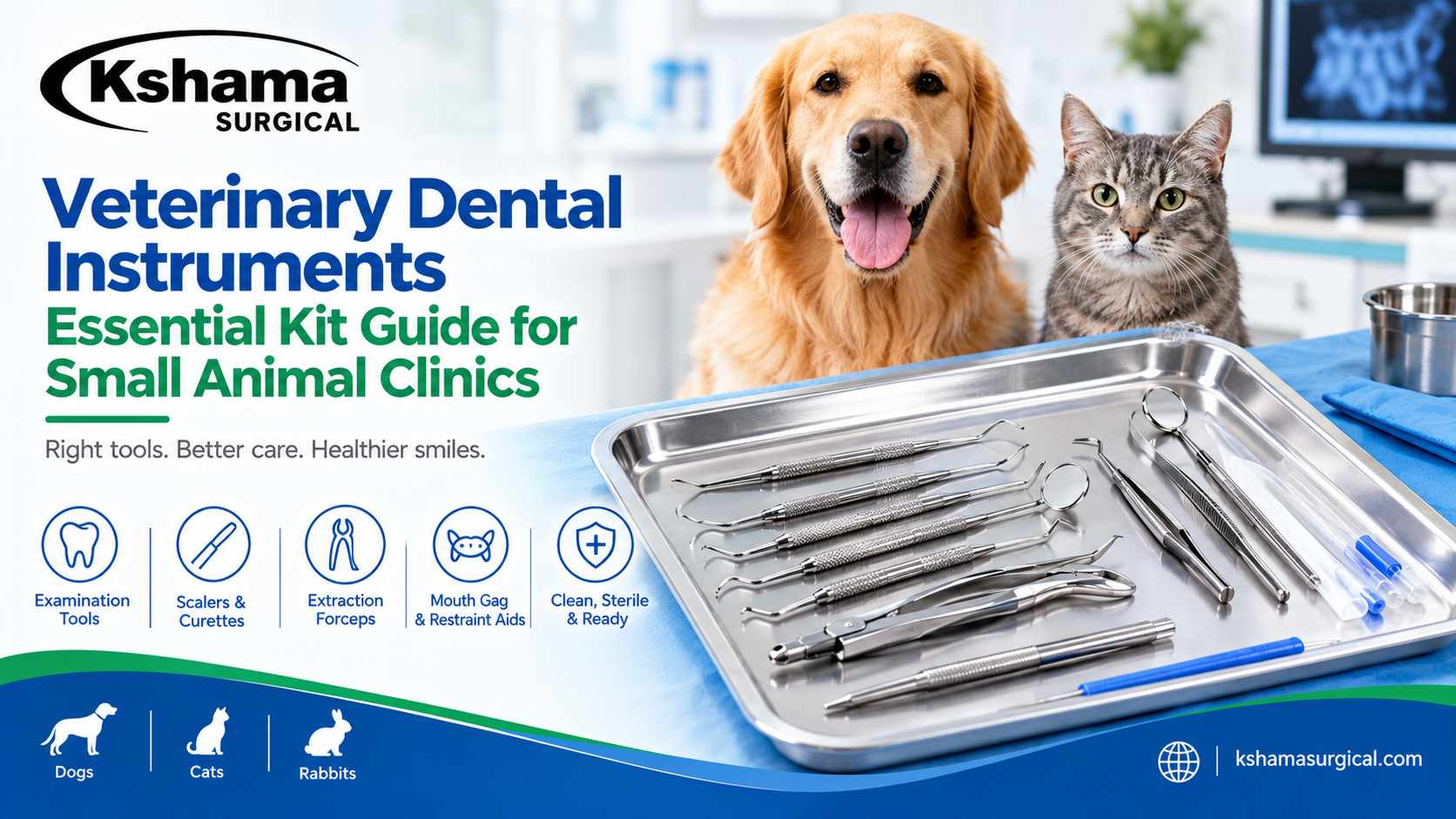
Most small animal clinics do not need a hundred veterinary dental instruments to deliver good dental care. They need the right few, kept sharp, clean and ready. A dog with a mouth full of tartar, a cat with a broken tooth and a puppy with retained baby teeth all depend on the same core set of veterinary dental instruments, used with skill and good restraint. This 2026 guide explains which tools matter, how they differ, how to assemble a practical kit, and how to look after it. For safe access to the mouth, a reliable mouth gag for dogs is one of the first accessories many clinics add.
When Does a Pet Need Dental Treatment?
Common signs include bad breath, yellow or brown calculus on the teeth, red or bleeding gums, drooling, dropping food, reluctance to chew and a broken or loose tooth. Some animals show no outward signs until disease is advanced, which is why a routine oral examination matters. When treatment is needed, the veterinarian works with a defined set of veterinary dental instruments, a safe anaesthetic protocol and a plan for aftercare.
Why Does Small Animal Dentistry Need the Right Instruments?
Because teeth are small, roots are deep and the gum tissue is delicate, poor tools cause avoidable damage. An adult dog has 42 teeth and an adult cat has 30. Puppies have 28 deciduous teeth and kittens have 26. Each tooth has a different root pattern, and instruments must fit those shapes.
Periodontal disease is widely regarded as one of the most common conditions seen in dogs and cats. The American Veterinary Dental College, through AVDC, publishes position statements and educational material that explain why proper scaling, probing and charting are part of good practice. Cleaning only the visible crown is not enough, because disease often sits below the gum line.
Using the correct instrument also protects the operator, and good veterinary dental instruments are as much a safety measure as a clinical one. A dull scaler slips, and a poorly fitting forceps can fracture a root. The aim of a good kit of veterinary dental instruments is predictable, controlled work. Veterinary dental instruments are designed around specific tooth surfaces and angles, so a general-purpose forceps or a household tool is no substitute for the correct instrument.
What Are the Core Veterinary Dental Instruments?
A basic set of veterinary dental instruments covers examination, cleaning and simple extraction. The sections below describe each group and what it is for.
Dental probe and explorer
The probe measures pocket depth around a tooth, and the explorer detects defects such as resorptive lesions or exposed pulp. Both are used during the oral exam, usually under anaesthesia, and findings are recorded on a dental chart. Without a probe, hidden periodontal disease goes unnoticed, which is why it sits at the top of any list of veterinary dental instruments.
Scalers
Scalers remove plaque and calculus from the crown. Hand scalers have a pointed or sickle-shaped tip and are used above the gum line. Many clinics also use a powered ultrasonic scaler for speed, with hand scalers for finishing and for areas the powered tip cannot reach.
Curettes
Curettes have a rounded back and toe, which makes them safer under the gum line. They clean the root surface in periodontal pockets. A set normally includes several shapes so that different teeth and surfaces can be reached.
Dental elevators and luxators
Elevators and luxators loosen the periodontal ligament so a tooth can be removed with less force. Luxators are thin and sharp and require a controlled technique. Use a size that matches the tooth, and never lever against bone or an adjacent tooth.
Extraction forceps
Forceps grip a loosened tooth for final removal. Small animal forceps are lighter and narrower than those used in large animal or human work. Because roots can fracture, extraction is best done after the tooth has been elevated and, where needed, radiographed.
Mouth gag, props and restraint aids
A gag or prop keeps the mouth open for access. Use it with care and avoid forcing the jaws wide for long periods, particularly in cats, since excessive opening can cause problems. Many vets prefer short, gentle opening and regular breaks. A basic muzzle also helps with handling before anaesthesia, and the dog muzzle listed at Kshama Surgical is one example of this kind of aid.
Polishers and supporting items
After scaling, teeth are polished to smooth the enamel and slow plaque return. Add suction, gauze, suture material, a light source and a mouth mirror to complete the workflow.
What Makes Good Veterinary Dental Instruments Different from General Instruments?
Dental work depends on fine tips and controlled leverage. Look for these qualities when assessing veterinary dental instruments:
- A hard, corrosion-resistant steel that holds an edge
- Handles that give a secure grip when wet and gloved
- Working ends that are accurately shaped, not rough or uneven
- A design that can withstand repeated autoclaving
- Availability of replacements, so a damaged piece does not leave a gap in the set
Quality veterinary dental instruments cost more than basic items, but they stay sharp longer and are safer to use. A poor scaler is not a bargain if it must be replaced every few months.
Dental Instruments for Dogs vs Cats: What Changes?
The principles are the same, but size and shape change. Dental instruments for dogs vary with breed. Good dental instruments for dogs also differ by technique, not only size. A giant breed has large teeth and heavy calculus, so you need strong scalers and larger forceps. Toy breeds have crowded, small teeth and fragile jaws, so fine instruments and gentle technique matter more.
Cats have small, narrow teeth and are prone to resorptive lesions, which need careful probing and often radiographs. The finest tips and smallest elevators are reserved for cat work. Many vet dental tools are sold in small and large sizes for this reason. Having at least two size ranges of each hand instrument is a sensible rule for a mixed practice.
How Do You Build a Dental Kit for Animals?
Build a dental kit for animals in layers, starting with what you will use in almost every procedure. A dental kit for animals should also match your caseload, so a mixed practice needs more size ranges than a cat-only clinic. The following order works well for a clinic starting out:
- A probe and explorer for examination
- Two or three hand scalers and a set of curettes
- An elevator and luxator set in small and medium sizes
- Small animal extraction forceps
- A mouth gag or prop and basic restraint aids
- Polishing equipment and consumables
- Sterilisation pouches or a dedicated instrument tray
Add specialist veterinary dental instruments such as bone burs, root tip picks or dental radiography only when your caseload demands them. Buying everything at once ties up money in tools that may stay in the drawer.
When you review vet dental tools from any supplier, check the metal grade, the sharpness of the working edge, how well the instrument can be resharpened and whether it can survive repeated autoclaving. Ask for clear photos or specifications, because dental tips are small and the differences are subtle.
How Do You Keep Dental Work Safe for the Patient?
Instruments are only part of safe dentistry. Pre-anaesthetic assessment, appropriate fasting, intravenous access and continuous monitoring of heart rate, oxygen levels and temperature are standard good practice. Small patients lose body heat quickly during a long scale and polish, so warm bedding and efficient work matter. Efficient work depends on having the right veterinary dental instruments laid out before the animal is anaesthetised, not hunting for a missing elevator halfway through a case.
What Equipment Sits Around the Instruments?
Good dentistry needs more than hand tools. Anaesthesia and monitoring, an intubated airway, warm bedding, good lighting and suction all matter. A cuffed endotracheal tube protects the airway from water and debris. Dental work is a surgical procedure, and the clinic should treat it as one. Even the best veterinary dental instruments cannot compensate for poor anaesthesia, poor light or poor monitoring.
For a broader range of clinic essentials, see the veterinary surgical instruments category and the dog accessories range at Kshama Surgical. Dental-specific items can differ from the general catalogue, so ask the team about availability for your needs.
How to Clean, Sterilise and Maintain Dental Instruments
Veterinary dental instruments are small and carry blood, saliva and calculus. Clean them promptly after every case.
- Remove debris with a soft brush under running water. Do not let blood dry on the tips.
- Use an ultrasonic bath if available, then rinse.
- Dry the instruments and inspect each tip under good light.
- Package in pouches and sterilise by autoclave.
- Sharpen scalers and curettes regularly. A dull blade slips and increases trauma.
- Store in a dry tray so tips do not knock against each other.
Replace veterinary dental instruments that are bent, chipped or no longer hold an edge. Treat sharpening as routine maintenance, not an emergency fix.
A Simple Dental Procedure Workflow
Knowing the sequence helps you decide which veterinary dental instruments to lay out:
- Anaesthetise and intubate the patient, then perform a full oral exam with the probe and explorer.
- Scale the crowns, then use curettes subgingivally.
- Chart findings and take radiographs where available.
- Extract or treat diseased teeth with elevators, luxators and forceps.
- Polish, rinse and close any surgical sites with suitable sutures.
- Recover the patient and send home care instructions.
Laying out the tray in this order keeps the procedure smooth and reduces time under anaesthesia.
Common Mistakes with Veterinary Dental Instruments
Most errors come from skipping steps, not from missing equipment.
- Scaling only above the gum line and skipping the probe and chart
- Using dull scalers that polish plaque in rather than remove it
- Forcing elevators or forceps, which can fracture roots
- Leaving a gag open too long or too wide
- Skipping radiographs before extracting multi-rooted teeth when imaging is available
- Not recording findings, so progress cannot be tracked
Setting Up a Dental Corner in a Small Clinic
Even a modest clinic can create a safe dental workflow. Reserve a table or tray area with good overhead light, a water-resistant surface and room for suction. Keep the veterinary dental instruments you use most in labelled, pre-packed pouches so that a set is always sterile and ready. Train technicians to handle the instruments, chart findings and prepare the tray, because teamwork shortens anaesthesia time. Review your vet dental tools twice a year, discarding anything bent or dull and noting gaps in the set before they cause delays.
Buying Guidance
Compare more than price when choosing veterinary dental instruments. Look at steel quality, finish, ease of resharpening and whether the supplier can replace faulty pieces. A modest but well-made kit of veterinary dental instruments that you maintain will outperform an expensive one that is neglected. For general veterinary instruments and handling accessories, you can contact Kshama Surgical and discuss what suits your practice.
For background reading, the Wikipedia article on veterinary dentistry gives a useful overview of the field and its history.
Frequently Asked Questions
Which veterinary dental instruments does a basic clinic need?
A probe and explorer, hand scalers, curettes, small elevators or luxators, extraction forceps, a mouth gag and polishing supplies. Add specialist items only as your caseload grows and you identify real gaps in the set.
How many teeth do dogs and cats have?
Adult dogs have 42 teeth and adult cats have 30. Puppies have 28 baby teeth and kittens have 26. Instrument sizes should match these different tooth shapes, crown sizes and root patterns in each species.
Are dental instruments for dogs the same as for cats?
The types are the same, but cats need finer tips and smaller elevators because their teeth are narrow and prone to resorptive lesions. Dogs vary widely by breed, so keep several size ranges available in your set.
How often should vet dental tools be sharpened?
Check scalers and curettes at every use and sharpen them regularly, depending on workload. A dull tip slips and traumatises tissue. Replace pieces that are chipped, bent or unable to hold an edge after sharpening.
Can I build a dental kit for animals gradually?
Yes. Start with examination tools, scalers, curettes and a gag, then add elevators, forceps and polishers as cases require. Kshama Surgical can advise on general instruments and handling accessories for your clinic.
Is a mouth gag safe for cats and dogs?
It is safe when used briefly and gently under veterinary control. Avoid forcing the mouth very wide or leaving it open for long, especially in cats, and give the jaw regular rest during longer dental procedures.
How should dental instruments be sterilised?
Brush off debris, use an ultrasonic bath if available, dry, inspect, pouch and autoclave. Clean promptly after use so blood does not dry on the tips, and store the finished set in a dry, covered tray ready for the next case.
