
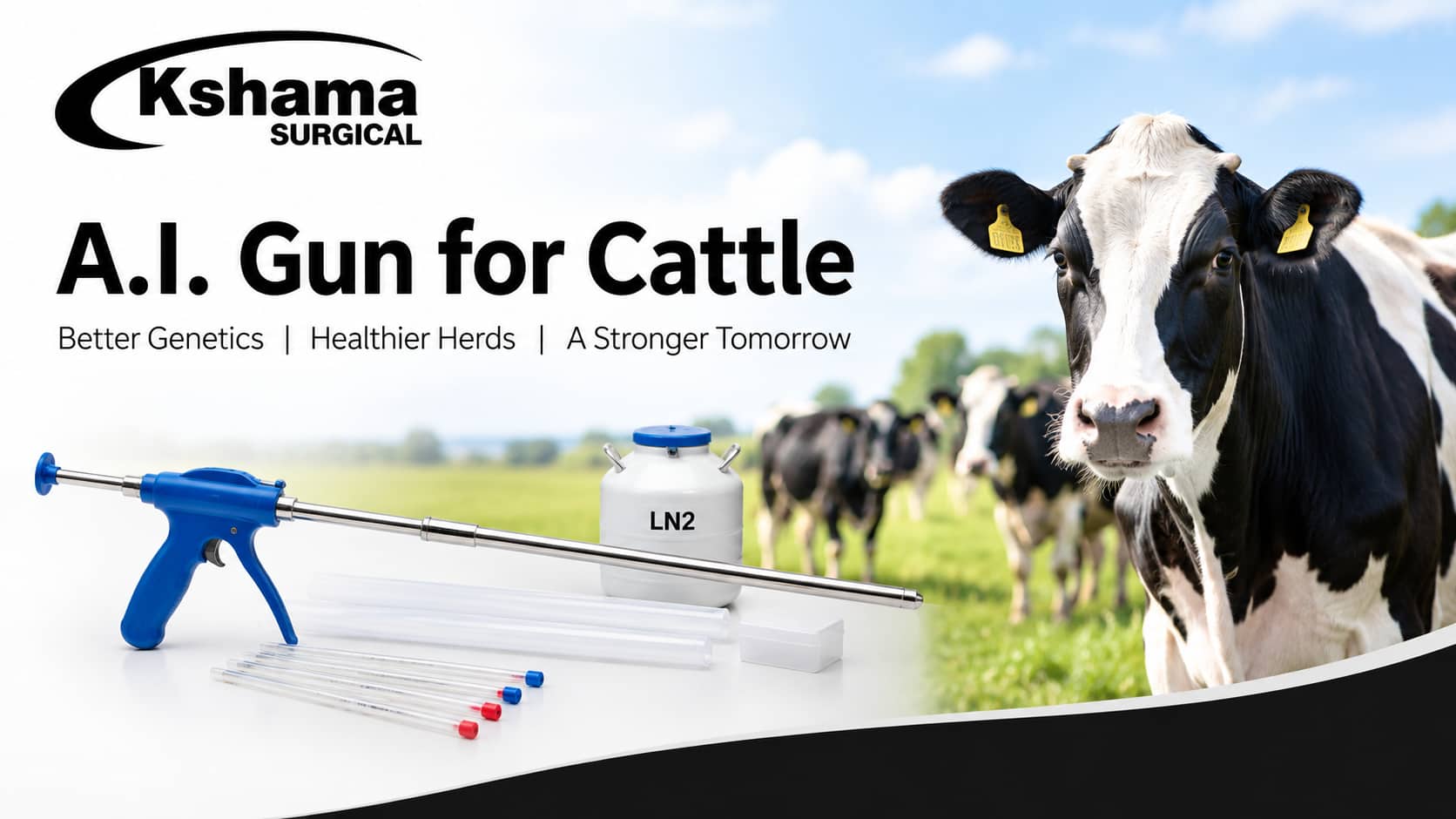
The shift from natural service to controlled breeding rests on one instrument: the a.i. gun for cattle. It is a thin stainless steel tube with a plunger, and it replaces an uncontrolled biological event with a repeatable technical procedure. This article compares modern insemination using an a.i. gun for cattle with natural mating and earlier insemination techniques, explains the main gun designs in use today, sets out the honest advantages and disadvantages of each approach, and covers what to check before buying. The aim is to help you decide which method suits your herd rather than to argue that one option fits everyone.
What an A.I. Gun for Cattle Actually Does
An insemination gun holds a frozen-thawed semen straw, protects it behind a disposable sheath, and lets the technician deposit its contents at a precise point in the reproductive tract. The gun does three things a bull cannot: it places a measured dose exactly where conception rates are highest, it isolates the semen from contamination until the moment of deposition, and it allows one ejaculate to serve many animals across many locations.
Straws are stored in liquid nitrogen, thawed in a water bath, dried, cut squarely, and loaded into the barrel. The sheath locks over the straw, and the plunger pushes the contents forward when the tip has passed the cervical rings into the uterine body. Every design feature of an a.i. gun for cattle serves that sequence: length for reach, narrow diameter to limit trauma, and a smooth finish that spares the mucosa.
Traditional Methods: Natural Service and Early Techniques
Natural service means keeping a bull with the herd or hand-mating selected animals. It requires no equipment, no cold chain and no technical training. It also means feeding, housing and handling a mature bull, accepting the genetics that bull carries, and accepting the disease transmission risk that comes with direct contact.
Before modern guns, insemination was attempted with glass syringes, rubber catheters and early speculum-based methods. These worked, but they were difficult to clean reliably, awkward to use in field conditions, and unforgiving of poor technique. The recorded history of artificial insemination shows steady refinement from these early instruments toward the sealed, single-use-sheath systems in use today.
Comparison: A.I. Gun vs Traditional Methods
| Factor | A.I. Gun with Frozen Semen | Natural Service (Bull) | Early Syringe / Catheter Methods |
| Genetic control | High — sire selected per animal | Limited to the bull on hand | Moderate, limited by semen handling |
| Disease transmission risk | Low with single-use sheaths | Higher, direct contact | Higher, cleaning dependent |
| Equipment needed | Gun, sheaths, gloves, LN2 storage | None | Basic instruments, poor standardisation |
| Skill requirement | Trained technician | Minimal | Trained operator |
| Record keeping | Precise dates and sire recorded | Often approximate | Variable |
| Ongoing cost | Consumables and nitrogen refills | Bull maintenance | Consumables, high failure rate |
| Best suited for | Herds pursuing genetic improvement | Extensive or remote systems | Historical interest only |
Main Types of A.I. Gun for Cattle Designs in Use
Not every gun suits every operation. Four designs cover almost all practical use.
- Universal auto-lock gun: accepts both mini and medium straws, secures the sheath with a mechanical catch, and has no rubber part to wear out. The most versatile everyday choice.
- Mini-French gun: built for 0.25 ml mini straws with a French-lock sheath. Simple and dependable when your semen supply is standardised.
- O-ring gun: uses a rubber ring to seat the sheath. Widely used and economical, with the O-ring treated as a replaceable wear part.
- Digital or endoscopic gun: carries a small waterproof camera for visual guidance. Valuable in training, research and repeat-breeder investigations rather than routine field work.
Brass and stainless steel variants of the same lock design are both common, though stainless steel resists corrosion best under repeated cleaning. Anyone comparing the ai gun price across these designs will find O-ring models at the lower end and camera-equipped instruments far above the rest. The ai gun price also varies with body material, since brass and stainless steel are machined and finished differently.
Advantages of Using an A.I. Gun
- Genetic progress: semen from proven sires can be used across the herd, improving milk yield potential and conformation within a few generations.
- Disease control: eliminating direct mating removes an important route for venereal disease transmission between animals.
- Cost of maintenance: no bull to feed, house, restrain or replace, and no injury risk to handlers from a mature bull.
- Accurate records: service date and sire are logged exactly, which makes pregnancy diagnosis, calving prediction and culling decisions far more reliable.
- Flexibility: straws from different sires can be held in one container and matched to individual animals.
Disadvantages and Practical Limitations
- Heat detection becomes critical: the method fails when oestrus is missed. A bull finds the animal; a technician must be called at the right time.
- Cold chain dependency: nitrogen must be refilled on schedule, and a lapsed refill can destroy an entire straw inventory.
- Skill requirement: cervical passage takes practice, and a poorly trained operator will record lower conception rates regardless of equipment quality.
- Initial investment: a container, gun and consumable stock represent real capital for a small herd.
- Timing logistics: in remote areas, technician availability can delay insemination past the optimal window.
These limitations explain why natural service persists in extensive grazing systems, while organised dairy units almost universally adopt the a.i. gun for cattle. Neither approach is universally correct; the deciding factors are herd size, heat detection capability and access to a reliable nitrogen supply.
Hygiene and Handling: Where Most Failures Start
Equipment rarely fails outright. It fails gradually through handling errors that are easy to correct once identified.
Thawing is the first risk point. Straws must be thawed at the recommended temperature and used promptly; semen left in a warm gun barrel loses viability quickly. The second risk is contamination — a sheath must be fitted immediately after loading and the gun kept clean of manure during passage. The third is temperature shock during transfer from thaw flask to animal, which is a genuine problem in cold weather and is managed by warming the gun barrel against the body before loading.
Cleaning protocol matters as much as the instrument. Guns should be rinsed with warm water, dried completely and stored in a dedicated container. Detergent or disinfectant residue inside the barrel is spermicidal, which is why many technicians avoid chemical cleaning of the bore entirely.
Checks Before Buying an A.I. Gun for Cattle
- Confirm straw format compatibility before anything else, since this determines every future sheath purchase.
- Inspect the tip finish for burrs or sharp edges, which cause mucosal trauma during cervical passage.
- Check plunger travel — it should move smoothly through the full stroke without binding or excessive play.
- Verify sheath fit with the exact sheaths you intend to use, since moulds vary between makes.
- Ask about spares, particularly O-rings and plungers, because a gun without available parts becomes disposable.
- Buy a gun container at the same time; storing instruments loose in a bag is the fastest route to a damaged tip.
Farms comparing the best a.i. gun brand in India should weigh material grade, finish quality and spares availability rather than brand recognition alone. In practice, the best a.i. gun brand in India for a daily-use technician is the one whose sheaths, spares and replacement parts stay available year after year. A manufacturer that publishes material specifications and supports bulk buyers is a safer choice than one competing only on price. For bulk buyers, the same logic applies to an a.i. gun bulk order India-wide: consistency across units matters more than the saving on any single piece.
Cost Comparison: Ai Gun Price Against Bull Maintenance
A single a.i. gun for cattle is a one-time purchase used for thousands of inseminations if maintained properly. The recurring costs are sheaths, gloves and nitrogen. Against this, natural service carries continuous costs — feed, housing, handling labour and eventual replacement of the bull — that are easy to underestimate because they are spread across the year rather than invoiced at once.
The usual pattern is that a.i. becomes clearly cheaper per confirmed pregnancy once herd size passes the point where a bull would otherwise be kept solely for breeding. Below that point, the decision depends more on genetic ambition than on arithmetic. Farms that browse for an a.i. gun online shopping India option usually find that the gun itself is a small fraction of first-year spending compared with a nitrogen container. An a.i. gun online shopping India search will also show wide variation in what is included, so check whether a container or spare O-rings form part of the listing.
Export and institutional buyers have a different calculation again. An a.i. gun for cattle exporter from India typically supplies in volume, where packaging, documentation and batch consistency carry as much weight as unit cost. The same applies when an a.i. gun for cattle exporter from India serves veterinary distributors across several markets. Government and cooperative tenders are similar: a cattle insemination gun manufacturer India-based must meet defined material and finish specifications. Buyers sourcing an a.i. gun for sale for training programmes often add a camera-equipped instrument for demonstration purposes. Local a.i. gun dealers in India can supply single units quickly, though an a.i. gun for sale through the manufacturer usually gives better clarity on material grade.
Frequently Asked Questions
What is an a.i. gun used for in cattle?
An a.i. gun for cattle holds a thawed semen straw and deposits it in the uterine body past the cervix. It protects semen from contamination behind a disposable sheath and allows precise placement, which is the main reason artificial insemination achieves consistent conception rates.
Is artificial insemination better than natural service?
It offers better genetic control, lower disease transmission risk and accurate records, but it depends on reliable heat detection, a nitrogen supply and trained operators. Natural service remains practical in extensive or remote systems where those three conditions are difficult to meet consistently.
How long does an a.i. gun for cattle last?
A stainless steel gun used and maintained correctly lasts for years and thousands of inseminations. Lifespan depends on cleaning discipline, protected storage between uses, and replacement of wear parts such as O-rings rather than on the number of services performed.
Can the same gun be used on multiple animals?
Yes, provided a new disposable sheath is fitted for every animal and the barrel is wiped clean between services. The sheath is the barrier that prevents cross-contamination; reusing one defeats the purpose of the design entirely.
Which a.i. gun is best for beginners?
A universal auto-lock stainless steel gun suits most beginners because it accepts both mini and medium straws and has no rubber wear part, which is why it is often recommended as the best a.i. gun brand in India choice for new technicians. Those working exclusively with mini straws from one source can use a mini-French gun at comparable cost.
Do a.i. guns come with sheaths?
Usually not. Guns are sold individually, often with a protective container, while sheaths are purchased separately in packs. Any a.i. gun online shopping India listing should state this clearly. Always confirm that the sheath type matches your gun’s locking mechanism before ordering consumables in quantity.
How do I place a bulk order for insemination guns?
Contact the manufacturer directly with quantity, straw format and lock type. An a.i. gun bulk order India-wide is quoted differently from retail supply. Volume buyers, cooperatives and institutional purchasers usually receive quoted pricing, batch consistency assurance and packaging suited to distribution rather than single-unit retail supply.
Conclusion
Comparing an a.i. gun for cattle with traditional breeding is less a question of old versus new than of control versus convenience. Natural service asks little and delivers unpredictable genetics. An a.i. gun for cattle asks for training, a cold chain and disciplined heat detection, and in return gives measurable genetic progress, lower disease risk and records you can actually plan around. For most organised dairy operations the trade is worth making, provided the supporting systems are in place before the first straw is purchased.
Before ordering an a.i. gun for sale, confirm your straw format, decide between O-ring and auto-lock designs, and calculate consumable needs for a full breeding season. Explore the Kshama Surgical A.I. equipment range or contact the team to discuss gun and sheath compatibility for your herd.
