
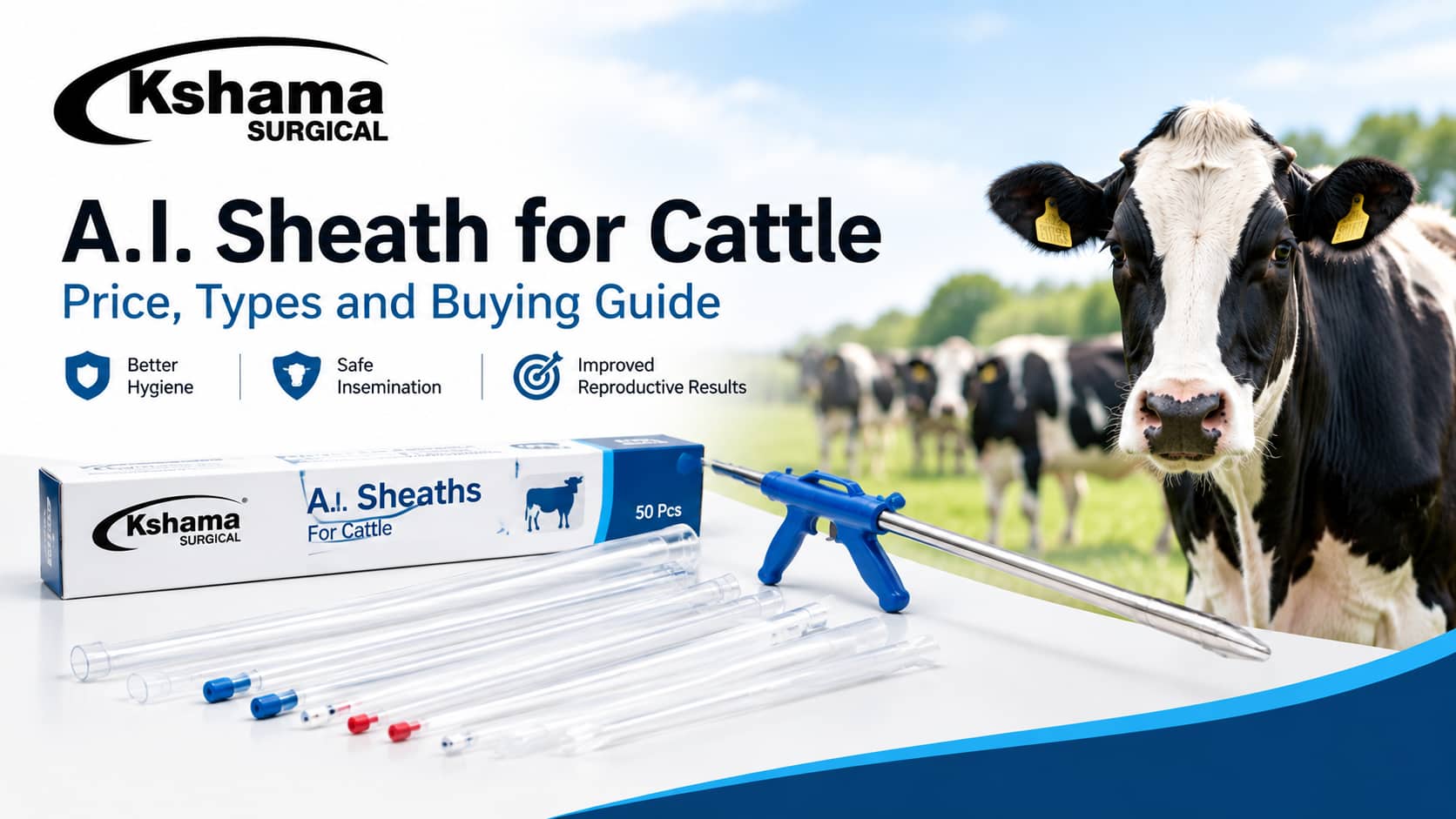
An a.i. sheath for cattle costs a fraction of the semen straw it carries, yet it decides whether that straw reaches its destination intact. A split sheath, a loose lock or a poorly moulded tip can undo everything that came before it in the breeding process. This guide explains the sheath types in common use, how they lock onto different insemination guns, what drives pricing across pack sizes, and how to judge quality before committing to a bulk purchase. It also covers storage, common handling mistakes, and the questions buyers ask most often about the a.i. sheath for cattle.
What an A.I. Sheath for Cattle Does
An a.i. sheath for cattle is a thin, single-use plastic tube that slides over a loaded insemination gun. It performs three jobs at once. It seals the thawed straw inside the barrel so semen cannot leak or contact the gun surface. It gives the instrument a clean outer surface that passes through the vulva and vagina without carrying contamination forward. And it provides the open tip through which semen is deposited when the plunger is pushed.
Because it is disposable, the a.i. sheath for cattle is the item that makes a reusable gun hygienic across many animals. One gun, one container of nitrogen and a box of sheaths can serve an entire herd without the cross-contamination risk that ended the era of reusable catheters. The wider principles of artificial insemination assume exactly this kind of sterile, single-use barrier at the point of delivery.
Types of A.I. Sheath for Cattle in Common Use
Sheaths look similar in a photograph and behave differently in the field. The variations that matter are the locking method, the delivery design and the straw size they suit.
- Universal sheaths: the most widely stocked type, designed to fit standard guns using an O-ring or auto-lock mechanism.
- French-lock sheaths: shaped to seat on mini-French guns with a positive mechanical lock at the base.
- Dual-delivery sheaths: designed with a split delivery tip that spreads semen at deposition rather than releasing it as a single stream.
- Mini and medium straw sheaths: internal diameter differs to suit 0.25 ml mini straws or 0.5 ml medium straws. Using the wrong one causes leakage.
- Standard and sanitary sheaths: sanitary versions carry an additional outer sleeve that is stripped away after the vulva is passed, reducing contamination in dirty conditions.
For most Indian dairy operations the universal and dual-delivery formats cover routine work. Sanitary sheaths earn their place where animals are housed on heavily soiled bedding or where technicians work outdoors in wet conditions.
Sheath Type Comparison
| Factor | Universal Sheath | French-Lock Sheath | Dual-Delivery Sheath | Sanitary Sheath |
| Gun compatibility | O-ring and auto-lock guns | Mini-French guns only | Standard guns, check lock type | Standard guns |
| Straw size | Mini and medium, by variant | Mini straws | Mini and medium, by variant | Mini and medium |
| Contamination control | Standard | Standard | Standard | Highest |
| Typical pack format | 50 or 100 pieces | 50 or 100 pieces | 100 pieces | 50 pieces |
| Best suited for | General field and farm use | Single-format operations | Technicians preferring spread delivery | Soiled or outdoor conditions |
Do not assume interchangeability across makes. Even where two sheaths are both described as universal, small differences in moulding can produce a loose fit on a particular gun. Always test a sample against your own instrument before ordering in volume.
Understanding A.I. Sheath for Cattle Price and Pack Sizes
Every a.i. sheath for cattle is sold by the pack, and pack size is the single biggest influence on unit cost. A 50-piece packet, a 100-piece packet and a carton of ten packets are priced very differently per piece. Anyone comparing the ai sheath 50 pcs pack price with a bulk carton will see the gap immediately. The ai sheath 50 pcs pack price suits occasional users, while cartons suit technicians working daily.
Several factors shape the a.i. sheath for cattle price in India:
- Pack quantity: the a.i. sheath price per piece falls steadily as pack size increases, which is why regular technicians buy by the carton.
- Material quality and wall thickness: a slightly thicker wall resists splitting during cervical passage but must stay flexible enough to follow the gun.
- Tip design: dual-delivery and sanitary designs cost more to mould than plain open-tip sheaths.
- Packaging and sterility handling: sealed, dust-protected packaging adds marginally to cost and considerably to shelf life in humid storage.
- Order volume and freight: bulk orders reduce both the per-unit price and the proportionate cost of delivery.
Because sheaths are a recurring expense rather than a one-time purchase, small differences compound. A farm performing frequent inseminations should calculate consumable cost across a full breeding season rather than per pack. Reviewing the a.i. sheath cost in India against your expected annual volume usually makes the correct pack size obvious.
How to Judge Sheath Quality Before Bulk Buying
- Check tip finish under good light. The opening should be cleanly cut with no burr or flash from the mould.
- Flex the tube gently. It should bend without kinking and return to shape; brittle plastic splits during passage.
- Test the lock fit on your own gun, not on a demonstration unit, and confirm there is no rotation once seated.
- Inspect packaging integrity. Loose or torn packets allow dust ingress, which introduces contamination before the sheath is even used.
- Load a straw and fire a test into a container to confirm the plunger reaches the tip fully and nothing leaks at the base.
- Order a sample pack first. A small trial order costs little and prevents committing to a carton that fits poorly.
Working with an established bovine insemination sheath supplier in India makes sample testing straightforward, since a serious bovine insemination sheath supplier in India expects buyers to verify compatibility before a bulk order. A supplier who cannot state which gun locks their sheath fits is not a reliable source.
Advantages and Disadvantages of Disposable Sheaths
Advantages
- Hygiene: a fresh barrier for every animal eliminates the cross-contamination risk inherent in reusable instruments.
- No cleaning burden: nothing to sterilise between services, which saves time in field conditions where clean water is limited.
- Low unit cost: consumable spend per insemination is small relative to the value of the straw and the service.
- Consistent performance: moulded to a fixed specification, so behaviour does not degrade with use as a cleaned instrument might.
Disadvantages
- Recurring expense: unlike a gun, sheaths must be purchased continuously, and stock-outs stop work entirely.
- Plastic waste: every insemination generates disposable waste requiring proper handling.
- Compatibility risk: a sheath that does not fit your gun precisely is useless regardless of quality.
- Storage sensitivity: prolonged heat, sunlight or damp storage degrades plastic and packaging over time.
The recurring cost is real but modest. The practical risk for most farms is not price; it is running out mid-season or discovering that a newly ordered batch does not seat correctly on an existing gun.
Storage and Handling
Store sheaths in sealed packets in a cool, dry place away from direct sunlight. Ultraviolet exposure gradually embrittles the plastic, and humidity damages packaging long before it damages the sheath itself. Keep them off the floor and away from chemicals, disinfectants and fuel, since plastic absorbs vapours.
In the field, carry sheaths in a dedicated container rather than loose in a bag. Remove one at a time, handle only the base, and fit it to the gun immediately after loading the straw. Never set a loaded gun down on the ground, and never reuse a sheath under any circumstances — not between animals, and not between two attempts on the same animal.
A practical habit among experienced technicians is to carry slightly more sheaths than expected services for the day. The marginal cost is negligible and it prevents the temptation to improvise when an insertion attempt fails.
Buying Options in India
Sheaths are sold through veterinary supply dealers, cooperative stores and direct from manufacturers. Dealers suit small, urgent purchases, while a bovine insemination sheath supplier in India working at manufacturer level suits volume, where batch consistency matters. Buyers searching for a bovine insemination sheath online India-wide will find a wide spread of listings, and a bovine insemination sheath online India search is best filtered by pack size, straw compatibility and lock type rather than headline price.
When comparing the a.i. sheath rate in India across sources, and the a.i. sheath rate in India quoted per packet against per carton, check what a listed price actually covers — a single packet, a multi-pack or a carton. A listing that appears cheaper often refers to a smaller pack. Buyers looking for a bovine insemination sheath for sale in India in institutional quantities should also ask about batch numbering and packaging, which matter for storage rotation in larger operations. Comparing the a.i. sheath price per piece is the only way to make a bovine insemination sheath for sale in India listing genuinely comparable across sellers.
Frequently Asked Questions
What is an a.i. sheath used for?
An a.i. sheath for cattle covers a loaded insemination gun to keep the semen straw sealed and the instrument surface clean during passage. It provides the delivery tip through which semen is deposited and prevents cross-contamination between animals as a single-use barrier.
Can an a.i. sheath for cattle be reused?
No. Sheaths are strictly single-use items. Reusing one risks transferring pathogens between animals, introduces residue that reduces sperm viability, and compromises the seal at the gun tip, which can cause semen leakage during deposition.
What is the a.i. sheath cost in India?
Cost depends almost entirely on pack size and sheath type rather than on brand. Fifty-piece and hundred-piece packets are priced per packet, while cartons reduce the a.i. sheath price per piece considerably, making bulk purchase the economical option for regular technicians.
Which sheath fits my insemination gun?
Match the lock type first: O-ring and auto-lock guns take universal sheaths, while mini-French guns require French-lock sheaths. Then match the internal diameter to your straw format. Always test a sample on your own gun before ordering a carton.
How many sheaths come in a standard pack?
Most packs contain 50 or 100 pieces, with cartons combining several packets for bulk buyers. Dual-delivery sheaths are commonly supplied in hundred-piece packs, while sanitary variants are more often packed in fifties.
How long can sheaths be stored?
Sealed sheaths stored cool, dry and out of sunlight remain usable for a long period. Degradation comes from ultraviolet exposure, heat and humidity rather than age alone, so storage conditions matter far more than the time since purchase.
Are dual-delivery sheaths better than standard ones?
They spread semen at the point of deposition rather than releasing a single stream, which some technicians prefer. Both types work when used correctly, and the choice usually comes down to technician preference and gun compatibility rather than a clear performance difference.
Conclusion
The a.i. sheath for cattle is the least expensive component in a breeding kit and one of the easiest to get wrong. Match the lock type to your gun, match the internal diameter to your straw format, test a sample before buying in quantity, and store packs properly once they arrive. Buy by the pack size that suits your real annual volume, since the a.i. sheath for cattle price in India falls sharply with bulk purchase while quality requirements stay exactly the same.
Before your next order, check which lock your gun uses, count the inseminations planned for the coming season, and request a sample pack to confirm fit. Explore the Kshama Surgical A.I. sheath range or contact the team for compatibility and bulk pricing guidance.
