
Anti kick bar price in India generally sits between ₹1,500 and ₹6,000 per piece for a stainless steel model. Kshama Surgical lists its SA-33 model, adjustable from 33 to 57 cm, at ₹4,250 to ₹5,000 on trade platforms. Rope hobbles cost under ₹500 but control the animal less reliably.
Those figures are a starting point, not an answer. Anti kick bar price varies more than most farm buyers expect. What you should pay depends on material, adjustment range, stopper design, and how many animals the bar has to fit. This guide breaks down the anti kick bar cost structure so you can read a quote properly.
What Determines Anti Kick Bar Price?
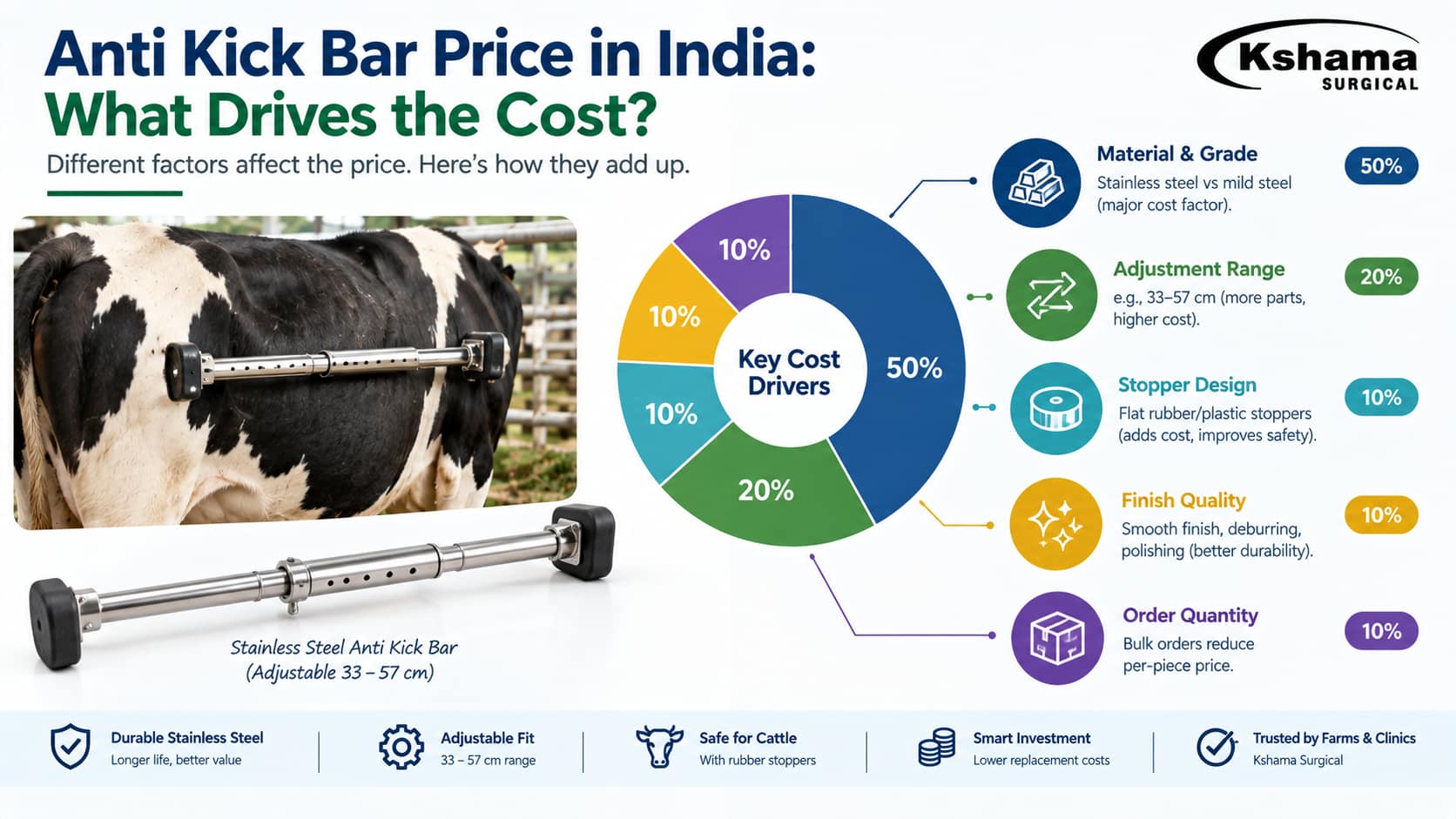
Five factors move anti kick bar price: material and grade, adjustment range, stopper design, finish quality, and order quantity. Material is the largest single driver, often accounting for more than half the anti kick bar price difference between two bars of the same shape.
A stainless steel anti kick bar costs more than a painted mild steel one because the raw material costs more and because stainless resists the urine, dung, and washdown chemicals present in every milking parlour. A cow anti kick bar in mild steel is cheaper on day one and frequently rusts through within two seasons.
Adjustment range is the second factor. A bar that spans 33 to 57 cm needs a machined telescoping section with a locking mechanism, which adds manufacturing steps. A fixed-width anti kick bar for cows skips that step and costs less, but it only fits one body size.
Stoppers matter more than buyers expect. Flat rubber or plastic pads at both ends spread load across the flank and prevent bruising. Bare metal ends are cheaper and cause injury. Any anti kick bar price that looks unusually low is worth checking against this detail first.
Finish and quantity round out the list. A properly deburred, polished bar costs more to make than a rough-cut one. Most Indian manufacturers also apply quantity breaks, and some trade listings set a minimum order of 10 pieces for the best rate.
Anti Kick Bar Price by Type
| Type | Indicative price in India | Fits | Durability | Best for |
| Rope hobble or leg rope | Under ₹500 | Any size | 1 to 2 seasons | Emergency use, very small herds |
| Mild steel fixed bar | ₹800 to ₹1,500 | One body size | 1 to 3 years | Low-budget, single-breed herds |
| Stainless steel fixed bar | ₹1,500 to ₹3,000 | One body size | 8 years or more | Uniform herds, indoor parlours |
| Stainless steel adjustable bar | ₹3,000 to ₹6,000 | 33 to 57 cm range | 8 years or more | Mixed herds, veterinary practice |
| Anti-kick chain or clamp device | ₹1,000 to ₹3,500 | Most adult cattle | 3 to 6 years | Short procedures, quick application |
| Crush-mounted anti kick device for cattle | ₹6,000 upwards | Fixed installation | 10 years or more | Large parlours, veterinary facilities |
The anti kick bar price ranges above are indicative for 2026 and vary by supplier, order quantity, and region. Treat them as a way to judge whether a quote is reasonable, not as a fixed rate card.
Why Is the Anti Kick Bar Price Higher for Stainless Steel?
Because it lasts longer in the one environment where this milking safety equipment is used. A milking parlour is wet, acidic from dung, and washed daily with alkaline detergent. Austenitic stainless in the 304 family handles that. Painted mild steel does not, and once the paint chips at the adjustment slot, corrosion starts inside the telescoping section where you cannot see it.
The economics behind the anti kick bar price favour stainless at any reasonable usage level. A ₹1,200 mild steel bar replaced every two years costs more across 8 years than a ₹4,500 stainless bar bought once, before counting the disruption of a failure mid-milking.
There is also a welfare argument. A corroded bar with rough edges causes skin damage. The World Organisation for Animal Health treats handling equipment condition as part of routine animal welfare practice, and a bar in poor condition undermines the reason you bought it.
What Anti Kick Bar Price Should a Dairy Farm Budget For?
Build the anti kick bar price into your budget from herd size and problem-animal numbers rather than total head count. Most herds have 5 to 15 percent of cows that kick during milking or treatment, usually first-lactation heifers and cows with teat lesions.
Work from milking points, not head count. A 20-animal unit typically needs 1 adjustable bar. A 50-animal unit needs 2. A 100-animal unit with two milking points needs 3 to 4, so a bar is always within reach at each point. Buying one bar for a large herd means it is never where the problem cow is.
Add a leg rope and hobbles as backup milking safety equipment regardless of herd size. They cost under ₹500 together and cover the case where the bar is in use elsewhere or a cow will not tolerate flank pressure.
For a veterinary practice, 1 adjustable bar in the vehicle is the minimum. Practitioners handling buffalo as well as crossbred cattle should confirm the upper end of the adjustment range on any anti kick bar for cows, because buffalo body width often exceeds what a bar sized for Jersey crosses will span.
How Do You Check Quality Before You Pay?
Run five checks on any sample before committing to an order, whatever the anti kick bar price quoted.
- Confirm the material in writing. Ask for the grade, not just the word stainless.
- Extend the bar to its full length and lock it. There should be no rotation at the joint.
- Inspect both stoppers. They should be flat, securely fixed, and at least 5 cm across.
- Run a bare hand along every edge. A burr you can feel will cut a wet hide.
- Weigh it. A bar under roughly 1.5 kg is usually thin-walled tube that will bend under a determined cow.
Ask about certification before you judge an anti kick bar price as high or low. Kshama Surgical manufactures the SA-33 at an ISO 9001:2015 and CE certified unit in Idar, Gujarat, and has supplied veterinary and dairy equipment since 2008 across India and 10 export markets. Certification does not guarantee a good bar, but it confirms a documented manufacturing process exists behind the quote.
When You Should Not Buy an Anti Kick Bar
There are three situations where an anti kick device for cattle is the wrong purchase, and a supplier who says otherwise is selling rather than advising.
If a cow has started kicking recently and did not before, the problem is usually pain rather than temperament. Mastitis, a teat lesion, or a hock injury will make any cow kick, and no cow anti kick bar changes that. Restraining her treats the symptom and delays the diagnosis. The anti kick bar price is irrelevant if the cause is clinical. Check the udder and the teat first, and stock the veterinary teat instruments needed to deal with what you find.
If your parlour routine is rushed or the handling is rough, a bar will not fix the underlying issue. Herds with poor let-down and high kick rates often improve with a consistent pre-milking routine and calmer handling. Equipment cannot substitute for that.
If you have 2 or fewer problem animals and a working crush, hobbles at under ₹500 may be enough milking safety equipment. Spend the difference on hoof trimming or udder health instead, which will pay back faster.
Hidden Costs Behind the Anti Kick Bar Price
The quoted anti kick bar price is rarely the delivered cost. Freight on a 2 kg steel item shipped across states can add several hundred rupees to any anti kick bar in India. GST treatment varies by whether the item is classified as a veterinary instrument. Replacement stoppers are consumable and are not always available separately.
Ask five questions before ordering any anti kick device for cattle: what steel grade is used, what is the exact adjustment range in centimetres, are replacement stoppers sold separately, what is the minimum order quantity for the quoted rate, and is freight included. The answers usually separate manufacturers from resellers faster than the price does.
One more practical point. Buying a bar alongside other equipment on the same order usually reduces per-unit freight noticeably. If you are already ordering from the veterinary general instruments range or replacing veterinary surgical instruments, consolidating the order is worth 10 minutes of planning.
For broader context on dairy handling practice and herd management in India, the National Dairy Development Board publishes guidance worth reading alongside any equipment decision, and the Department of Animal Husbandry and Dairying sets out current sector programmes.
Getting an Accurate Anti Kick Bar Price for Your Herd
A useful quote needs three inputs: herd size, breed mix, and the number of milking points. Send those to the Kshama Surgical team and ask for a delivered price including freight, rather than a per-piece rate. That single change makes quotes comparable across suppliers.
Frequently Asked Questions
What is the typical anti kick bar price in India?
A stainless steel anti kick bar in India generally ranges from ₹1,500 to ₹6,000 depending on adjustment range and build. Kshama Surgical lists its SA-33 adjustable bar at ₹4,250 to ₹5,000 on trade platforms. Rope hobbles cost under ₹500.
Is a stainless steel anti kick bar worth the extra cost?
Usually yes, despite the higher anti kick bar price. A mild steel bar replaced every two years costs more across 8 years than a stainless bar bought once. Stainless also resists the daily washdown chemicals and dung exposure that corrode painted steel from inside the joint.
What adjustment range should a cow anti kick bar have?
A 33 to 57 cm range fits most crossbred and indigenous Indian dairy cattle, which is why that span is standard on an anti kick bar in India. Buffalo often need the upper end of that span. Fixed-width bars cost less but only suit uniform herds, so confirm your breed mix before choosing.
How many bars does a dairy farm need?
Multiply the anti kick bar price by milking points rather than head count. A 20-animal unit usually needs 1 bar, a 50-animal unit 2, and a 100-animal unit with two milking points 3 to 4. Keep leg ropes as backup.
Does an anti kick bar for cows hurt the animal?
Not when correctly fitted. Flat rubber or plastic stoppers at both ends spread pressure across the flank. Injuries come from bare metal ends, corroded edges, or leaving a bar applied longer than the procedure requires.
Can an anti kick bar replace a crush or travis?
No. An anti kick device for cattle prevents kicking during milking and short procedures. It does not immobilise the animal or protect the handler during surgery, hoof work, or rectal examination, all of which need proper restraint infrastructure.
Why has a cow suddenly started kicking during milking?
No anti kick bar price is worth paying until this is ruled out. Sudden kicking usually signals pain rather than temperament: mastitis, a teat lesion, or a hock or hoof injury. Examine the udder and feet before restraining her, since a bar hides the symptom and delays treatment.
