
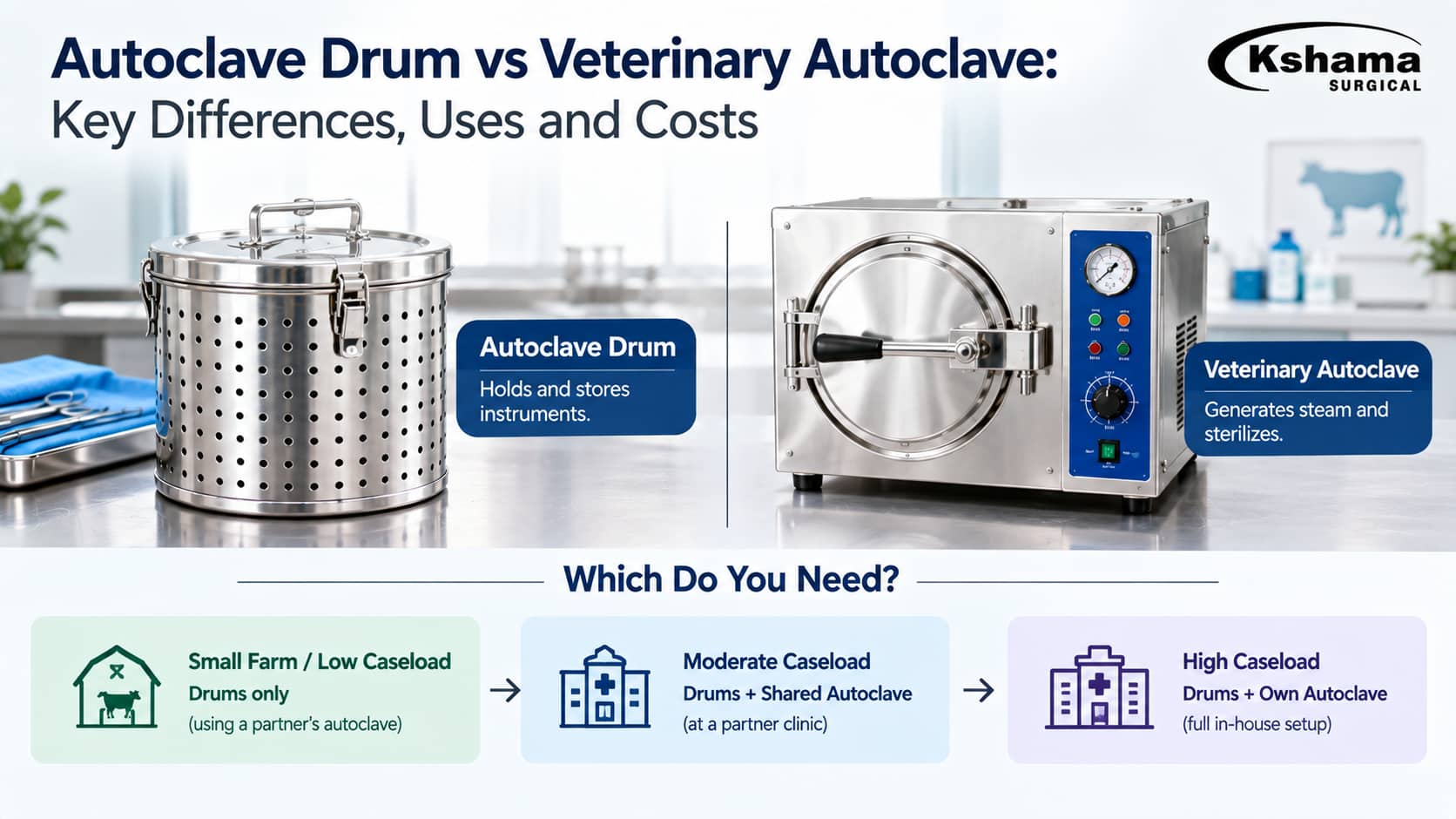
Autoclave drum vs veterinary autoclave is not an either-or choice. A veterinary autoclave is the machine that generates saturated steam at 121°C and 15 psi. An autoclave drum is the perforated stainless container that holds instruments inside it. A clinic performing surgery needs both. A farm or a first-aid setup may only need drums and access to someone else’s autoclave.
That distinction is the whole of the autoclave drum vs veterinary autoclave question, and it gets confused often enough to cause real problems. This comparison covers cost, capacity, and suitability, using the current autoclave drum and autoclave ranges as reference points.
Autoclave Drum vs Veterinary Autoclave: What Is the Difference?
A veterinary autoclave is a pressure vessel with a heating element, gauge, safety valve, and timer. It raises water to steam, holds the chamber at a set temperature and pressure, then releases. The sterilizing work happens here.
An autoclave drum, also called a dressing drum, is a cylindrical stainless steel autoclave drum with side vents that open during the cycle and close afterwards. It lets steam reach the contents, then seals them so the load stays sterile in storage. It has no heating element and sterilizes nothing on its own.
Put simply, in the autoclave drum vs veterinary autoclave pairing, the drum is packaging and the autoclave is the process. Anyone comparing the two as alternatives has usually been sold the drum as a sterilizing device, which it is not. The Wikipedia entry on autoclaves covers the underlying physics, and moist heat sterilization explains why saturated steam kills spores that dry heat at the same temperature does not.
Comparison Table: Autoclave Drum vs Veterinary Autoclave
| Factor | Autoclave drum | Veterinary autoclave |
| Function | Holds and stores instruments during and after a cycle | Generates saturated steam and holds the sterilizing cycle |
| Sterilizes on its own | No | Yes |
| Typical price in India | Autoclave drum price ₹1,200 to ₹3,000 | Veterinary autoclave price in India ₹12,000 to ₹37,500 |
| Common sizes | 6 x 6, 9 x 9, 11 x 9 and 15 x 12 inch | 12 x 12 inch, around 18 litre chamber |
| Buying signal | Autoclave drum price stays flat across sizes | Veterinary autoclave price in India scales with chamber volume |
| Material | Stainless steel, perforated with sliding vent band | Stainless steel chamber, pressure rated |
| Power needed | None | Electric, single phase for benchtop models |
| Consumables | None | Water, indicator strips, gaskets |
| Service life | 10 years or more with care | 7 to 10 years with gasket and valve servicing |
| Fails when | Vents left open, dents break the seal | Gasket perished, valve blocked, timer drift |
| Right for | Every clinic, plus farms with external sterilizing access | Any practice running its own surgery |
Autoclave Drum vs Veterinary Autoclave: Which Does Your Clinic Need?
Answer three questions before buying clinic sterilization equipment: do you perform surgery on site, how many packs do you process weekly, and do you have reliable single-phase power?
If you run any surgical caseload, the autoclave drum vs veterinary autoclave question answers itself: you need the machine. Boiling, pressure cookers, and chemical soaks do not reliably kill bacterial spores. Steam sterilization for veterinary clinics is the only method with a verifiable hold at temperature.
If you process fewer than 3 packs a week and a partner clinic 20 minutes away will run your loads, drums alone work as an interim arrangement. Buy 4 so two are always sealed. Revisit once weekly volume passes 5 packs.
If power is unreliable, size up rather than down. An 18 litre chamber allows one load a day at a predictable hour instead of three short cycles whenever power allows. Interrupted cycles are the most common cause of failed sterilization in field clinics.
How Many Drums Per Autoclave?
Plan 3 to 4 drums per pack type. One sits in the chamber, one is sealed on the shelf, and one is being repacked. Clinics with a single drum break sterility to retrieve an instrument mid-list.
Mixed sizes work better than a matched set. A 6 x 6 inch stainless steel autoclave drum suits a small suture pack, while 11 x 9 inch takes a full bovine laparotomy set. Filling a large drum with three instruments slows steam penetration.
How Do You Run a Cycle Correctly?
The autoclave drum vs veterinary autoclave relationship only works if both are used correctly, and the sequence below is where most clinics lose sterility.
- Clean and dry instruments within 20 minutes of use, using a neutral pH enzymatic cleaner.
- Pack loosely. A drum filled beyond 75 percent blocks steam from reaching the centre.
- Slide the drum vents open before loading. This is the step most often missed.
- Run 121°C at 15 psi for 15 to 20 minutes for wrapped loads, or 134°C for 3 to 4 minutes on a pre-vacuum machine.
- Close the vents as soon as the drum comes out, while it is still hot.
- Label the drum with the date and contents.
- Reprocess unopened drums after 21 days, since the seal degrades either way.
Steam sterilization for veterinary clinics is only as good as its monitoring. Use a chemical indicator strip in every load and a biological indicator monthly. A strip on the outside only proves the drum saw steam. One in the centre of the pack tells you the steam reached the instruments. Dressing drum sterilization is only verified when that inner strip changes.
Autoclave Drum vs Veterinary Autoclave: Where Each Falls Short
An autoclave drum fails quietly. A dented rim or a vent band that no longer closes fully lets room air back in as the drum cools, and nothing on the outside tells you. Inspect the rim and run the vent band through its full travel monthly.
A veterinary autoclave fails more visibly and more expensively. Gaskets perish after roughly 500 to 800 cycles, and hard water scales the element and blocks the safety valve. Distilled or RO water roughly doubles gasket life.
Neither option handles heat-sensitive items. Plastic AI sheaths, rubber teat liners, and electronic probes need chemical disinfection or single-use replacement. A steam cycle destroys them and contaminates the chamber.
When You Should Not Buy a Veterinary Autoclave
Three situations settle autoclave drum vs veterinary autoclave in favour of drums alone, at least for now.
If you run a farm rather than a clinic, the capital is better spent elsewhere. A 50-animal dairy unit gains more from hoof trimming equipment and milking hygiene than from a chamber that runs twice a month. Buy 4 drums and use your vet’s autoclave.
For clinic sterilization equipment in a mobile practice with no fixed base, a benchtop unit living in a vehicle will not survive the vibration or hold a stable cycle. Arrange access at a fixed site and carry sealed drums instead.
If your surgical caseload is under 2 procedures a month, run the numbers before committing. A ₹23,800 machine at that volume costs roughly ₹1,000 per sterilized pack in the first year. Sharing a partner clinic’s autoclave is not a compromise on sterility. It is a sensible use of capital until volume justifies the purchase. This is the practical answer to autoclave drum vs veterinary autoclave at low caseload.
Buying Guidance and Specifications to Check
Specification checks differ on each side of the autoclave drum vs veterinary autoclave decision. For a stainless steel autoclave drum, check material grade, vent mechanism, and rim flatness. Austenitic stainless in the 304 family resists corrosion better than chrome-plated alternatives. The vent band should move with one hand and stop firmly at both ends. A rim that does not sit flat will not seal.
For the machine, check chamber volume in litres rather than inch dimensions, confirm the pressure gauge and safety valve are separately serviceable, and ask whether gaskets are stocked locally. A gasket that takes 6 weeks to source means 6 weeks out of service.
Kshama Surgical manufactures both drums and autoclaves at an ISO 9001:2015 and CE certified unit in Idar, Gujarat, and supplies 10 export markets alongside clinics across India. Both sides of autoclave drum vs veterinary autoclave sit in the same clinic sterilization equipment line, with drums listed under veterinary general instruments alongside the veterinary surgical instruments they are usually bought to protect.
If you are still weighing autoclave drum vs veterinary autoclave for your own setup, send the Kshama Surgical team your weekly pack count and surgical caseload. A specification built on real volume beats a catalogue comparison.
Frequently Asked Questions
Can an autoclave drum sterilize instruments on its own?
No. The autoclave drum vs veterinary autoclave distinction matters here: a drum is a perforated stainless container that holds instruments during a steam cycle and seals them afterwards. It has no heat source. Sterilization happens inside the autoclave chamber at 121°C and 15 psi.
What does an autoclave drum cost in India?
On the cost side of autoclave drum vs veterinary autoclave, the autoclave drum price in India typically runs ₹1,200 to ₹3,000 depending on size, with 6 x 6, 9 x 9, 11 x 9 and 15 x 12 inch options in common use. Kshama Surgical lists these sizes within its veterinary general instruments range.
What is the price range for a veterinary autoclave?
Veterinary autoclave price in India commonly sits between ₹12,000 and ₹37,500, with a 12 x 12 inch, roughly 18 litre stainless model mid-band. That gap is the main budget question in autoclave drum vs veterinary autoclave planning.
How long do sterilized drums stay sterile?
Storage life depends on the drum, not the machine, so autoclave drum vs veterinary autoclave matters here. Treat 21 days as the working limit for dressing drum sterilization when the drum is sealed, unopened and stored dry. Reprocess after that, because the vent seal and wrap degrade with humidity.
Can a pressure cooker replace a veterinary autoclave?
No. A cooker sits outside the autoclave drum vs veterinary autoclave comparison entirely. Steam sterilization for veterinary clinics needs a calibrated gauge, a timer, and a validated hold at temperature, none of which a domestic cooker provides. They also fail to displace air reliably, which leaves cold spots where spores survive.
How many drums should a small clinic keep?
Plan 3 to 4 per pack type: one in the chamber, one sealed and ready, one being repacked. Mixed sizes beat matched sets, since a small suture pack wastes space in a large drum.
Do drums and autoclaves need different maintenance?
Yes, and maintenance is where autoclave drum vs veterinary autoclave differs most. Dressing drum sterilization hardware needs monthly rim and vent-band inspection only. Autoclaves need gasket replacement every 500 to 800 cycles, safety valve checks, descaling, and distilled or RO water to slow scale build-up on the element.
