
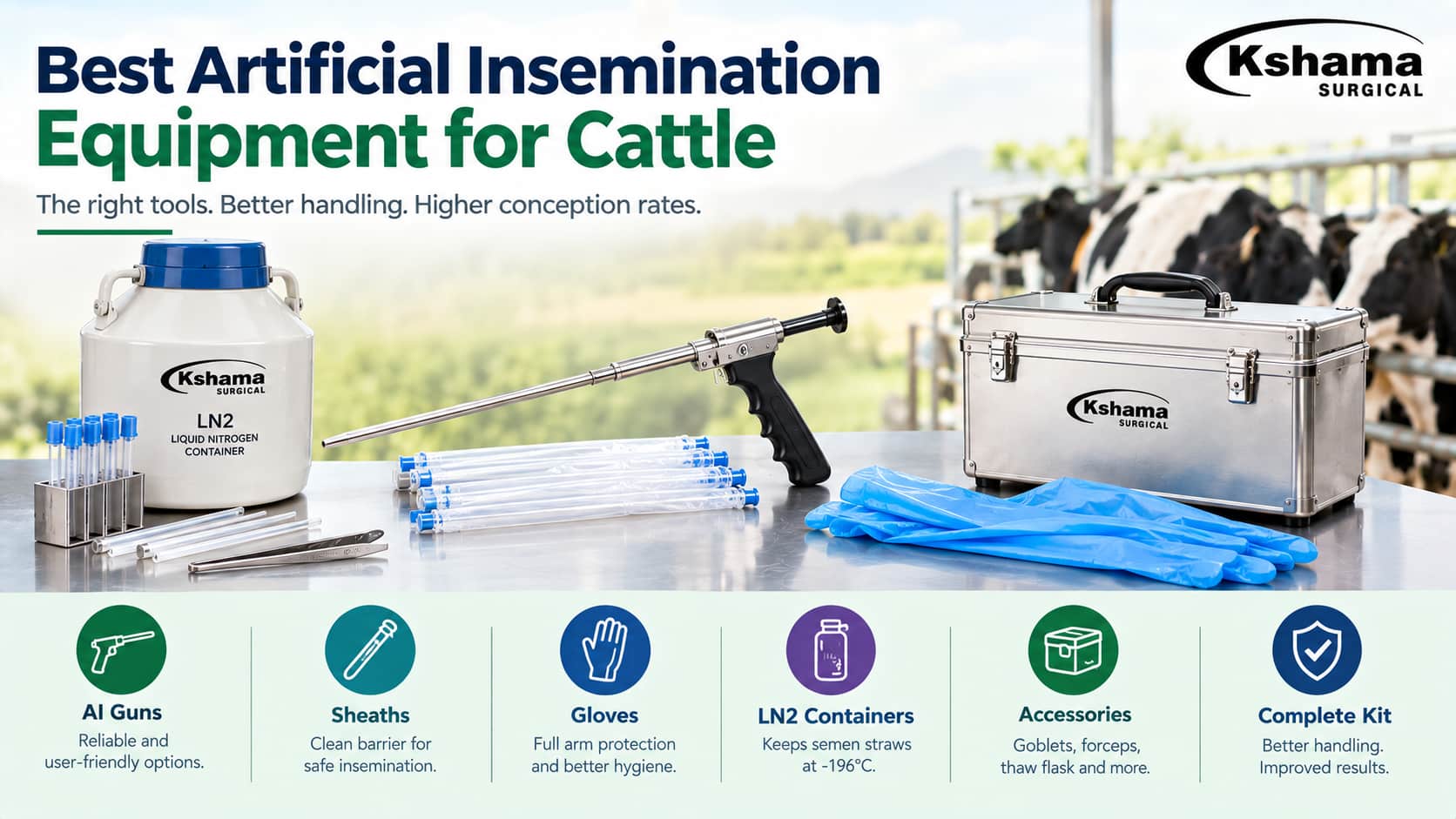
Choosing the right artificial insemination equipment for cattle decides how much of your breeding effort actually converts into confirmed pregnancies. A gun that loses grip on the straw, a sheath that splits during passage, or a nitrogen container that runs dry between refills will quietly reduce conception rates long before anyone notices a pattern in the records. This guide explains what each item in a working kit does, how the components interact, what to check before you buy, and where budget decisions genuinely matter. You will also find a comparison of common gun types, practical selection criteria, and answers to the questions buyers ask most often about artificial insemination equipment for cattle.
Why Artificial Insemination Equipment for Cattle Affects Conception Rates
Artificial insemination is a sequence of small technical steps, and each one depends on a tool performing predictably. Semen straws are stored at approximately -196°C in liquid nitrogen, thawed under controlled conditions, loaded into an insemination gun, and deposited in the uterine body. Damage at any stage — thermal shock during thawing, contamination during loading, or trauma during passage through the cervix — reduces the number of viable sperm reaching the site of fertilisation.
This is why equipment is not a place to economise carelessly. The cost of a straw, a technician’s visit and an extra non-productive day for the animal usually exceeds the price difference between adequate and poor instruments. Reliable artificial insemination equipment for cattle protects the value of the genetics you have already paid for. The technical background of artificial insemination is well documented, and most field failures trace back to handling and hardware rather than to the semen itself.
What a Complete Cattle A.I. Kit Contains
A working set of artificial insemination equipment for cattle is more than a gun. Most field technicians and organised dairy units carry the following:
- Insemination gun: the reusable stainless steel instrument that holds the straw and delivers semen. Variants include universal, mini-French, O-ring and auto-lock designs.
- Disposable sheaths: single-use plastic sleeves that cover the loaded gun and prevent cross-contamination between animals.
- Long-arm gloves: shoulder-length disposable gloves used for rectal palpation and cervical fixation.
- Liquid nitrogen container: vacuum-insulated storage for semen straws, available in a range of capacities and static holding times.
- Goblets, canisters and forceps: for organised straw storage and safe retrieval without warming the rest of the inventory.
- Thaw flask and thermometer: for controlled water-bath thawing at the recommended temperature.
- Carry bag and gun containers: to keep instruments clean and protected between farms.
Buyers assembling their first set often find a pre-packed kit simpler than sourcing components separately, which is one reason many choose to buy artificial insemination equipment online India-wide rather than through scattered local dealers. When you buy artificial insemination equipment online India-wide, a complete kit also avoids the common problem of mismatched gun and sheath sizes.
Matching Guns, Sheaths and Straws
Compatibility is the single most common source of frustration. Straws come in two dominant formats: the 0.25 ml mini straw and the 0.5 ml medium or French straw. Guns are built to suit one or both, and sheaths must match the gun’s outer diameter and locking mechanism.
Mini-French guns accept only mini straws. Universal guns accept both formats but require the correct sheath type. O-ring guns rely on a rubber ring to seat the sheath; auto-lock guns use a mechanical catch that secures the sheath without a separate ring. If your semen supply is standardised on mini straws, buying a universal gun adds flexibility you may never use. If you draw straws from multiple sources, that flexibility is worth paying for.
Comparison of Common A.I. Gun Types
| Factor | Universal / Auto-Lock Gun | Mini-French Gun | O-Ring Gun | Digital Camera Gun |
| Straw compatibility | Mini and medium straws | Mini straws only | Mini and medium, ring dependent | Mini and medium straws |
| Sheath locking | Mechanical catch | French lock | Rubber O-ring | Mechanical, waterproof body |
| Consumable wear parts | Minimal | Minimal | O-ring needs periodic replacement | Minimal |
| Typical user | Mixed-source technicians | Single-format users | Cost-conscious field use | Training, difficult cases, research |
| Relative cost | Moderate | Moderate | Lowest | Highest |
A digital or endoscopic gun with a camera is a specialised tool rather than a daily instrument, earning its place in training, research and repeat-breeder cases. For routine work, a well-made stainless steel gun remains the standard choice.
Understanding the Artificial Insemination Equipment for Cattle Price in India
Pricing questions dominate buyer research, and the honest answer is that the range is wide because the category is wide. A single O-ring gun, a pack of 100 sheaths and a box of gloves sit in one price band; a nitrogen container with a long static holding time sits in another entirely. When you review an artificial insemination equipment price list, read it as a list of independent decisions rather than a single total.
A published artificial insemination equipment price list rarely explains these gaps, so it helps to know what drives them. Several factors move the artificial insemination equipment for cattle price in India up or down:
- Material grade: surgical-grade stainless steel resists corrosion and repeated disinfection far better than plated alternatives.
- Manufacturing finish: a smooth, burr-free gun tip reduces the risk of mucosal trauma and makes cervical passage easier.
- Container specification: static holding time, neck diameter and canister count drive most of the cost of nitrogen storage.
- Pack size: consumables such as sheaths and gloves are priced per pack, so the artificial insemination equipment wholesale price per unit falls sharply at higher volumes.
- Brand and support: the best artificial insemination equipment brand in India for one buyer may not suit another, so judge on material grade and spares rather than name alone.
- After-sales support: availability of spares, replacement O-rings and canisters matters more over five years than the initial invoice.
For most buyers, the reusable parts of artificial insemination equipment for cattle justify spending slightly above the cheapest option, while consumables are where bulk purchasing delivers genuine savings. Comparing cattle insemination equipment price across pack sizes usually shows that larger sheath or glove packs cost far less per insemination.
Advantages and Disadvantages of Investing in a Full Kit
Advantages
- Independence: owning equipment lets a farm inseminate at the correct point in oestrus rather than waiting for a technician’s schedule.
- Hygiene control: you decide how instruments are cleaned, stored and replaced.
- Lower cost per service over time on herds performing regular inseminations.
- Genetic access: proper nitrogen storage lets a farm hold straws from selected sires rather than using whatever is locally available.
Disadvantages
- Skill dependency: equipment does not compensate for poor heat detection or incorrect semen placement. Training is essential.
- Ongoing running cost: liquid nitrogen must be topped up on a schedule, and missed refills can destroy an entire straw inventory.
- Maintenance discipline: guns need cleaning and drying after every use; neglected instruments corrode and fail.
- Upfront capital: a container is a significant purchase for a small herd, and custom or shared storage may be more economical below a certain animal count.
Smaller units often start with a gun, sheaths and gloves while sourcing straws from a nearby storage point, then invest in their own container once insemination volume justifies it.
Key Factors to Consider Before Buying
- Verify straw format first. Confirm whether your semen source supplies 0.25 ml or 0.5 ml straws before selecting a gun, because this determines sheath purchases for years.
- Check sheath fit physically. Sheaths from different moulds vary slightly; a loose fit causes semen leakage at the tip.
- Assess container static holding time honestly. A container rated for long holding assumes an undisturbed unit. Frequent opening in field conditions consumes nitrogen much faster.
- Buy gloves by arm length, not by generic size. Shoulder-length gloves of 34 to 36 inches suit most operators; shorter gloves leave the forearm exposed during palpation.
- Avoid mixing cleaning chemicals. Residual disinfectant inside a gun barrel is spermicidal, so rinsing and drying protocol matters as much as the instrument.
- Confirm spare part availability. A gun whose O-ring or plunger cannot be replaced becomes disposable at the first failure.
Established artificial insemination equipment suppliers in India answer format and compatibility questions directly, and the better artificial insemination equipment suppliers in India also state material grade and pack contents clearly. Reviewing the record of an artificial insemination equipment for cattle manufacturer in India is a reasonable step before placing a first bulk order, particularly when comparing artificial insemination equipment wholesale price quotations.
Care, Cleaning and Storage
Guns should be wiped clean, rinsed with warm water, dried fully and stored in a protective container. Never store a gun with a used sheath attached. Nitrogen containers should be kept off bare concrete on a wooden or plastic base, checked for frost patches on the outer shell, and refilled well before the level reaches the canister base. Sheaths and gloves need dry, dust-free storage away from direct sunlight, as plastic degrades with prolonged UV exposure.
A simple logbook recording refill dates, straw usage and gun cleaning takes minutes per week and prevents the quiet failures that damage conception rates. Keep spare sheaths and gloves in stock as well, since farms that buy artificial insemination equipment online India-wide can usually restock consumables faster than reusable instruments.
Frequently Asked Questions
What equipment is needed for artificial insemination in cattle?
A complete set includes an insemination gun, disposable sheaths, shoulder-length gloves, a liquid nitrogen container with goblets and canisters, straw forceps, a thaw flask with thermometer, and a carry bag. Reusable instruments are stainless steel; sheaths and gloves are single-use consumables replaced after every animal.
What is the artificial insemination equipment for cattle price in India?
Cost varies by component rather than by set. Guns and containers are one-time capital purchases, while sheaths and gloves are recurring consumables priced per pack. Read any artificial insemination equipment price list by component, since bulk pack sizes sharply reduce the per-insemination cost of consumables.
Can I reuse an A.I. sheath?
No. Sheaths are single-use items designed to prevent cross-contamination between animals and to keep the gun barrel clean. Reuse risks transferring pathogens, introducing residue that harms sperm viability, and compromising the seal at the gun tip during semen deposition.
How long does semen stay viable in a nitrogen container?
Frozen semen remains viable indefinitely while fully submerged in liquid nitrogen at -196°C. Viability is lost when the nitrogen level drops below the straws or when straws are repeatedly raised into the neck of the container during retrieval, causing partial thawing.
Which gun type is best for a first-time buyer?
An auto-lock stainless steel universal gun suits most first-time buyers because it accepts both mini and medium straws and has no rubber wear part to replace. Buyers standardised on mini straws from a single source can choose a mini-French gun at similar cost.
Do I need training to use this equipment?
Yes. Equipment quality cannot compensate for poor heat detection, incorrect thawing or wrong semen placement. Most state animal husbandry departments and dairy cooperatives run structured A.I. technician courses covering reproductive anatomy, timing and hygiene alongside instrument handling.
Is it cheaper to own equipment or hire a technician?
Ownership becomes economical once insemination volume is high enough to spread the container cost across many services. Small herds often use a shared storage point initially, buying only a gun, sheaths and gloves.
Conclusion
Good breeding results come from matching the right tools to the right protocol and then maintaining both. Select a gun that matches your straw format, buy sheaths that fit that gun precisely, size your nitrogen container for realistic refill intervals rather than best-case figures, and treat gloves and sheaths as consumables to be replaced without hesitation. Assessed this way, artificial insemination equipment for cattle is a modest investment protecting a much larger investment in genetics, feed and labour.
If you are assembling or upgrading a set of artificial insemination equipment for cattle, list the straw formats you use, your monthly insemination volume and your nitrogen refill access before comparing products. Explore the complete Kshama Surgical A.I. equipment range or contact the team for compatibility guidance based on your herd size and breeding schedule.
