
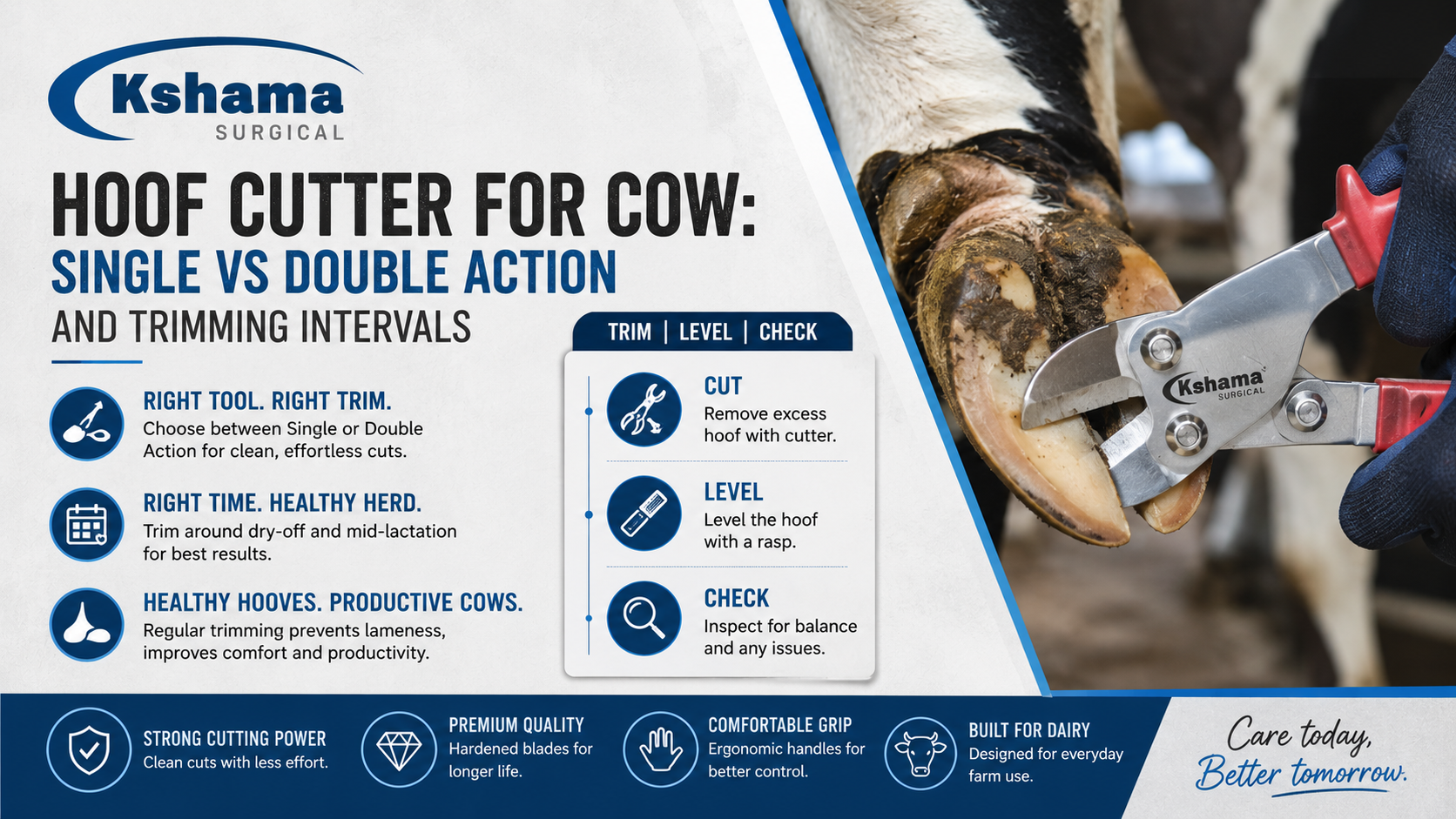
A single action hoof cutter for cows gives you speed and control on routine overgrowth; a double action model roughly doubles the cutting force at the blade, which is what you want on a hard, neglected claw or a heavy bull. Most dairy herds need trimming roughly twice a year, timed around dry-off and mid-lactation. The tool matters less than the interval, and the interval is what almost every herd gets wrong.
Lameness is the third big cost in a dairy after mastitis and fertility, and unlike the other two it is largely preventable with a routine. A lame cow eats less, lies down more, comes into heat later and gets served late. None of that appears in the accounts as a hoof cost. It shows up as low yield and a long calving interval, and the feet are the last thing anyone checks.
The choice between a single and a double action hoof cutter matters less than most buyers assume; blade hardness matters far more. What follows covers what the tool does and where it stops, how the two actions differ under a real claw, how often a hoof cutter for cows should come out on housed and grazing herds, why cheap blades burr inside an afternoon, and the cutter-rasp-check sequence that leaves a level bearing surface.
What a Hoof Cutter for Cows Actually Does
A hoof cutter for cows removes bulk horn from the wall and toe with a scissor or plier action, bringing an overgrown claw back towards its correct length. It does not shape, does not level, and will not give you a flat weight-bearing surface on its own.
That is the part people miss when they buy one tool and expect a finished job. A hoof cutter for cows takes the claw down to roughly the right length; a hoof rasp or a knife then flattens and balances the sole. Cutting alone leaves ridges and an uneven bearing surface, which shifts weight onto the wrong part of the claw and creates the lameness you were trying to prevent.
Where the tool sits among cattle hoof trimming tools
Cattle hoof trimming tools divide by job, not by preference: cutters for bulk, a rasp for levelling, a knife for sole work and lesion exploration, and a searcher for finding the painful spot. Buy cattle hoof trimming tools as a set rather than one at a time. A hoof cutter for cows is first in that sequence and does the heaviest work.
Bulk off with the cutter, level with the rasp, and only then look at the sole.
Single vs Double Action: Which Hoof Cutter for Cows Suits You
Single action means one pivot and one moving blade against a fixed jaw. Double action adds a second linkage, so the same squeeze produces substantially more force at the edge. On an adult cow with hard, dry, overgrown horn in April, that difference decides whether you cut cleanly or crush and tear.
| Feature | Single action | Double action |
| Cutting force at the blade | Lower | Substantially higher |
| Best for | Routine trims, softer horn, calves | Hard horn, bulls, neglected claws |
| Control on fine work | Better | Slightly reduced |
| Operator fatigue over a herd | Higher on hard horn | Lower |
| Typical handle length | Shorter | Longer |
If you trim twenty animals a season on soft, regularly maintained feet, a single action hoof cutter for cows is honestly enough, and it is lighter and easier to work in a confined crush. If you are trimming a hundred animals, or dealing with feet that have not been touched in two years, the double action pattern will save your hands and give cleaner cuts by the fortieth animal, when a tired operator starts making bad ones.
Size and the calves question
Handle length multiplies force, and a long-handled hoof cutter for cows is unusable on a calf in a small pen. A small hoof trimmer suits young stock, goats and sheep, where horn is thinner and space is tight. Most mixed operations own both sizes.
How Often Should You Use a Hoof Cutter on a Cow?
Twice a year is the general standard for a housed dairy cow, once at drying off and once around mid-lactation, with any lame animal trimmed as soon as she is spotted rather than at the next scheduled round. Grazing herds on abrasive ground often need less, since walking wears the claw. Cows on soft bedding, wet concrete or deep slurry need more, sometimes three times a year.
Housing drives the interval more than breed. Concrete that stays wet for months softens horn, growth outpaces wear, and the claw overgrows steadily. A cow on hard dry ground in a Rajasthan village may barely need a hoof cutter for cows in a year. Move her into a wet shed and she needs one twice.
Signs the interval is too long
Watch for an overlong toe, a claw turning up at the front, uneven claw sizes on the same foot, and any change in gait. If you reach for a hoof cutter for cows and find the horn has grown past what a single trim can correct, your interval was too long by at least one cycle.
Lame animals are a separate matter. Causes range from white line disease to sole ulcers to digital dermatitis, and correcting a lame foot is a clinical procedure that should be carried out by or under the supervision of a qualified veterinarian, who decides on any analgesia, antibiotic or blocking required.
Two trims a year for housed dairy cows; more on wet concrete, less on abrasive ground.
Blade Steel, Hardness and Why Cheap Cutters Burr
Blade hardness determines how long the edge survives cow horn, which is abrasive and unforgiving. This is where the difference between a cheap and a good hoof cutter for cows lives, and it is invisible at the point of purchase. Two tools identical in finish can differ by a season of working life.
A soft blade cuts beautifully for the first ten or fifteen feet, then rolls a burr along the edge. Once that burr forms the tool stops slicing and starts crushing, and crushed horn tears rather than parting cleanly. I have watched a cheap pair develop a visible burr inside one afternoon of twenty hard-footed animals, while a properly hardened pair in the next crush went through the season.
What to look at
Check whether the blade is a hardened insert or the same steel as the body. Check the pivot for play, because a loosened pivot lets the blades pass each other rather than meet, and no amount of sharpening fixes misalignment. A hoof cutter for cows that flexes visibly under load is telling you where it will fail.
Both hoof trimmers and cutters live or die on this. Good hoof trimmers hold an edge and stay in alignment through a season of hard use, which is exactly what separates instruments finished properly from those finished in a hurry.
The Trimming Sequence: Cutter, Rasp, Check
Use the hoof cutter for cows in this order every time: restrain and lift the foot, clean it, assess both claws, cut the inner claw to length, match the outer to it, level both with a hoof rasp, then check the bearing surface by hand and eye before setting the foot down.
Length is the reference point everyone needs and few use. For an adult dairy cow, a dorsal wall length commonly quoted at around 7.5 cm from the coronary band is the working target, adjusted down for smaller and indigenous breeds. Cut to length first, then balance, then dish the sole slightly between the claws. A hoof cutter for cows sets the length; the rest is finishing work. Finishing with the cutter is how operators take too much sole off a flat claw.
Why the rasp is not optional
A hoof rasp levels what the hoof cutter for cows has left ridged and takes the last two or three millimetres you would not risk with a blade. Skipping it is the commonest shortcut in field trimming and leaves a surface that concentrates load. Keep the rasp dry, since a rusted hoof rasp glazes over and stops cutting.
Take small bites rather than one confident squeeze, because a hoof cutter for cows cannot give horn back. Do not cut into the corium. If you reach pink, soft or bleeding tissue, stop, and treat it as a veterinary matter rather than something to trim your way out of.
Buying and Maintaining a Hoof Cutter for Cows
Buy on blade hardness, pivot quality and handle construction, in that order, and treat finish as the last consideration. A hoof cutter for cows that arrives sharp and stays aligned for five seasons costs less per animal than two cheap pairs.
Maintenance of a hoof cutter for cows in Indian conditions comes down to moisture. Wash off manure and horn dust immediately, dry the tool, and put a light film of oil on the pivot and blades before storage, because monsoon humidity finds any bare steel left in a shed. Hoof trimmers stored wet in a closed box come out pitted, and pitting on an edge never fully sharpens out.
Kshama Surgical makes hoof cutters and rasps within its veterinary general instruments range, and the construction questions behind smart surgical instruments for veterinary medicine apply to a hoof cutter for cows too: what is the steel, how is the joint made, what does it look like after two years.
Frequently Asked Questions
Do I need a double action hoof cutter for cows or is single enough?
Single action suits routine trims, softer horn and calves. Double action earns its cost on hard, overgrown claws, on bulls, and when fatigue across a long round starts affecting your cuts.
Can I trim a cow’s hooves without a rasp?
Not properly. A hoof cutter for cows removes bulk but leaves ridges. A rasp levels the bearing surface, and skipping it concentrates weight on the wrong part of the claw.
What is the correct toe length for a dairy cow?
Around 7.5 cm along the dorsal wall from the coronary band is the commonly used working target for an adult dairy cow, adjusted downward for smaller and indigenous breeds.
How do I sharpen a hoof cutter for cows?
Follow the existing bevel with a fine stone or file from the outer face, and check the blades still meet cleanly. Tighten a loose pivot before sharpening.
When should the vet be involved instead?
Whenever the cow is lame, whenever you find a lesion, ulcer or bleeding, and whenever trimming reaches sensitive tissue. Those need clinical judgement, not more trimming.
How should hoof trimming tools be stored in the monsoon?
Clean, dry, lightly oiled, and ventilated rather than sealed in a box. Trapped moisture pits blades and stiffens pivots within one wet season.
Is a hoof cutter for cows suitable for goats and sheep?
No. Small ruminants need a smaller, lighter trimmer. A full-size cattle tool is too heavy and too coarse for thin horn and small feet.
For a quotation on hoof cutters, trimmers or rasps, or to ask which size suits your herd and crush setup, send your requirement to Kshama Surgical through the contact page and specify the animals and volumes you trim.
