
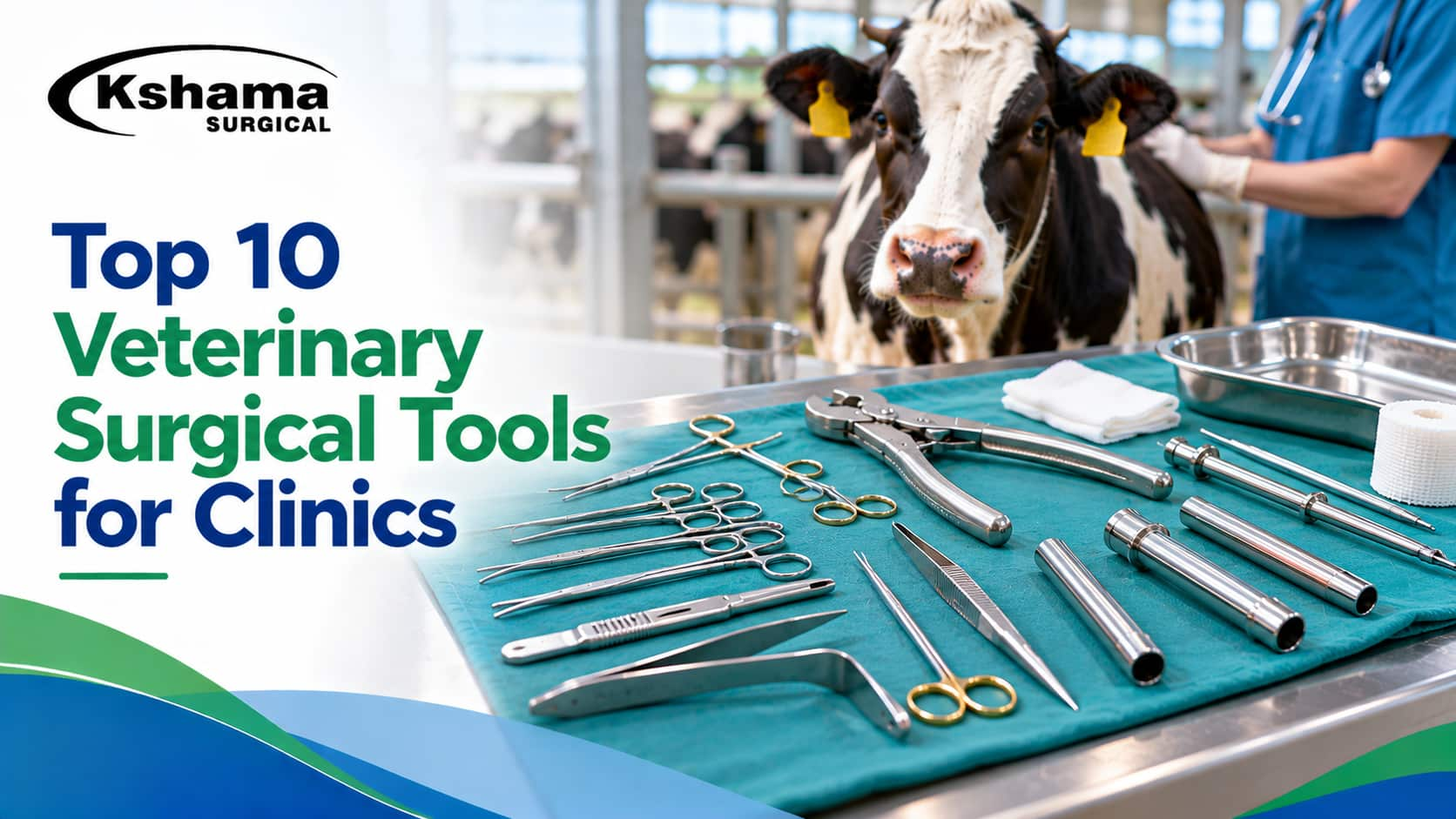
Top 10 Veterinary Surgical Tools for Clinics
A busy clinic runs on a short list of instruments that get used every day, and the quality of those instruments shows up in every procedure. This list covers the ten veterinary surgical tools most mixed and large-animal practices rely on, and it explains how to judge what you are buying. If you are equipping a new practice or replacing worn stock, our veterinary general instruments range covers many of these tools, and the guidance below applies to any supplier.
What Makes Veterinary Surgical Tools Worth the Investment?
Good veterinary surgical tools do three things, and the best veterinary surgical tools do them every day: they cut and grip precisely, they survive repeated sterilisation, and they stay safe to use for years. A cheap instrument that bends, rusts or loses its edge costs more in the long run because it must be replaced and can compromise a procedure.
Clinics also work in harsh conditions. Large-animal work exposes veterinary surgical tools to blood, manure, disinfectants and wet storage. That is why material and build quality matter as much as the design of the veterinary surgical tools themselves. The sections below start with material, then move through the ten veterinary surgical tools.
How Does Surgical Tool Material Affect Performance?
Surgical tool material decides how long an instrument resists corrosion and how it holds its shape. Stainless steel is the standard, but the grade matters.
SS 304 instruments use the grade known as 18/8 stainless steel, which means roughly 18 percent chromium and 8 percent nickel. Wikipedia’s page on SAE 304 describes it as the most common stainless steel, with higher corrosion resistance than regular steel. It also notes that 304 cannot be heat treated, and that in harsher chloride or acidic conditions it is commonly replaced by 316.
That last point has a practical meaning. Because 304 cannot be hardened by heat treatment, it suits non-cutting items such as trays, retractors, cannulae, tubes and many holders. Cutting and gripping instruments such as scissors and needle holders usually need a hardenable grade for the working edges. In practice, SS 304 instruments are a sensible choice for trays and holders, and a trustworthy supplier will say which grade is used where, and the best surgical tool material is simply the one that matches the job.
What Are the Top 10 Instruments Every Clinic Should Stock?
The ten veterinary surgical tools below suit a mixed or large-animal practice, with notes on what to check for each.
1. Surgical scissors
You need straight and curved pairs, plus a heavier pair for tough tissue and dressings. Check that the blades meet cleanly along their length and that the screw joint moves smoothly with no wobble.
2. Needle holders
A good needle holder grips the needle without letting it rotate. Look for serrated, well-aligned jaws and a ratchet that locks firmly and releases without a jerk.
3. Tissue forceps
Toothed and non-toothed versions handle different tissues. The tips should align exactly, and the spring tension should be even so your hand does not tire.
4. Haemostatic forceps
These clamp vessels during surgery and need strong, fully closing jaws. A ratchet that slips under pressure is a safety problem, so test it before you buy.
5. Scalpel handles and blades
A solid, correctly sized handle that matches your blade range keeps cuts controlled. Stock several blade sizes for different species.
6. Retractors
Retractors hold tissue clear of the surgical field. Smooth edges and a sturdy build matter here, and this is a place where stainless steel excels for durability.
7. Burdizzo castrator
A burdizzo is a staple for bloodless castration in cattle, sheep and goats. Look for jaws that close evenly, a tight pivot and a size that matches your animals.
8. Trocar and cannula
Used for relieving bloat in ruminants, this needs a sharp, well-finished trocar and a cannula that is easy to clean. Corrosion resistance matters, since the instrument is often stored between emergencies.
9. Teat siphon and teat instruments
Teat tubes drain blocked quarters and support treatment of teat problems. Choose smooth, burr-free tips and a collar design that prevents the tube from slipping inside the gland.
10. Mouth gag and speculum
A gag keeps the mouth open safely for oral examination or dental work, and it protects the person handling the animal. Check that locking mechanisms hold and that all edges are smooth.
How Many Instruments Does a Clinic Really Need?
Fewer than most catalogues suggest. A small practice can cover everyday work with perhaps three pairs of scissors, two needle holders, several forceps and a basic retractor set, then add species-specific veterinary surgical tools as the caseload demands. Buying a few well-made veterinary surgical tools and keeping spares of the most used ones is a better plan than filling drawers with cheap duplicates.
Think in sets rather than single items. A clean, wrapped pack for each routine procedure speeds up preparation and keeps sterilisation manageable. It also shows quickly which veterinary surgical tools wear out first, so you know where durable vet tools earn their cost.
How Do You Keep Instruments in Good Condition?
Care is what turns durable vet tools into long-lasting ones, and it protects the money you spent on veterinary surgical tools. Rinse instruments straight after use so blood and tissue do not dry on. Clean them with a soft brush and a neutral detergent, rinse well, and dry them completely before sterilising. Inspect joints and ratchets regularly and lubricate hinges with instrument-safe lubricant.
Sterilisation is the other half. Wikipedia’s overview of surgical instruments gives useful background on how instruments are classified and maintained. Whatever method your clinic uses, follow it consistently, and retire any of your veterinary surgical tools that have bent, cracked or pitted surfaces.
What Should You Check Before Buying?
Use this checklist when you compare suppliers of veterinary surgical tools.
- Material: ask which stainless grade is used and for which parts.
- Finish: surfaces should be smooth, with no burrs, rough welds or sharp unfinished edges.
- Joints and ratchets: they should move cleanly and lock firmly.
- Sterilisation: confirm the tools can handle your method and cycle count.
- Range: a supplier with a broad catalogue of veterinary surgical tools lets you equip a whole clinic in one order.
- Support: clear specifications, spare parts and responsive service matter once you own the tool.
Reliable durable vet tools are rarely the cheapest item on the page, and good SS 304 instruments are no exception. They are the ones with honest specifications and a build that holds up in daily use.
Equipping Your Clinic with Kshama Surgical
Kshama Surgical manufactures and exports veterinary surgical tools, general instruments, gynaecology instruments and teat instruments from India. If you are setting up or restocking a clinic, share your caseload and the species you treat, and the team can suggest a practical starting set. Browse the veterinary surgical instruments category or contact Kshama Surgical for guidance on materials and quantities.
Frequently Asked Questions
Which instruments does a new veterinary clinic need first?
Start with scissors, needle holders, tissue and haemostatic forceps, scalpel handles and retractors. Then add species-specific items such as a burdizzo, trocar and cannula or teat instruments, depending on the animals your clinic treats most often.
Is stainless steel always the best material?
Stainless steel is the standard because it resists corrosion, but grades differ. SS 304 suits many non-cutting items, while cutting edges usually need a hardenable grade. Ask your supplier which grade is used for each instrument you buy.
What does SS 304 mean for instruments?
It refers to a common austenitic stainless steel with about 18 percent chromium and 8 percent nickel. It resists corrosion well and forms easily, but it cannot be hardened by heat treatment the way cutting-grade steels can be hardened.
How do I tell if a tool is high quality?
Check that joints move smoothly, jaws and blades align, ratchets lock firmly and surfaces are smooth with no burrs. Ask for material details too. A well-made tool feels solid and consistent in the hand, with no rattle or rough spots.
How often should instruments be replaced?
There is no fixed schedule. Replace an instrument when it bends, rusts, pits, loses its edge or stops locking properly. Inspecting each tool after every cleaning cycle is the best way to catch trouble before it affects a procedure.
Can one set of tools serve large and small animals?
Partly. General items like forceps and scissors cross over, but species-specific tools such as a burdizzo or trocar need correct sizing. Kshama Surgical can help match instruments to the animals your clinic treats, large or small.
Should I buy directly from a manufacturer?
Direct purchase often gives clearer specifications, access to bulk quantities and fewer middlemen. It is worth asking any manufacturer about materials, finishing and spare parts before you place a larger order for your clinic.
