
Veterinary surgery needs many different instruments, and each one has a specific job. Some instruments are used for cutting, others for stitching, and some are used for holding or moving tissue. Among these tools, veterinary forceps are very useful because they give the surgeon better control during different animal procedures.
For a new clinic, choosing surgical instruments can be a little confusing. Many forceps look almost the same when they are placed on a tray. But their tips, teeth, length, shape, and locking systems can be quite different. One type may be suitable for delicate tissue, while another is made for firm tissue or bleeding control.
Understanding these differences before purchasing instruments can save money and avoid unnecessary confusion. It also helps veterinary professionals, students, clinic managers, and buyers understand why different forceps are needed for different procedures.
This guide explains the common types, their surgical uses, important differences, maintenance needs, and what buyers should check before placing an order.
What Are Veterinary Forceps?
Veterinary forceps are hand-held instruments used to grasp, hold, clamp, move, or handle tissue and other materials during veterinary procedures. Most professional instruments are made from stainless steel because it provides strength and can resist corrosion when the instrument is cleaned and maintained properly.
The design depends on the purpose. Some forceps have smooth tips, while others have teeth or serrated surfaces. Some are straight and others are curved. Locking designs have a ratchet system that allows the instrument to remain closed.
Because of these differences, one instrument should not be used for every job. The correct choice depends on the procedure, animal, tissue type, surgical area, and amount of pressure needed.
For clinics looking at a wider selection of instruments, our veterinary surgical equipment collection at Kshama Surgical can be useful when comparing different instrument types and sizes.
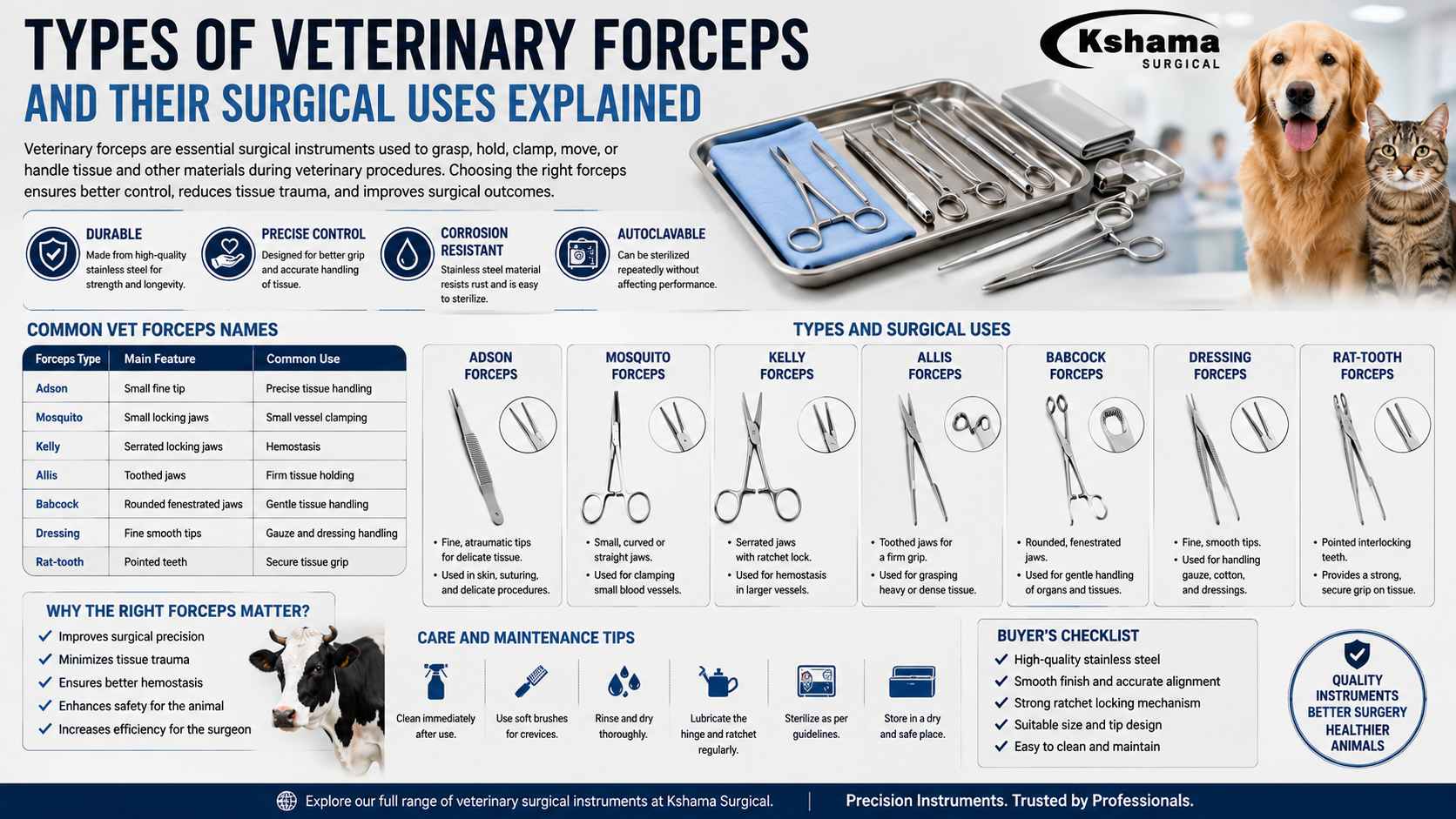
Common Vet Forceps Names
There are many vet forceps names used by veterinary professionals. Names may vary slightly between manufacturers, but several designs are commonly recognized.
| Forceps type | Main feature | Common use | |
| Adson | Small fine tip | Precise tissue handling | |
| Mosquito | Small locking jaws | Small vessel clamping | |
| Kelly | Serrated locking jaws | Hemostasis | |
| Allis | Toothed jaws | Firm tissue holding | |
| Babcock | Rounded fenestrated jaws | Gentle tissue handling | |
| Dressing | Fine smooth tips | Gauze and dressing handling | |
| Rat-tooth | Pointed teeth | Secure tissue grip |
Knowing the names is useful, but the name alone does not tell the whole story. The user also needs to understand the instrument’s tip, size, and intended purpose.
Tissue Forceps
Tissue forceps are designed to hold tissue during surgery. Depending on the design, they can have smooth or toothed ends.
Adson forceps are smaller and can be useful where precise handling is required. Larger designs can provide more reach or a stronger grip for suitable tissue.
Pressure is very important when using tissue instruments. A firm grip may be useful for tough tissue, but delicate structures require much more care. Too much pressure can cause unnecessary tissue injury.
This is why veterinary forceps should be selected according to the tissue and procedure instead of simply choosing the nearest instrument from the tray.
Dressing Forceps
Dressing forceps are generally used for handling gauze, swabs, cotton, dressings, and other small materials. Their fine ends allow the user to pick up and move these materials without touching them directly.
They are especially useful during wound cleaning and dressing changes. However, they are not designed for heavy tissue gripping and should not be used as a substitute for stronger tissue instruments.
For clinics that perform regular wound care, suitable dressing instruments can make everyday work more organized and convenient.
Choosing the right veterinary forceps for dressing work also makes routine wound care easier and more organized.
Hemostatic Forceps
Hemostatic veterinary forceps are designed to clamp blood vessels or tissue to assist with bleeding control. Mosquito, Kelly, and Crile patterns are common examples.
Their ratchet mechanism allows them to stay closed after being applied. Different sizes are available because vessels and surgical areas can vary considerably.
The correct size and pressure should always be selected according to the clinical situation. More pressure is not always better. Excessive clamping can damage tissue, so the instrument should be used by a trained veterinary professional.
Allis and Babcock Forceps
Allis forceps have teeth that provide a firm grip. They can be useful when tougher tissue needs to be held securely. However, their teeth can cause tissue trauma, so they are not suitable for every type of tissue.
We also offer Allis Tissue Forceps in different sizes, including 6-inch, 8-inch, and 10-inch options. These are ratcheted instruments designed for grasping heavy or dense tissue.
Babcock forceps have rounded, fenestrated jaws. This design can allow certain structures to be held with less crushing action than toothed instruments. Our Babcock Forceps are available in 6-inch and 8-inch options and are intended for handling delicate tissue and tubular structures.
These examples show why surgical forceps for animals should be selected according to the procedure and tissue rather than appearance.
The right veterinary forceps can provide better control when the surgeon needs to handle tissue carefully.
How Veterinary Forceps Help During Surgery
One of the most common jobs of veterinary forceps is tissue handling. During an operation, the veterinarian may need to hold tissue aside, move it slightly, or keep a structure stable while another part of the procedure is completed.
The instrument needs to provide enough grip without unnecessary pressure. If the grip is too weak, the tissue can slip. If it is too strong, the tissue may be damaged.
Length also affects control. A long instrument may be useful in a deep surgical area but less comfortable in a small open area. This is why veterinary teams normally keep different sizes and designs available.
Forceps Uses in Bleeding Control and Other Tasks
The main forceps uses include holding tissue, clamping vessels, handling dressings, assisting with suturing, and managing suitable small materials during procedures.
Some designs may also be used for foreign object removal when a veterinarian decides that this approach is clinically appropriate. The tip shape can make a major difference in such cases.
A narrow or curved instrument may reach a space that a wider straight instrument cannot. But foreign object removal can involve risks, especially if the object is sharp or deeply lodged. It should always be performed by a trained veterinary professional.
How to Choose the Right Instrument
When choosing veterinary forceps, start with the procedure rather than the price or appearance. Consider what needs to be held, where the instrument will be used, and how much grip is actually required.
Inspect the working end carefully. Is it smooth, toothed, serrated, curved, or fenestrated? Then check the length and make sure it is suitable for the operating area.
The handles and ratchet should also be checked. A good instrument should open and close smoothly. The jaws should meet correctly when closed and should not appear badly misaligned.
For bulk buyers, consistency matters a lot. If every instrument feels different, staff may find them harder to use. Ordering samples before placing a large order can be a smart way to check quality.
Material, Cleaning, and Sterilization
Most professional veterinary forceps are made from stainless steel. This material is widely used because it offers strength and can withstand repeated cleaning and sterilization when the instrument is designed for those processes.
Still, stainless steel does not automatically mean excellent quality. Buyers should check the finish, construction, hinge, ratchet, and jaw alignment.
Cleaning should always follow the manufacturer’s instructions. Instruments should be cleaned before sterilization because sterilization does not replace proper cleaning or remove all physical material. Clinics can also refer to the infection-control and instrument-handling guidance published by the American Veterinary Medical Association when preparing their own cleaning protocols.
After cleaning, inspect every instrument. Rust, damaged tips, loose handles, or faulty ratchets should not be ignored. A damaged instrument may not work correctly during surgery.
Buying Surgical Forceps for Animals
When buying surgical forceps for animals, price should not be the only deciding factor. A very cheap instrument may look attractive at first, but poor finishing or weak construction can lead to replacement costs later.
Ask suppliers about the material, available sizes, manufacturing quality, sterilization suitability, and replacement options. If the order is large, requesting samples first can help the buyer check the actual product quality.
For clinics that want a complete selection rather than individual instruments, a veterinary general surgery kit is another option to consider. Our kit includes artery forceps, simple forceps, needle holder, scissors, towel clamp, and other instruments used for veterinary surgery.
Clinics should also maintain a basic instrument inventory. This makes purchasing easier and helps staff identify instruments that are missing, damaged, or used very frequently.
A dependable supplier should provide clear product information instead of making only general claims about quality.
Common Mistakes to Avoid
One common mistake is using the same type of veterinary forceps for every procedure. Different designs exist for different reasons, and an instrument with sharp teeth may not be suitable for delicate tissue.
Another mistake is forcing a stiff hinge or ratchet. If an instrument is not moving smoothly, forcing it can make the damage worse.
Leaving used instruments dirty for a long time is also not a good practice. Dried blood and tissue can become harder to remove and may contribute to staining or corrosion.
Quality Checks Before Purchase
Before buying veterinary forceps, inspect the jaws carefully. When closed, the working ends should meet correctly without obvious gaps or misalignment.
Open and close the instrument several times. It should feel smooth and controlled. If it has a ratchet, check each locking position and make sure the release works properly.
The surface finish should also be checked. Scratches, pits, rough edges, or uneven polishing may become more noticeable after repeated cleaning.
For bulk orders, check more than one sample. One good sample does not always mean every piece in a large shipment will have identical quality.
Good-quality veterinary forceps should maintain their alignment and smooth operation even after repeated clinical use and proper maintenance.
Frequently Asked Questions
What are veterinary forceps mainly used for?
Veterinary forceps are mainly used for holding, grasping, clamping, moving, and handling tissue or materials during animal procedures. Different designs are made for different tasks, so the correct instrument depends on the procedure and tissue involved.
What are common vet forceps names?
Common vet forceps names include Adson, Allis, Babcock, Kelly, Crile, mosquito, dressing, and rat-tooth forceps. Their tips and gripping styles differ, making them suitable for different surgical tasks.
Which surgical forceps for animals should a new clinic buy?
A new clinic should select surgical forceps for animals based on the procedures performed by its veterinary team. Tissue, dressing, and hemostatic types are common starting choices, while specialized instruments can be added later.
What are the main forceps uses?
The main forceps uses include tissue handling, bleeding control, dressing handling, assisting with suturing, and managing suitable foreign materials. The correct instrument and technique should always be used.
Is stainless steel suitable for surgical instruments?
Yes. Stainless steel is widely used because it offers strength and corrosion resistance when properly maintained. Buyers should still check construction, finish, steel specification, and sterilization instructions before purchasing.
How should forceps be maintained?
Veterinary forceps should be cleaned according to manufacturer instructions and the clinic’s infection-control procedures. After cleaning and sterilization, they should be inspected for rust, damaged jaws, loose handles, or ratchet problems.
Can one type be used for every surgery?
No. Different designs are made for different tissues and tasks. Using the wrong instrument can provide poor control or cause unnecessary tissue damage. Selection should always match the procedure.
What should buyers check before bulk purchasing?
Before purchasing veterinary forceps in bulk, check material, size, jaw alignment, ratchet action, surface finish, sterilization suitability, and supplier consistency. Testing samples first can help prevent problems with a larger order.
Final Thoughts
Choosing the right veterinary forceps becomes easier once their different designs and purposes are understood. Although many instruments look similar, their tips, teeth, length, and locking systems can make them suitable for completely different jobs.
A veterinary clinic does not need every instrument available. It needs the tools that match its actual procedures and working conditions. Proper cleaning, sterilization, inspection, and storage are equally important for keeping surgical instruments reliable.
For buyers, the basic approach is simple: understand the procedure, choose the correct design, inspect quality carefully, and purchase from a dependable supplier. Most importantly, these instruments should always be used by trained veterinary professionals.
Good surgical equipment does not have to be complicated. Having the right instrument for the right job can help the veterinary team work with better control and confidence while supporting professional animal care.
