
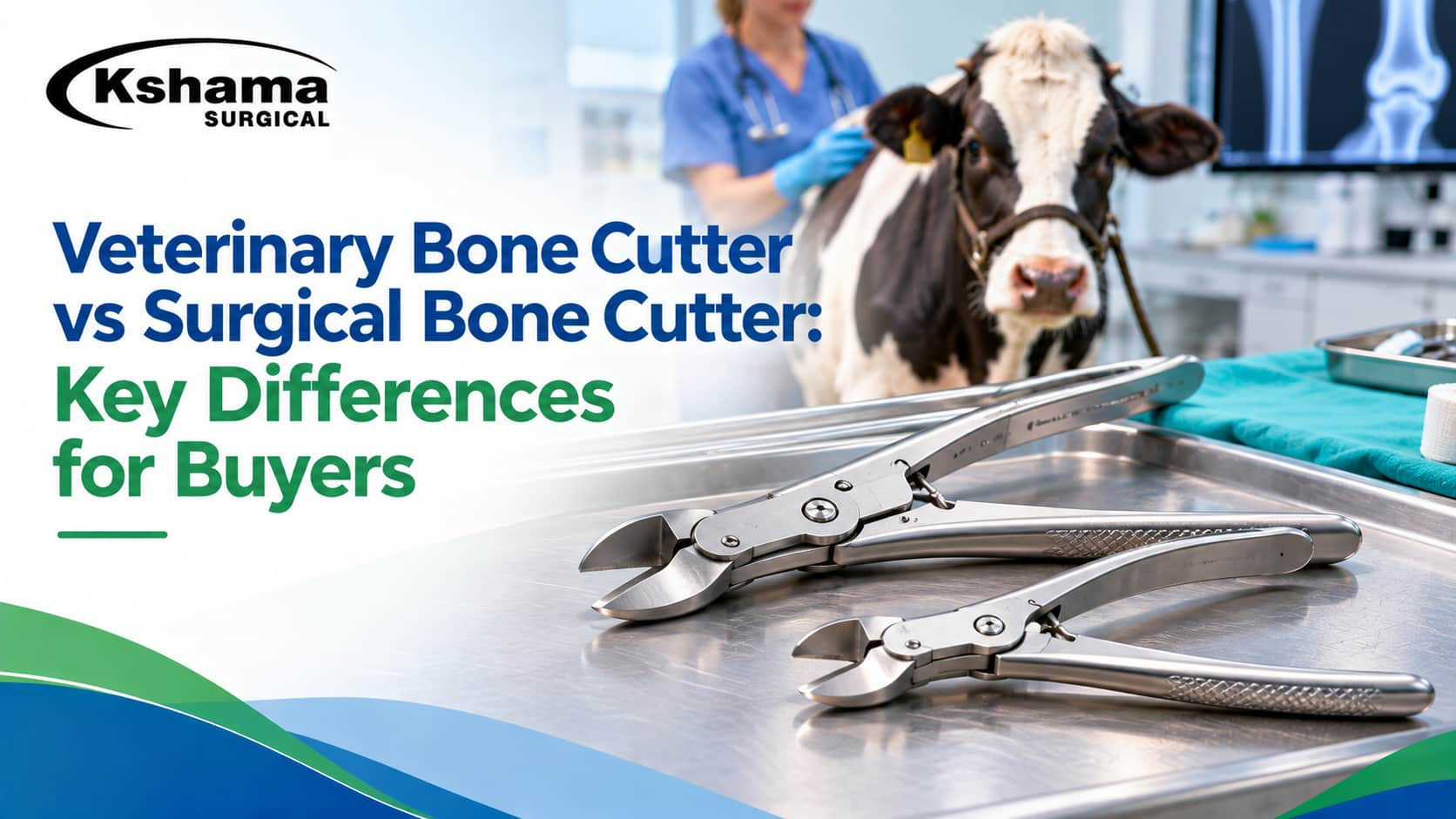
A bone cutter is a hinged, forceps-style instrument used to cut or trim bone during surgery, and the labels “veterinary” and “surgical” describe different things: the first names the patient, the second names the instrument class. Buyers searching for a veterinary bone cutter or a surgical bone cutter often find the two terms used interchangeably, which makes listings hard to compare. This guide separates what the labels mean, explains single and double action, shows how to read a product listing, and lists the checks that matter before you order for a clinic or hospital.
Reading the Labels Before You Compare
Product names in this category overlap, because there is no single rule that governs how sellers describe them. The practical meaning of each label looks like this.
Veterinary bone cutter usually signals that the instrument is intended for animal patients. Animals range from cats and small dogs to cattle and horses, so veterinary listings tend to cover a wide spread of lengths and strengths. Kshama Surgical lists a veterinary bone cutter in an 8 inch single-action version, described as an orthopedic spine-surgery instrument for veterinary use.
Surgical bone cutter is the broader term. It points to the instrument class, a cutting forceps built for surgical work on bone, without saying which species it is meant for. A surgical bone cutter listed in a veterinary catalogue and one listed for human surgery can look nearly identical.
Orthopedic bone cutter describes the surgical field in which the instrument is used. The term is common in listings for spine, limb and other orthopedic procedures, and a listing may use all three labels at once.
The useful conclusion is that names alone do not settle suitability. Length, jaw design, action type and steel finish do.
What a Bone Cutter Does in Surgery
Bone cutting forceps are built to nip or shear through bone and bony tissue rather than to grasp it. Surgeons use them to shorten bone, remove bony projections, take tissue away at an amputation site or make room during spinal and other orthopedic approaches. The general field is described in references on orthopedic surgery.
Because bone is dense, the instrument is heavier and stronger than ordinary scissors or tissue forceps. Its jaws are shaped to concentrate force at the cutting edge, and its handles are long enough to give leverage. That design is exactly why the instrument should never be used on wire, pins or hard objects it was not made for, since misuse dulls or springs the jaws.
Veterinary and Surgical Labels Compared
The table summarises how buyers usually encounter the terms. It is qualitative and describes common usage, not a formal standard.
| Question | Veterinary label | Surgical label | Orthopedic label |
| What does it tell you? | The intended patient is an animal | The instrument class used in surgery | The field of surgery it serves |
| Typical sizing | Wide range, from small pets to livestock | Depends on the maker | Depends on the procedure |
| Typical buyer | Clinics, farms, veterinary hospitals | Hospitals and general surgical suppliers | Orthopedic and spinal surgical teams |
| What you still need to confirm | Length, action type, steel finish | Species suitability | Jaw shape and cutting capacity |
Single Action or Double Action?
Action type is the specification that changes how an instrument feels in the hand, so it deserves attention before price.
A single-action cutter has one pivot point. It is simple, light and easy to clean, and it suits tasks where moderate force is enough, particularly on smaller patients. A double-action cutter uses a compound joint that multiplies the force at the jaws, so the surgeon can cut thicker bone with less hand effort. The trade-off is slightly more complexity in the joint and a little more cleaning care.
Kshama Surgical lists both styles: an orthopedic bone cutter ranger in straight double-action form, offered in more than one size, and an 8 inch single-action version.
- Choose single action when the work is lighter, the animal is smaller, or you value a simple, quick-to-clean instrument.
- Choose double action when cutting denser or larger bone, or when reducing hand fatigue matters over longer procedures.
- Consider owning both if your caseload spans small companion animals and large animals.
For example, a mixed practice that mostly treats dogs and cats but occasionally sees a large animal might keep a lighter single-action instrument for routine work and one double-action instrument for the heavier case. That approach avoids paying for strength that is rarely needed while keeping the right tool within reach when it is.
Checking an Orthopedic Bone Cutter Before You Order
A listing can look complete and still leave important questions unanswered. Before ordering an orthopedic bone cutter or a full orthopedic set, check the following:
- Action type and length are stated clearly for the exact size you want.
- Jaw shape is described, for example straight or angled, so it suits your approach.
- Material is named, and the finish is smooth with no rough edges or burrs.
- Joint movement is smooth in both directions, with no grinding or play.
- Jaw alignment brings the cutting edges together cleanly when closed.
- Sterilisation suitability is confirmed for the method you use.
Kshama Surgical also lists orthopedic sets in which cutting forceps sit alongside other bone instruments, which can be convenient when equipping a new surgical room.
Related Instruments That Are Often Confused With Cutters
Listings frequently group bone instruments together, and buyers sometimes order the wrong item. A bone cutter surgical instrument cuts or shears bone, but several neighbouring tools do something different.
- Bone nibbler: takes small bites of bone to reshape or smooth an edge, rather than making a single cut. A bone cutter surgical instrument is not the same as a nibbler, though both are used in bone work.
- Bone drill: a powered instrument for making holes, not for cutting through bone.
- Amputation saw: a saw used to divide larger bone in amputations.
- Bone scoop: a small spoon-shaped tool for removing material from a cavity.
- Plaster or cast cutter: a saw for removing casts, which is a different category entirely despite sometimes carrying bone-cutting wording in a product address.
Confirm the function in the description, not just the product name.
What Affects Price
Searches for the veterinary bone cutter price usually return a wide spread, and the reasons are straightforward. The factors below explain most differences between listings.
- Action type: double-action designs involve a more complex joint than single-action ones.
- Size: longer instruments use more material and cost more to make.
- Material and finish: a well-polished stainless steel instrument takes more manufacturing care.
- Brand and set contents: a single cutter and a full orthopedic set are not comparable.
- Order quantity: hospitals and distributors can request written quotations for volume.
Prices change, so check the current veterinary bone cutter price on the product page rather than relying on a figure quoted elsewhere. When comparing, match action type, length and material before comparing the number.
Care, Cleaning and Storage
Treat every bone cutter surgical instrument as a precision tool. Clean it soon after use so tissue does not dry on the jaws. Open the joint fully, brush out debris and rinse, then dry thoroughly before sterilising or storing. Check the cutting edges and alignment periodically, and take a worn or misaligned cutter out of service. Instruments with a compound joint benefit from occasional inspection of the pivot for debris and stiffness.
Mistakes to Avoid
- Buying by label alone, without checking action type and length.
- Using the cutter on pins or wire, which damages the cutting edges.
- Ignoring the joint, then discovering stiffness or play after delivery.
- Storing damp, which invites corrosion at the pivot.
- Ordering a nibbler or saw by mistake because the listing groups bone instruments together.
For wider reading on instruments used in animal orthopedic work, see the Kshama Surgical article on veterinary surgical implants and devices.
Frequently Asked Questions
Is a veterinary cutter different from a surgical one?
The names overlap. “Veterinary” signals that the instrument is intended for animal patients, while “surgical” describes the instrument class used in surgery. Many instruments carry both labels, so compare length, action type and material rather than relying on the name alone.
What is the difference between single and double action?
A single-action cutter has one pivot and is simple and light. A double-action cutter has a compound joint that multiplies force, so it cuts denser bone with less hand effort. Choose according to the size of the animal and the bone involved.
What size should I choose?
Match the instrument to the patient and the procedure. Shorter, lighter instruments suit small animals and confined spaces, while longer, stronger ones suit larger animals and denser bone. Check the stated length, and ask the supplier for the exact size of the model you want before ordering.
Can the same cutter be used on pins or wire?
No. It is designed for bone and bony tissue only. Cutting pins or wire dulls or springs the jaws and shortens the instrument’s life. Use dedicated pin or wire cutters for those materials, and keep them separate from bone instruments.
How should I clean and store it?
Rinse soon after use, open the joint, brush out debris, dry thoroughly and sterilise using a method suitable for stainless steel. Store dry in a case. Inspect the joint and cutting edges regularly, and replace the instrument if it is misaligned.
What is the difference between a cutter and a nibbler?
A cutter shears or nips through bone in one action, while a nibbler takes small bites to smooth or reshape an edge. They serve different steps in a procedure, so check the description carefully to confirm which instrument a listing actually offers.
Where can I find sizes and current prices?
Veterinary surgical suppliers list sizes and prices on their product pages, and any veterinary bone cutter price varies by action type and length. Choose a seller who states the length, action type and material clearly and who can provide a written quotation for hospital or bulk orders.
Conclusion
Choosing between the veterinary and surgical labels is mostly a question of reading past the name. Check whether the instrument is single or double action, confirm length and jaw shape, look at the material and finish, and make sure the listing really offers a cutter rather than a nibbler, drill or saw. A well-matched bone cutter reduces fatigue, protects the animal and lasts for years with simple care.
Before ordering, note your usual patients, the procedures you perform and whether you prefer single or double action. Explore the Kshama Surgical range of veterinary surgical equipment, or contact the team for help matching the right instrument to your clinic.
