
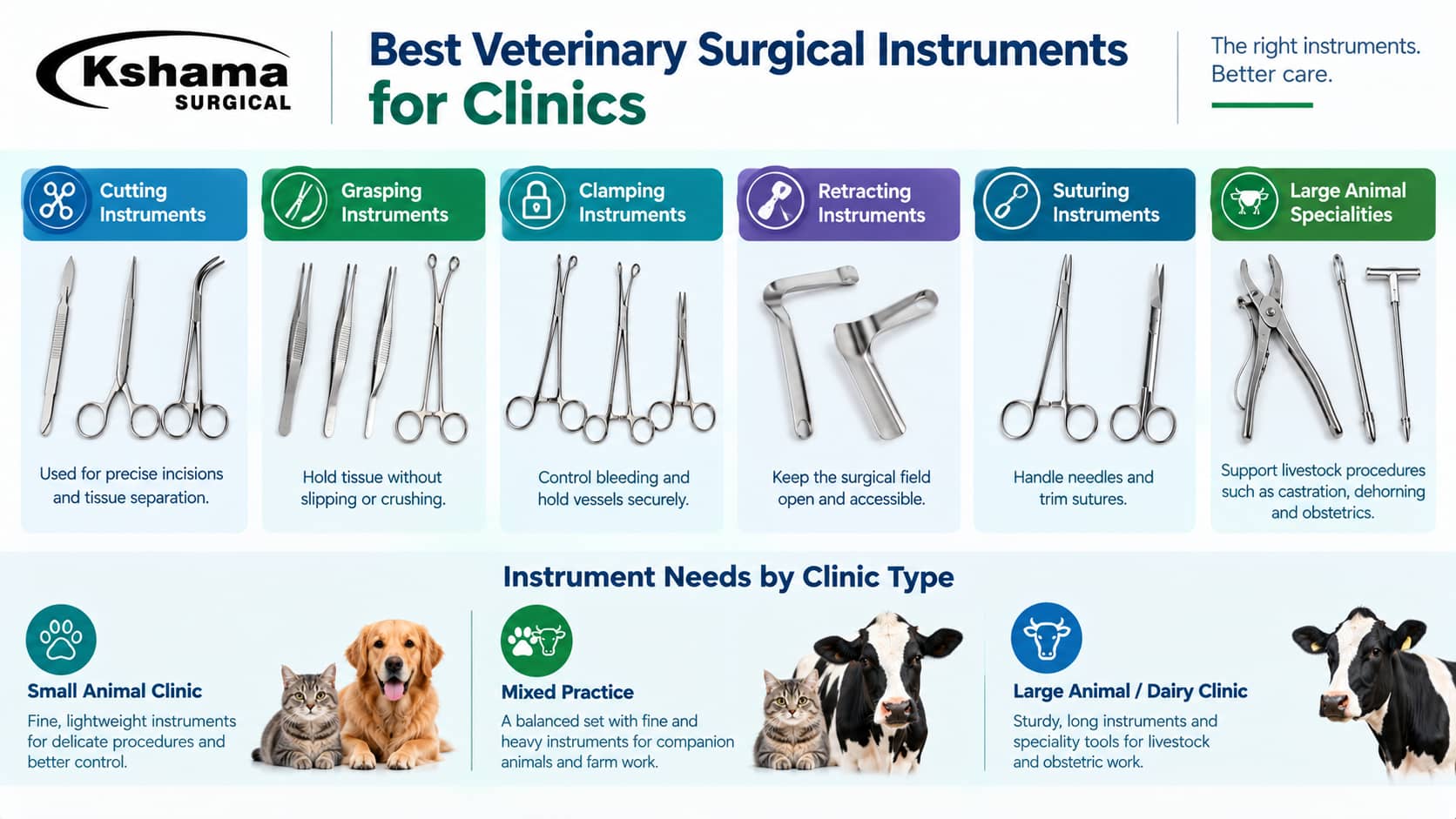
The best veterinary surgical instruments for a clinic are the ones that suit your caseload, survive repeated sterilisation and can be reordered without delay. That sounds simple, but a clinic treating dogs and cats needs a different set from a mixed practice serving dairy farms. This guide explains which instrument categories every clinic should hold, how to judge build quality, what affects price, and where common buying mistakes occur, so you can equip an operating room with confidence rather than guesswork.
Essential Veterinary Surgical Instruments Every Clinic Needs
Most operations rely on a core group of hand instruments used in the same order every time. Understanding what each group does makes it easier to decide what to buy first and what can wait. A well-planned set of veterinary surgical instruments usually covers these groups:
- Cutting instruments: scalpel handles, surgical scissors and dissecting scissors for incision and tissue separation.
- Grasping instruments: tissue forceps such as Allis and Babcock, which hold tissue without slipping or crushing.
- Clamping instruments: artery forceps and haemostats for controlling bleeding and holding vessels.
- Retracting instruments: retractors and speculums that keep the surgical field open.
- Suturing instruments: needle holders and suture scissors for closure.
- Large animal specialities: castrators, dehorners, elastrator forceps and trocars used in livestock work.
Small animal practices lean towards fine, lightweight instruments, while large animal and dairy practices need heavier, longer tools that tolerate force. Buying the wrong scale is one of the most frequent and expensive errors, because fine instruments bend under livestock work and heavy ones lack the delicacy for small patients.
Building a Set in the Right Order
Few clinics buy everything at once, and there is no need to. A practical sequence starts with the instruments used in nearly every procedure: scalpel handle, dissecting and suture scissors, two or three sizes of artery forceps, tissue forceps, needle holders and a basic retractor. These handle spays, wound repairs, lump removals and most soft-tissue work.
The second stage adds items driven by your caseload. A clinic with regular abdominal surgery may add self-retaining retractors and sponge-holding forceps. A mixed practice serving dairy farms will want obstetric and livestock tools such as dystocia sets, castrators and elastrator forceps. Recording which instruments are used in every procedure for a month gives a far better shopping list than any generic catalogue.
The third stage is duplication. Autoclave cycles take time, so a busy clinic with only one set of scissors and forceps will find surgeries delayed while instruments are processed. Holding a second set of the most-used items keeps the operating schedule moving and spreads wear across more pieces.
Choosing Instruments by Clinic Type
Clinics differ in caseload, so the same instruments do not serve everyone equally well. The table below compares four common practice types using qualitative guidance only.
| Factor | Small Animal Clinic | Mixed Practice | Large Animal / Dairy Unit | Teaching or Referral Centre |
| Instrument scale | Fine and lightweight | Both fine and heavy | Heavy and long | Full range, fine grades |
| Priority items | Scissors, tissue forceps, needle holders | General set plus livestock tools | Castrators, trocars, dystocia tools | Duplicate sets for rotation |
| Sterilisation load | Daily autoclave cycles | Moderate | Field cleaning between farms | Very high |
| Main risk | Fragile tips damaged by misuse | Poor storage between sites | Corrosion in wet conditions | Wear from heavy reuse |
What Makes a Good Surgical Instrument
Build quality shows in the steel, the joint and the finish. Guidance published on the Kshama Surgical buying guide for surgical forceps recommends stainless steel of surgical grade, such as 304 or 316, because it resists corrosion and tolerates autoclave cycles. The same logic applies to every instrument in a set.
Quality Checklist Before You Buy
- Steel grade: confirm stainless steel, and ask which grade the manufacturer uses.
- Box joint: it should open and close smoothly with no wobble or grinding.
- Jaw alignment: tips and teeth should meet exactly when closed.
- Ratchet action: locks should engage firmly and release without force.
- Finish: look for smooth, burr-free surfaces that clean easily and do not trap residue.
- Sterilisation compatibility: check that the instrument suits autoclave use.
Ask to handle a sample before committing to a large order. Open and close the jaws several times, check that teeth mesh cleanly and feel the weight in your hand, since balance affects control during long procedures. A cheap instrument that corrodes within a season costs more than a properly finished one, particularly when a clinic buys in volume and has to replace items together.
Pricing, Rates and Where to Buy
Clinics comparing veterinary surgical instruments price in India quickly find that quoted figures vary widely, because the category spans a small haemostat and a large-animal castrator. Reading a veterinary surgical instruments price list by item type, rather than as one total, is the only fair way to compare sellers.
For routine items such as scalpel handles or forceps, look at the price per piece and check what a pack actually contains. A veterinary surgical instruments rate in India that looks low may be for a smaller size or a lighter grade, so always confirm dimensions, steel grade and pack count alongside the number.
Sourcing is the second half of the decision. A veterinary surgical instruments manufacturer in India can usually state materials and certifications, whereas resellers may not. The About page lists Kshama Surgical as ISO 9001:2015 and CE certified, which is the kind of information worth requesting from any supplier.
Many clinics now order online for convenience. A listing to buy veterinary surgical instruments online India should show steel grade, size and pack quantity. Those looking for animal surgery instruments online India-wide can browse animal surgery instruments online India by category, and anyone wanting animal surgery instruments for sale in India in bulk should ask about consistent batches. Buying animal surgery instruments for sale in India from a source that also supplies spares keeps a set complete over time.
A Practical Example: Equipping a Mixed Practice
Consider a mixed practice that treats companion animals in the morning and visits dairy farms in the afternoon. The operating room needs fine scissors, tissue forceps and needle holders for routine small animal surgery. The farm bag needs sturdier items: a Burdizzo castrator, elastrator forceps, trocar and cannula, and an obstetric set for difficult calvings. Keeping these as two separate kits avoids carrying delicate instruments into wet, dirty conditions, and it makes restocking simple because each kit has a defined contents list.
Labelling matters here. A checklist inside each case lets the team confirm every piece has returned after a call, which prevents the slow loss of small items that leaves a set incomplete within a year.
Advantages and Disadvantages of Buying Instruments as Sets
Advantages
- Compatibility: items are chosen to work together, which reduces gaps in the operating room.
- Convenience: one order replaces many small ones.
- Value: sets are often priced below the sum of individual pieces.
- Consistency: matching finish and steel grade across the set.
Disadvantages
- Unused items: a set may include instruments your caseload never requires.
- Fixed scale: you may be locked into sizes that do not suit your patients.
- Replacement difficulty: if one piece fails, matching it exactly can be harder.
- Storage needs: larger sets need proper cases and racks.
Many clinics start with a core set and add individual items as their case mix becomes clear.
Care and Sterilisation
Instruments last far longer when treated correctly. Rinse them soon after use so blood and tissue do not dry on the steel, open all ratchets before cleaning, and dry thoroughly before storage. Use an ultrasonic cleaner or a soft brush rather than abrasive pads, which scratch the finish and create places for corrosion to start. Follow autoclave guidance for your instruments and never store them damp or in contact with saline for long periods.
Common Mistakes to Avoid
- Using scissors for wire or suture removal, which dulls the blades.
- Forcing a jammed ratchet, which bends the joint.
- Storing wet, the fastest route to rust spots.
- Ignoring wear on tips, since misaligned jaws damage tissue.
- Mixing instruments from different suppliers without checking size and finish.
Frequently Asked Questions
What are the most important veterinary surgical instruments for a clinic?
The core group includes scalpel handles, surgical scissors, tissue forceps, artery forceps, needle holders and retractors. Large animal work adds castrators, trocars and dystocia tools. Start with the core set and add speciality items as your caseload becomes clear.
What is the veterinary surgical instruments price in India?
Price depends on instrument type, size and steel grade, so there is no single figure, and any veterinary surgical instruments rate in India should be read item by item. A small haemostat and a heavy castrator are priced very differently. Compare item-wise quotes and confirm what each includes before deciding.
How do I compare veterinary surgical instruments price per piece?
Divide the pack price by the number of pieces, then compare only items of the same size and steel grade. Veterinary surgical instruments price per piece is meaningful only when the specification matches, not when a lighter grade is being quoted.
Where can I buy veterinary surgical instruments online in India?
You can buy veterinary surgical instruments online India-wide from manufacturers and dealers that list steel grade, size and pack quantity. Choose a seller who provides written specifications, clear return terms and support for bulk or repeat orders.
What should I ask a veterinary surgical instruments manufacturer in India?
Ask about steel grade, certifications, sterilisation compatibility, batch consistency and spare availability. A reliable manufacturer will give these details in writing and explain warranty or return terms before you place an order.
Is a veterinary surgical instruments price list useful before ordering?
Yes. A veterinary surgical instruments price list shows what each item costs so you can prioritise purchases. Use it to separate one-time instruments from replaceable items, and request updated rates before ordering.
How long do surgical instruments last?
Well-made stainless steel instruments can last for many years with correct cleaning, drying and storage. Lifespan depends far more on handling and sterilisation practice than on age, so rinse promptly, dry fully and inspect joints and tips regularly.
Conclusion
Equipping a clinic well means matching instruments to caseload, checking steel grade and finish, reading prices by item and choosing a supplier who publishes specifications. The best veterinary surgical instruments are not the most expensive ones but those that stay aligned, resist corrosion and can be reordered when needed. Start with a core set, maintain it carefully and expand deliberately.
Before ordering, list your case types, sterilisation routine and instrument sizes. Explore the Kshama Surgical veterinary surgical range or contact the team for guidance based on your clinic’s requirements.
