
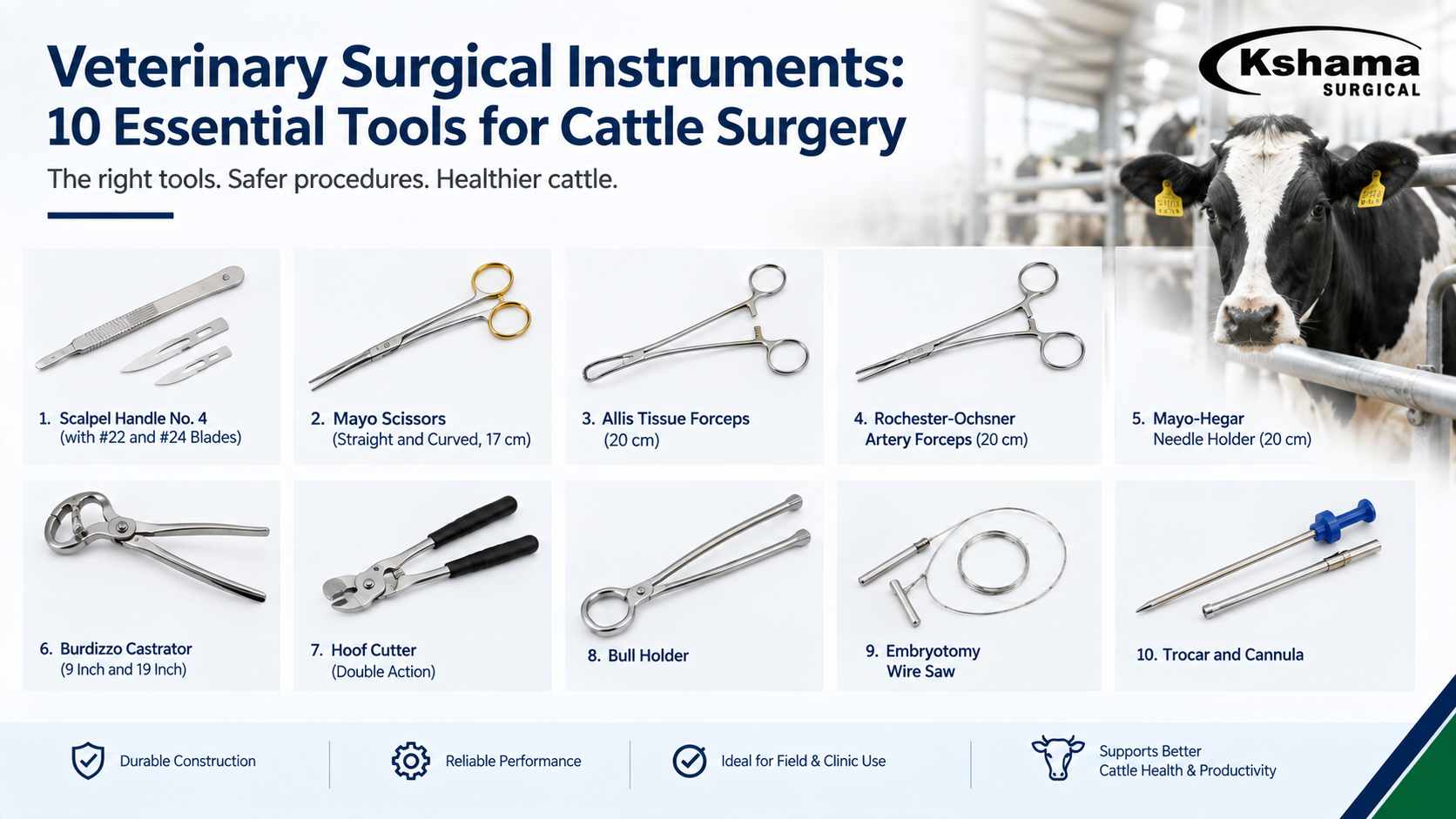
A cattle practice needs ten core instruments: a #4 scalpel handle, Mayo scissors, Allis tissue forceps, Rochester-Ochsner artery forceps, a Mayo-Hegar needle holder, a Burdizzo castrator, a hoof cutter, a bull holder, an embryotomy wire saw, and a trocar and cannula. Together these veterinary surgical instruments cover roughly 90 percent of routine field and clinic procedures on adult cattle.
That short list is the working core of most bovine kits. Everything else is built around it, which is why the veterinary surgical instruments you buy first matter more than the ones you add later. This guide explains what each instrument does, what size to order for cattle, and how to judge build quality before you pay.
What Are Veterinary Surgical Instruments Used for in Cattle Practice?
Veterinary surgical instruments are the hand tools used to cut, hold, clamp, retract, and suture animal tissue during a procedure. In cattle work they also cover restraint and obstetric tools, because most bovine surgery happens on a standing animal in a crush rather than on a table.
Cattle practice puts different demands on a kit than small animal practice does. Tissue planes are thicker, the abdominal wall on an adult cow runs 2 to 4 cm deep, and instruments often work through a flank incision at arm’s length. That is why bovine surgery instruments are longer, heavier in the jaw, and built with wider ratchets than canine equivalents. Veterinary surgical instruments sized for dogs simply do not reach.
The second difference is the environment. A left displaced abomasum correction happens in a shed, not a theatre. Large animal surgical instruments therefore need corrosion resistance that survives repeated exposure to dung, disinfectant, and hard water. Surgical-grade steel is not a marketing phrase here. It is the difference between a scissor that lasts 8 years and one that pits in 8 months. Good cattle surgical instruments are specified for that environment from the start.
For a broader view of instrument families and their naming conventions, the Wikipedia entry on surgical instruments is a reasonable starting reference.
The 10 Veterinary Surgical Instruments Every Cattle Practice Should Own
The list below is ordered by how often each item gets used in a mixed bovine caseload, not by price. Sizes given are the ones that suit adult cattle rather than calves. Treat these ten veterinary surgical instruments as the floor, not the ceiling.
1. Scalpel Handle No. 4 with #22 and #24 Blades
The No. 4 handle takes the large blades needed for hide. A #22 blade handles flank incisions; a #24 suits thicker skin over the tarsus and udder. Keep the No. 3 handle with #10 and #15 blades for calves and fine work. Buy handles with a knurled grip, because a smooth handle turns in a wet glove.
2. Mayo Scissors, Straight and Curved, 17 cm
Mayo scissors cut fascia and heavy connective tissue. Straight blades for suture and dressings, curved for dissection inside the wound. Tungsten carbide inserts, marked by gold handles, hold an edge far longer than plain steel and are worth the premium on a scissor used weekly.
3. Allis Tissue Forceps, 20 cm
Allis forceps grip tissue that must not slip: a uterine edge during caesarean closure, or a skin flap during teat repair. The 4×5 tooth pattern is standard for bovine work. Two pairs is the practical minimum, four if you do regular caesareans.
4. Rochester-Ochsner Artery Forceps, 20 cm
Haemostats stop bleeding from subcutaneous and uterine vessels. The 1×2 toothed tip of the Ochsner pattern holds heavier vessels than a plain Kelly. A caesarean set should carry at least six.
5. Mayo-Hegar Needle Holder, 20 cm
Suturing a 2 cm thick uterine wall with a 16 cm holder is uncomfortable and slow. The 20 cm size gives the reach a flank approach needs. Check that the box lock has no lateral play and that the ratchet holds a USP size 2 needle without release.
6. Burdizzo Castrator, 9 Inch and 19 Inch
The Burdizzo crushes the spermatic cord without breaking skin, which keeps flystrike risk low. The 9 inch model covers goats, sheep, and calves; the 19 inch is for adult bulls. Jaw alignment is the only thing that matters here. A Burdizzo whose jaws meet unevenly will fail to crush one cord and leave a stag.
7. Hoof Cutter, Double Action
Lameness is a routine call, and a double action hoof cutter gives the leverage a single-action pair cannot. Pair it with a hoof knife and a rasp. The compound joint roughly doubles cutting force for the same hand effort, which matters on a dry, overgrown claw.
8. Bull Holder or Nose Pliers
Restraint is a surgical instrument in cattle work. A stainless steel bull holder applied to the nasal septum gives control during examination, drenching, and standing procedures. Look for smooth, rounded ball tips that do not tear the septum.
9. Embryotomy Wire Saw with Handles and Introducer
Foetotomy is an unpleasant but necessary skill. The kit is a wire saw, two handles, a threader, and a Thygesen embryotome. Keep spare wire in the vehicle, as a single wire rarely survives more than two or three cuts.
10. Trocar and Cannula, 8 Inch
Bloat kills fast. An 8 inch trocar and cannula relieves ruminal tympany in the field when a stomach tube will not pass. Check the cannula seats cleanly and that the point is still sharp before each season.
Quick Reference: Cattle Instrument Priorities
| Instrument | Main use in cattle | Suggested size | Buy first or later |
| Scalpel handle No. 4 | Skin and hide incision | #22 and #24 blades | First |
| Mayo scissors | Fascia and heavy tissue | 17 cm, straight and curved | First |
| Allis tissue forceps | Holding uterus and skin | 20 cm, 4×5 teeth | First |
| Rochester-Ochsner forceps | Haemostasis | 20 cm, 6 pairs | First |
| Mayo-Hegar needle holder | Suturing deep layers | 20 cm | First |
| Burdizzo castrator | Bloodless castration | 9 inch and 19 inch | First |
| Hoof cutter, double action | Claw trimming, lameness | Standard adult | First |
| Bull holder | Standing restraint | Adult bovine | First |
| Embryotomy wire saw set | Foetotomy | Complete set | Later |
| Trocar and cannula | Ruminal tympany | 8 inch | Later |
How Do You Judge Quality in Veterinary Surgical Instruments?
Judge veterinary surgical instruments on four things: steel grade, joint fit, finish, and tip alignment. Cutting instruments should be martensitic stainless steel in the 410 or 420 family, which hardens well and holds an edge. Non-cutting items such as trays, drums, and retractors are better in austenitic 304 or 316, which resists corrosion but stays softer.
Test the joint on every instrument before accepting delivery. Hold a scissor at the box lock and wiggle the blades sideways. More than a trace of play means the pivot was not properly finished. Close a ratcheted forceps to the first click and shake it. The jaws should not spring open.
Finish tells you about the manufacturer. A satin or matt finish reduces glare and hides minor scratches; a mirror polish looks better but shows wear sooner. What you do not want is a bright coating hiding a rough substrate, because that surface will pit within a year.
Ask whether the supplier holds ISO 9001 certification for its manufacturing process. Kshama Surgical manufactures its stainless steel veterinary instruments at an ISO 9001:2015 and CE certified unit in Idar, Gujarat, and exports to 10 countries including Canada, Nepal, Egypt, and Vietnam. Certification is not a guarantee of a good scissor, but it does tell you that veterinary surgical instruments leave the floor against a documented process. The ISO 9001:2015 standard page sets out what that involves.
Sterilization and Daily Care That Protects Your Investment
Veterinary surgical instruments fail from neglect more often than from use. Rinse blood off within 20 minutes, because dried protein is far harder to remove and corrodes steel underneath. Use a neutral pH enzymatic cleaner rather than household detergent, which is usually alkaline.
Steam sterilize at 121°C and 15 psi for 15 to 20 minutes, or 134°C for 3 to 4 minutes in a pre-vacuum cycle. Store the processed set in a sealed autoclave drum rather than an open tray, and date the drum on closing. Lubricate box locks with instrument milk, never with mineral oil, which bakes onto the joint.
Run a fresh set of hinged veterinary surgical instruments through a cycle before first use. It removes manufacturing residue and shows you any joint that binds while you can still return the item.
When You Should Not Buy a Full Instrument Set
A prepacked set of veterinary surgical instruments is the wrong purchase in three situations, and it is worth being blunt about that.
If you see fewer than 5 surgical cases a month, a 16-piece cassette set leaves most of the tray idle while the whole set goes through every sterilization cycle. Buy the six cattle surgical instruments you actually use and add later.
If your caseload is mostly obstetric, a general surgery set skips the calving jack, embryotomy kit, and obstetric chains you genuinely need. Match the bovine surgery instruments you own to the calls you take, not to the catalogue.
If you are equipping a first clinic on a tight budget, spend on 6 good instruments rather than 16 average ones. A cheap needle holder with a worn ratchet will cost you time on every caesarean for the next decade. Six dependable livestock surgical tools beat a drawer of spares. Rebuilding a set piecemeal is normal practice and nothing to apologise for.
Common Mistakes When Buying Livestock Surgical Tools
Buying small animal sizes is the most frequent error when ordering livestock surgical tools. A 14 cm Mayo scissor is fine for a cat spay and useless through a bovine flank. Check the length of large animal surgical instruments in centimetres rather than trusting a product photograph.
Mixing steel grades in one drum causes galvanic pitting over time, especially where hard water is used. Stainless steel veterinary instruments should be stored as a single family. Keep chrome-plated carbon steel items, if you own any, out of the same drum as stainless.
The last mistake is skipping the boring items. Drapes, a kidney tray, ligature scissors, and a sharps container are not exciting, but a caesarean without them is slower and dirtier. The wider range of veterinary general instruments covers most of this supporting equipment, while heavier items such as tables and lifting frames sit under veterinary surgical equipment.
Getting the Right Set for Your Caseload
Buying veterinary surgical instruments is easier when someone has seen your kind of caseload before. If you are building a first bovine kit or replacing a worn set, speak to the Kshama Surgical team with your monthly case numbers and the procedures you take on. A specification for veterinary instruments for cattle built around real caseload beats a catalogue order every time.
Frequently Asked Questions
How many veterinary surgical instruments does a new cattle practice really need?
Around 10 to 12 core items cover routine bovine work, including a No. 4 scalpel handle, Mayo scissors, Allis forceps, six artery forceps, a 20 cm needle holder, a Burdizzo, and restraint tools. Add obstetric and foetotomy kit as caseload grows.
What steel grade is best for cattle surgical instruments?
Stainless steel veterinary instruments that cut perform best in martensitic 410 or 420 grades, which harden enough to hold an edge. Trays, drums, and retractors are better in austenitic 304 or 316 grades, which resist corrosion but are softer and will not take a keen edge.
How often should large animal surgical instruments be replaced?
Replace veterinary surgical instruments on condition, not on a calendar. A quality scissor lasts 8 years or more with proper cleaning. Retire any instrument with a loose box lock, a ratchet that slips, misaligned tips, or visible pitting, because all four compromise surgical control.
Can the same instruments be used for cattle and small animals?
Some bovine surgery instruments overlap with small animal kit, such as scalpel handles and artery forceps. Length is the limit. Bovine work needs 20 cm instruments for reach through a flank, while 14 to 16 cm sizes suit dogs and cats. Most mixed practices keep two separate packs.
Do I need a separate set for caesareans?
Yes. A dedicated caesarean pack of veterinary surgical instruments saves time and reduces contamination risk. It should carry extra Allis and Ochsner forceps, a 20 cm needle holder, USP size 2 suture, and obstetric chains, all wrapped and dated as one unit.
Where can I buy veterinary instruments for cattle in India?
Kshama Surgical manufactures and supplies veterinary instruments for cattle from an ISO 9001:2015 and CE certified facility in Gujarat, with online ordering and shipping across India. Buying direct from a manufacturer usually gives better traceability on steel grade than buying through resellers.
How should instruments be stored between cases in field conditions?
Keep sterilized livestock surgical tools sealed in a stainless drum inside a closed visit bag, away from heat and moisture. Date every drum on closing and reprocess unopened packs after 21 days, since the seal degrades even when the drum is never opened.
