
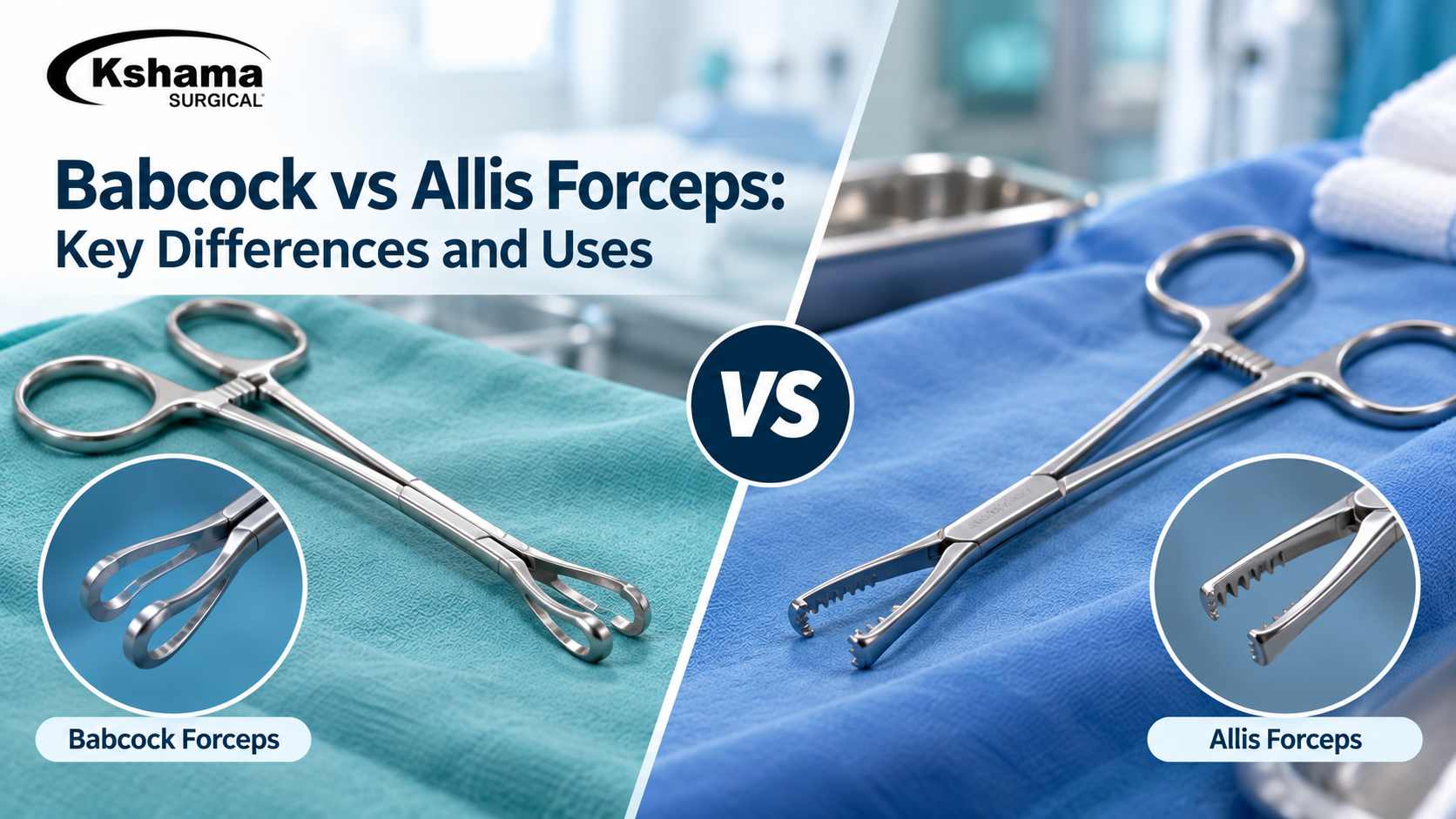
When choosing a tissue grasping instrument, understanding babcock vs allis forceps is important because both instruments provide different levels of tissue grip and handling. Their jaw designs make them suitable for different clinical situations. Babcock Forceps are generally selected for controlled, atraumatic handling of delicate tissue, while Allis Forceps provide a firmer grasp where stronger tissue control is needed.
Table of Contents
- Why the Choice Matters for Tissue Handling
- Babcock Forceps at a Glance
- Fenestrated, Atraumatic Jaws
- Allis Forceps at a Glance
- Interlocking Teeth for Firm Grip
- Babcock vs Allis: Side by Side
- Tissue Trauma, Grip and Indications
- Choosing the Right Forceps by Procedure
- Sourcing Both from a Certified Manufacturer
- Frequently Asked Questions
Why the Choice Matters for Tissue Handling
The main babcock vs allis forceps difference is the way each instrument grips tissue. Surgical forceps are not interchangeable simply because both have finger rings, ratchets and a similar overall shape. Jaw construction determines how securely tissue is held and how much pressure is transferred to it.
The choice becomes important when tissue is fragile, slippery, tubular or fibrous. A broad, rounded Babcock jaw distributes pressure over a larger area, making it suitable for delicate soft or tubular structures. Allis forceps use teeth to create a stronger mechanical hold when firm traction or retraction is required.
The tissue grasping forceps difference should therefore be considered according to the procedure rather than appearance or price.
Babcock Forceps at a Glance
Babcock forceps are ring-handled, ratcheted tissue holding instruments designed for controlled manipulation. Their jaws are typically broad, rounded and fenestrated. This construction helps hold delicate or tubular structures without sharp teeth.
Kshama Surgical offers Babcock Forceps in 6-inch and 8-inch versions. They are made from stainless steel and are suitable for surgical, veterinary and laboratory applications.
A major consideration in babcock vs allis forceps selection is whether the tissue needs gentle support or a stronger grasp. Babcock forceps are generally preferred when reducing crushing or puncturing is important.
Fenestrated, Atraumatic Jaws
The fenestrated jaw is a defining feature of Babcock forceps. Its rounded design creates a broader contact area, allowing the instrument to stabilize tissue while reducing concentrated pressure.
Atraumatic does not mean tissue injury is impossible. Excessive pressure, prolonged clamping or incorrect use can still damage tissue. However, the jaw profile supports gentler tissue handling than toothed instruments.
Common babcock forceps uses include handling intestine, appendix, fallopian tubes and other soft or tubular structures.
Allis Forceps at a Glance
Allis forceps are designed for stronger tissue control. Their jaws contain multiple sharp or interlocking teeth that engage tissue and help prevent slipping. This provides a firm grasp when traction or retraction is needed.
Kshama Surgical offers Allis Tissue Forceps in 6-inch, 8-inch and 10-inch sizes, with different configurations available.
The key point in babcock vs allis forceps comparison is that Allis forceps prioritize holding strength. They are therefore more appropriate for tissue that can tolerate a firmer grasp.
Interlocking Teeth for Firm Grip
The teeth are the defining feature of Allis forceps. When the jaws close, the teeth engage tissue and create mechanical resistance against movement. This can be useful when tissue needs to remain securely held during manipulation.
Because the teeth can penetrate tissue, Allis forceps are not usually the first choice for fragile structures. They are better suited to tougher, dense or fibrous tissue where secure traction is more important than atraumatic handling.
This is the central atraumatic vs traumatic forceps consideration. Babcock forceps generally support atraumatic handling, while traditional toothed Allis forceps provide a more traumatic grasp.
Babcock vs Allis: Side by Side
A practical babcock vs allis forceps comparison becomes easier when jaw design, grip, tissue effect and indications are considered together.
| Feature | Babcock Forceps | Allis Forceps |
| Jaw design | Broad, rounded and fenestrated | Toothed and interlocking |
| Grip style | Broad, controlled grasp | Firm mechanical grasp |
| Tissue handling | Generally atraumatic | More traumatic |
| Best suited for | Delicate and tubular tissue | Dense and tough tissue |
| Slipping resistance | Moderate to high | High |
| Main purpose | Gentle holding and manipulation | Firm holding and traction |
| Common applications | Intestine, appendix and tubes | Skin, fascia and dense tissue |
The tissue grasping forceps difference is most noticeable at the jaw. Babcock forceps distribute contact across a wider rounded surface, while Allis forceps rely on teeth. Neither instrument is universally better. Each is designed for a different tissue handling requirement.
The choice in babcock vs allis forceps should also consider the required level of traction. If tissue needs gentle stabilization, Babcock may be preferable. If tissue must remain firmly engaged during retraction, Allis can provide better control.
Tissue Trauma, Grip and Indications
The most important clinical distinction in babcock vs allis forceps is the balance between grip and tissue preservation. A stronger grip is not always better for delicate tissue.
Babcock forceps uses are centered on structures where excessive compression or puncture could be undesirable. Their rounded, fenestrated jaws are particularly useful for intestinal and reproductive structures.
Allis forceps uses are different. Their toothed jaws provide reliable tissue purchase and can be useful for holding heavier or tougher tissue during exposure, retraction or manipulation.
For additional information about surgical instrument terminology and medical devices, the U.S. National Library of Medicine provides authoritative medical and biomedical resources.
Choosing the Right Forceps by Procedure
When deciding when to use babcock, first consider the tissue being handled. Babcock forceps are a logical choice when tissue is delicate, soft or tubular and the objective is to hold it without unnecessary penetration. Intestinal surgery and some gynaecological procedures are common examples.
When deciding when to use allis, consider whether a stronger grasp is needed. Allis forceps can be appropriate when tissue is dense or when firm traction is required.
The practical rule in babcock vs allis forceps selection is simple: match the jaw design to tissue strength and the purpose of grasping. Do not use a toothed forceps simply because it provides a stronger hold. Similarly, do not select an atraumatic instrument when secure traction is required.
Before ordering, professionals should consider length, jaw size, handle comfort, ratchet function and stainless steel quality.
Sourcing Both from a Certified Manufacturer
For hospitals, veterinary clinics and surgical distributors, comparing babcock vs allis forceps should include more than jaw style. Instrument consistency, stainless steel quality, finishing, alignment, ratchet performance and available sizes can influence daily usability.
Kshama Surgical provides both instruments as part of its surgical instrument range. Buyers can review the Babcock Forceps product page and Allis Tissue Forceps product page when comparing specifications and sizes.
For practical guidance, the Babcock Forceps uses guide and Allis Tissue Forceps uses guide provide additional information about their clinical applications.
For buyers comparing both instruments, the dedicated Babcock vs Allis Forceps comparison provides a useful reference for evaluating their main differences.
Frequently Asked Questions
Are Babcock forceps more atraumatic than Allis forceps?
Generally, yes. Babcock forceps have rounded, fenestrated jaws designed for gentler tissue handling, while Allis forceps use teeth for a firmer grasp. However, either instrument can cause injury if excessive force or inappropriate technique is used.
What is the main difference between Babcock and Allis forceps?
The main babcock vs allis forceps difference is jaw construction. Babcock has broad, rounded fenestrated jaws, while Allis has toothed jaws designed for stronger tissue engagement.
When should Babcock forceps be used?
The when to use babcock decision generally relates to delicate or tubular tissue. They are commonly used for intestinal, gynaecological and other procedures requiring controlled tissue handling.
When should Allis forceps be used?
The when to use allis decision depends on the need for firm tissue purchase. Allis forceps are generally more suitable for tougher, dense or fibrous tissue where secure traction is required.
Can Babcock and Allis forceps be used interchangeably?
No. Although both are tissue grasping forceps, their jaw designs produce different effects. Selection should depend on tissue characteristics and the purpose of grasping.
Which is better for delicate tissue?
For delicate tissue, Babcock is generally preferred because its rounded, fenestrated jaws provide a broader and gentler grasp. Allis is more suitable when a firm toothed grip is required.
Conclusion
Understanding babcock vs allis forceps helps surgeons, veterinarians and procurement teams select the appropriate instrument for different tissue handling requirements. Babcock forceps provide a broad, rounded and fenestrated grasp for delicate structures, while Allis forceps provide stronger engagement through interlocking teeth.
The right choice is not simply about grip strength. It is about matching jaw design to tissue and procedure. For delicate structures, Babcock is often more suitable. For firm traction on tougher tissue, Allis may be the better choice.
To compare sizes and specifications, explore the Kshama Surgical catalogue and select the forceps that match your clinical requirements. Contact Kshama Surgical for catalogue assistance and product quotations for individual or bulk requirements.
