
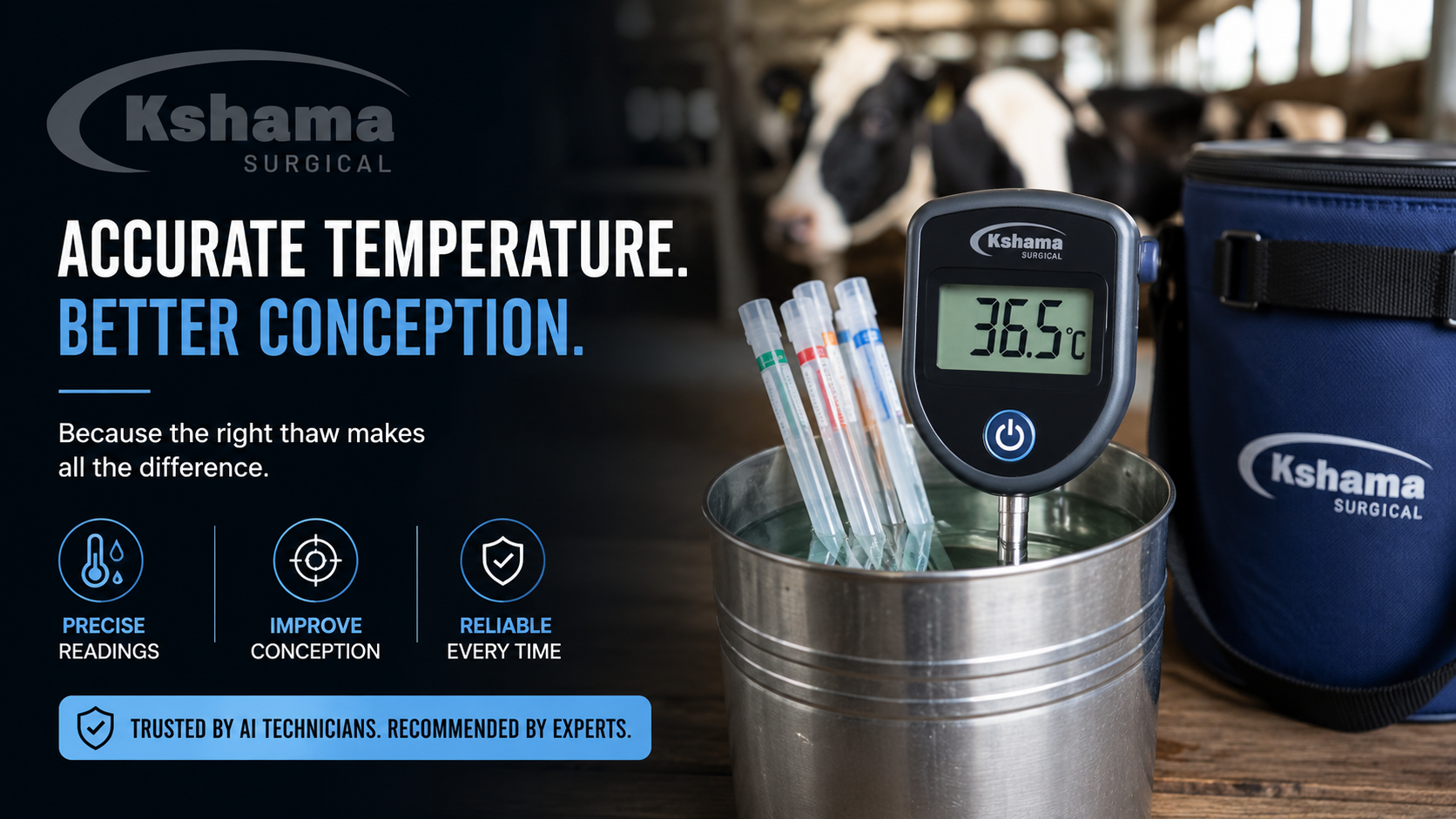
A thaw monitor measures the water your straw is actually sitting in. A thawing unit is the vessel that produces and holds that water. One reads, the other delivers, and a technician who owns only the second has no way of knowing whether the bath was at 36 C or 29 C when it mattered. A fair share of unexplained repeat breeding hides in exactly that gap.
The two get confused because suppliers list both under “thawing equipment”, and because the difference only shows once something has already gone wrong. Nobody writes down a bath at 31 C. What gets written down is a straw used and an animal inseminated, and six weeks later a repeat. Semen quality gets blamed. The bull gets blamed. The water almost never does, because nobody measured it.
Keeping a dedicated thaw monitor in the flask bag removes the guesswork from the one variable you can still control between the flask and the cow. Set against what a missed cycle costs in extra days open, a thaw monitor belongs in every AI kit rather than only the well-funded ones. What follows covers what each instrument actually does, the water temperature and timing that decide the outcome, the four errors field practice keeps repeating, and how to choose between a flask, a powered box and both.
What a Thaw Monitor Actually Measures
A thaw monitor reports the temperature of the thawing water at the instant the straw goes in, not the temperature the flask held twenty minutes earlier. It is graduated tightly around the 35 to 37 C band and responds fast enough that you can correct a bath before committing a straw to it. Everything else about the instrument follows from those two properties.
Why a general thermometer is not a substitute
A laboratory thermometer spreads its scale across a wide span, so the two degrees that decide your result occupy about a millimetre of glass. It also lags. Fill a flask from a cold tap and a slow-responding thermometer will still be showing the previous reading while your straw is already submerged. At six in the morning, in a shed, with a torch held in your teeth, you want a number you can take at a glance and act on. That is the argument for a dedicated instrument in the AI kit rather than the borrowed milk-testing thermometer.
What the instrument cannot do
It does not heat anything. It reports, and that is the whole of its job. Technicians occasionally assume a digital readout implies active control, then wonder why the water drifted between the second and third insemination of the morning.
The instrument tells you the truth about the water. It does not fix it.
Why Does a Thaw Monitor Matter for Conception Rates?
Frozen semen is damaged by warming that is too slow or too cold, and a thaw monitor is the only thing standing between a guessed bath and a verified one. Ice recrystallises inside the straw when the warming rate falls, and the sperm membranes take the damage. You will not see it. The straw looks identical, it loads identically, and the failure surfaces six weeks later as a return to heat.
Field water is rarely where you assume it is. In January in north Gujarat, a flask filled indoors and carried twenty minutes on a bike can shed several degrees before the first straw goes in. In May the reverse happens, and water standing in a dark mug in sunlight climbs past 40 C. A thaw monitor catches both cases in three seconds. Without one, you are inseminating on faith and blaming the bull afterwards.
I have watched a technician work an entire morning round convinced his water was warm enough. It read 30 C when somebody finally checked. That month’s conception figures went into the record as a semen quality problem.
Thaw Monitor vs Thawing Unit: What Each One Does
A thaw monitor measures, and a semen thawing unit generates and holds heat. The confusion comes from suppliers grouping both under “thawing equipment”, and from the fact that a well-made semen thawing unit usually carries a temperature display of its own. A display on a heating device is still worth checking independently, because a controller that has drifted will show you, with total confidence, the number it believes.
| Feature | Thaw monitor | Semen thawing unit |
| Function | Reads water temperature | Heats water and holds it |
| Power needed | None or a small cell | Mains or rechargeable battery |
| Typical band | 35 to 37 C readout | Thermostat set at 35 to 37 C |
| Usual failure | Quiet loss of calibration | Drift, or power loss mid-round |
| Where it earns its place | Every single insemination | Long rounds, high daily volume |
Both instruments sit in the same AI equipment range, and a technician handling eight to ten inseminations a day generally ends up carrying one of each. A semen thawing unit without an independent check is a system with no second opinion in it.
Straw Thawing Temperature, Timing and the Errors Nobody Records
Straw thawing temperature for conventional 0.25 ml French straws sits in the 35 to 37 C band, held for the short defined interval your supplier specifies for that straw type. Longer is not safer. A straw parked in warm water past its window loses motility steadily, and the water can read perfectly correct while the clock does the damage.
The four errors a thaw monitor exposes
Water topped up mid-round from a cold jerrycan and never rechecked. A flask filled the previous evening. Three straws dropped in together when the operator can only dry and load one before the rest cool. A bath measured once, at the start, for a round of fourteen animals. Each of these is invisible unless somebody is reading a thaw monitor between animals rather than at the beginning of the day.
What happens after the bath
Correct straw thawing temperature only counts if the next thirty seconds are handled properly. Dry the straw fully, load a gun that has already been warmed, and keep it against your body or in a warming sleeve while you walk to the animal. Ideal straw thawing temperature followed by a cold steel barrel wastes the entire exercise.
When a Thaw Monitor Is Enough and When You Need a Powered Box
A thaw monitor and a wide-mouth flask honestly cover most single-technician village rounds. If your day is four or five inseminations inside a few kilometres, water measured properly at the start and rechecked between animals will hold the band without any powered equipment at all. An AI thawing box earns its cost when volume climbs, when a round stretches past three hours, or when ambient conditions are working against you.
An AI thawing box with a thermostat removes the guesswork of topping up water, and a thawing unit with battery backup keeps working through the cuts that remain normal across much of rural India. That is not a small consideration. A mains-only AI thawing box in a village with six-hour outages is a bucket with a plug attached.
The trade-off, stated plainly: manual wins where power is unreliable and volumes are low, powered wins where volume and duration are the problem. Neither removes the need to verify.
Buy the powered box for volume. Buy the thaw monitor because there is no other way to know what the water did.
What Separates a Reliable Thaw Monitor From a Cheap One
Cost differences come down to sensor quality, factory calibration, the seal on the housing and the case protecting it. A cheap unit reads plausibly for one season, then drifts, and a drifting instrument is worse than none at all because it is believed. Check three things before buying: how the thaw monitor was calibrated and whether it can be rechecked against a reference, how the housing copes with being dropped in water and left there through a monsoon, and whether the display stays legible to cold hands in poor light.
Kshama Surgical manufactures AI equipment alongside its surgical range, and the durability questions that apply to veterinary surgical implants and devices apply just as directly to a thaw monitor. Ask what the sensor is. Not what colour the case is painted.
Frequently Asked Questions
What temperature should a thaw monitor show for semen straws?
35 to 37 C for standard French straws. Take the reading at the moment the straw enters the water, not while the flask is still standing on the table.
How long should a straw stay in the water bath?
A short, defined interval inside the 35 to 37 C band, following the protocol supplied with that straw type. Remove it, dry it and load it immediately afterwards.
Can I use a kitchen thermometer instead?
You will get a number, but the scale is coarse and the response is slow. The narrow band that decides the outcome needs an instrument graduated for it.
Does a thawing unit remove the need for a thaw monitor?
No. A thermostat drifts with age, and its display reports what the controller believes rather than what the water is doing. The independent check costs very little.
How often should a thaw monitor be checked for accuracy?
Against a known-good reference at the start of each breeding season, and any time its readings stop agreeing with a second instrument you trust.
What happens if the thawing water is too hot?
Past roughly 40 C the sperm cells are damaged and motility falls sharply. Overheating costs as much as under-heating and is far more common in summer.
Do I need a battery backup thawing unit for village work?
If cuts are routine and rounds run long, yes. For short, low-volume rounds a flask and careful measurement are usually enough.
For a quotation on AI equipment, or to ask which combination suits your daily volume and field conditions, send your requirement to Kshama Surgical through the contact page at and ask for the specification detail before you compare quotes.
