
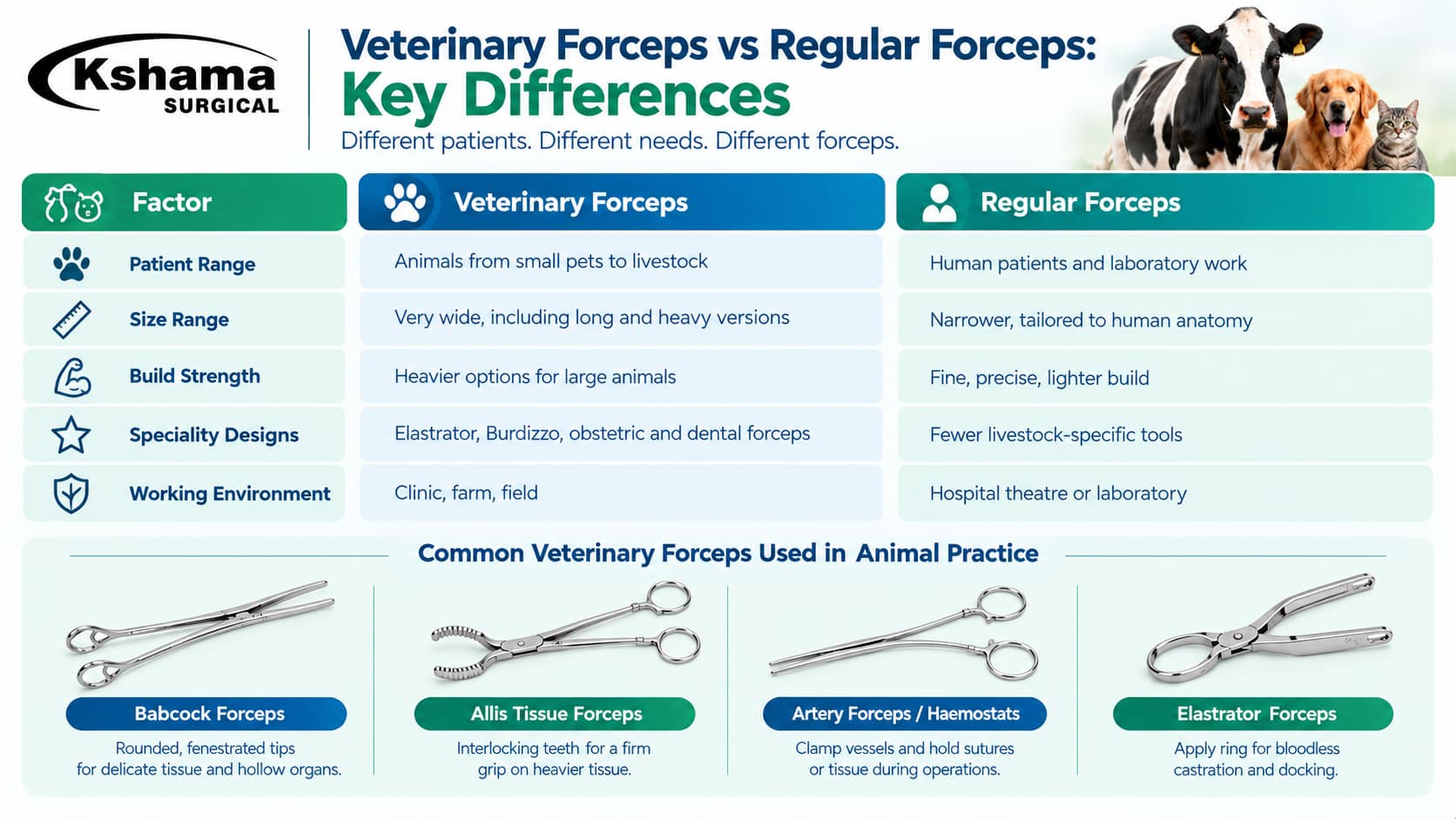
Veterinary forceps differ from regular forceps in scale, strength, tip design and the range of species and procedures they are built for. A pair that works well on a human patient or a small anatomical specimen can bend, slip or simply fall short when used on a cow, buffalo or horse. This article explains what separates them from the standard type, which designs animal practitioners use most often, how to check quality, and what to consider before buying, so you can choose instruments that match the animals you treat.
What Are Veterinary Forceps and How Do They Work
Forceps are hand-held, hinged instruments used to grasp, hold, compress or retract tissue and objects. The general principle is described in reference sources such as the Wikipedia entry on forceps: two opposing blades pivot on a joint, and squeezing the handles brings the tips together. Many designs add a ratchet so the grip stays closed without hand pressure.
Veterinary forceps follow the same principle but are adapted to animal anatomy and working conditions. Patients range from a kitten to a bull, so instruments come in a wide span of lengths, jaw widths and strengths. Some are designed for tasks that hardly exist in human medicine, such as applying elastrator rings, crushing the spermatic cord during castration or assisting difficult calvings. Working conditions also differ. Large animal procedures often happen in sheds, fields and cattle races, so these instruments need to tolerate rougher handling and easier cleaning than instruments used only inside a hospital theatre.
What Counts as Regular Forceps
Regular forceps usually means general-purpose forceps produced for human surgery, dressing and laboratory work. They are precise, often fine-tipped and built for consistent conditions such as an operating theatre with controlled lighting, sterile fields and a patient of predictable size. Their designs are excellent, and many are used in animal practice too, particularly on companion animals. The difference lies not in quality but in fit: regular forceps are sized and balanced for a narrower range of situations.
Key Differences at a Glance
The table compares the two groups in qualitative terms. It describes typical tendencies, not fixed rules, because both groups include many designs.
| Factor | Veterinary Forceps | Regular Forceps |
| Primary patient | Animals from small pets to livestock | Human patients and laboratory work |
| Length and size range | Very wide, including long and heavy versions | Narrower, tailored to human anatomy |
| Build strength | Heavier options for large animals | Fine, precise, lighter build |
| Speciality designs | Elastrator, Burdizzo, obstetric and dental forceps | Fewer livestock-specific tools |
| Working environment | Clinic, farm, field | Hospital theatre or laboratory |
| Sterilisation and cleaning | Must cope with field conditions and repeated cleaning | Controlled hospital sterilisation |
| Best suited for | Vets, livestock units, mixed practices | Human surgery, general dressing work |
Common Types Used in Animal Practice
Most animal surgical work relies on a familiar group of designs. For a closer look at one example, the Kshama Surgical article on how Babcock forceps handle delicate tissue explains why rounded, fenestrated jaws protect soft organs.
- Babcock forceps: rounded, fenestrated tips that hold soft tissue and hollow organs without crushing.
- Allis tissue forceps: interlocking teeth for firm grip on heavier tissue, available in several lengths.
- Artery forceps and haemostats: clamp vessels and hold sutures or tissue during operations.
- Cheatle forceps: used to lift sterile instruments without contaminating them.
- Dental forceps: for tooth extraction and oral work in animals.
- Elastrator forceps: open the ring used in bloodless castration and docking.
- Burdizzo castrator: a clamp-style tool used on sheep, goats and pigs.
- Sinus forceps: used to pack or hold gauze in nasal and other cavities.
How the Two Groups Differ in Practice
Three practical differences matter most when you compare the two groups for real work.
Scale. A 6 inch pair may suit a small animal, but a 10 inch pair reaches deeper in a large abdominal wound. Regular forceps often come in a narrower range of lengths, which limits reach in bigger patients.
Grip design. Animal tissue varies from thin skin to thick hide and dense muscle. Toothed jaws, ratchets and reinforced hinges are more common where heavy grip is needed.
Task specificity. Livestock work involves procedures such as castration, dehorning and obstetrics. Instruments like elastrator and Burdizzo forceps exist specifically for these tasks and have no true regular equivalent.
Even so, the two groups overlap. Many clinics use fine regular forceps for small animal surgery alongside stronger versions for larger patients.
How to Choose the Right Forceps
- Match size to patient: pick lengths that reach the surgical field without excess leverage.
- Check the jaw type: smooth or fenestrated for delicate organs, toothed for dense tissue.
- Inspect the ratchet: it should lock securely and release cleanly.
- Confirm the steel: stainless steel resists corrosion and suits autoclave cycles.
- Test alignment: tips must meet exactly when closed.
- Consider the task: buy speciality forceps only for procedures you actually perform.
Pricing and Where to Buy
Buyers often start with the headline figure, but a single number rarely exists because a small artery forceps and a heavy castrator are very different products. Compare like with like: same type, length and steel grade. Product pages such as the veterinary forceps price in India listed for sinus forceps show how price varies across sizes of the same instrument.
For volume purchases, compare veterinary forceps price per piece instead of the pack total, and confirm what size each pack contains. When asking for a veterinary forceps rate in India, request written figures, and compare the veterinary forceps cost in India across sellers only after checking steel grade and finish.
Choosing a source matters too. A reliable animal surgical forceps supplier in India will state materials and certifications and stock spares. Local dealers are convenient for urgent single items, and you can contact veterinary forceps dealers in India directly for availability. If you prefer to order remotely, browse animal surgical forceps online India listings that show size options and product codes. Those seeking animal surgical forceps for sale in India in bulk should ask about consistent batches and packaging.
Advantages and Disadvantages of Species-Specific Forceps
Advantages
- Better fit: sizes and jaw designs match animal anatomy.
- Task coverage: access to castration, obstetric and dehorning tools.
- Durability: heavier builds tolerate demanding livestock work.
- Field practicality: designed with farm conditions in mind.
Disadvantages
- Less delicate: heavy versions may be too coarse for fine small animal surgery.
- Storage bulk: larger tools take more space in kits and autoclaves.
- Speciality cost: rarely used designs may sit idle in a set.
- Skill required: some, such as castrators, demand training to use safely.
Choosing Between the Two in Real Situations
A few everyday scenarios show how the decision plays out. In a city clinic that mainly sees dogs and cats, fine regular forceps are often the first choice for spays and wound repair, with a few heavier pairs held back for larger breeds. In a mixed practice, the vet may carry a small tray of fine instruments for the morning and a sturdier bag of veterinary forceps for farm calls, because a delicate pair dropped in a cattle shed is easily bent or lost.
For a dairy cooperative or livestock unit the calculation shifts again. Procedures such as ring castration, dehorning and difficult calvings rely on purpose-built instruments, so the value lies in designs that have no counterpart in general hospital kits. A teaching institution usually holds both: fine forceps for training students on delicate technique and heavier animal-specific designs for large animal demonstrations.
The practical lesson is that neither group is simply better. Choose according to patient size, procedure and working environment, and keep a record of which instruments are used most so future orders match real demand.
Care and Common Mistakes
Rinse forceps soon after use so tissue does not dry on the jaws, open the ratchets before cleaning, dry thoroughly and store them in a dry case. Mistakes are usually simple: forcing a jammed ratchet, using forceps as pry bars, leaving them wet, or mixing damaged pieces back into a sterile set. Regular inspection of hinges and tips prevents most failures.
Frequently Asked Questions
What are veterinary forceps used for?
They are used to grasp, hold, clamp or retract tissue and objects in animal procedures. Designs range from fine tissue forceps for small animals to heavy castrators and elastrator tools for livestock, each suited to a specific task.
How do veterinary forceps differ from regular forceps?
They cover a wider size and strength range and include livestock-specific designs such as elastrator and Burdizzo tools. Regular forceps are usually sized for human anatomy and controlled hospital settings, though many are used on small animals too.
What is the veterinary forceps price in India?
It varies with type, size and steel grade, so no single figure applies. Treat any veterinary forceps cost in India or veterinary forceps rate in India as item-specific, since a small artery forceps and a heavy castrator are priced very differently.
How do I compare veterinary forceps price per piece?
Divide the pack price by the number of pieces, then compare only forceps of the same type and length. A lower price per piece can hide a smaller size or lighter steel grade.
Where can I find veterinary forceps dealers in India?
Search for established sellers that list specifications and provide written quotes. They range from local suppliers to manufacturers; choose one that states steel grade, offers spares and answers technical questions before you order.
What should I ask an animal surgical forceps supplier in India?
Ask about steel grade, sterilisation compatibility, size range, batch consistency and returns. A dependable animal surgical forceps supplier in India will supply this in writing and explain how to reorder matching pieces later.
Can I buy animal surgical forceps online in India?
Yes. Many sellers list animal surgical forceps online India-wide with size, code and material details. Confirm lengths, steel grade and delivery terms first. When comparing animal surgical forceps for sale in India, check product codes and sizes, and choose a seller who supports returns and bulk orders.
Conclusion
Veterinary forceps and regular forceps share the same basic mechanism, yet they diverge in size range, build strength, speciality designs and working environment. Regular forceps suit fine work in controlled settings, while heavier animal-specific designs cover livestock tasks and dense tissue. Most practices use both, choosing by patient size and procedure rather than by label.
Before buying veterinary forceps, list your procedures, patient sizes and sterilisation method. Explore the Kshama Surgical range of forceps and surgical instruments, or contact the team for guidance on the right sizes and types for your practice.
